
Google Reviews for Contractors: 100+ Reviews Without Begging.
Contractors with 100+ Google reviews close 40% more inbound leads than those with fewer than 30. Here's the automated review system that builds review velocity without manual follow-up.
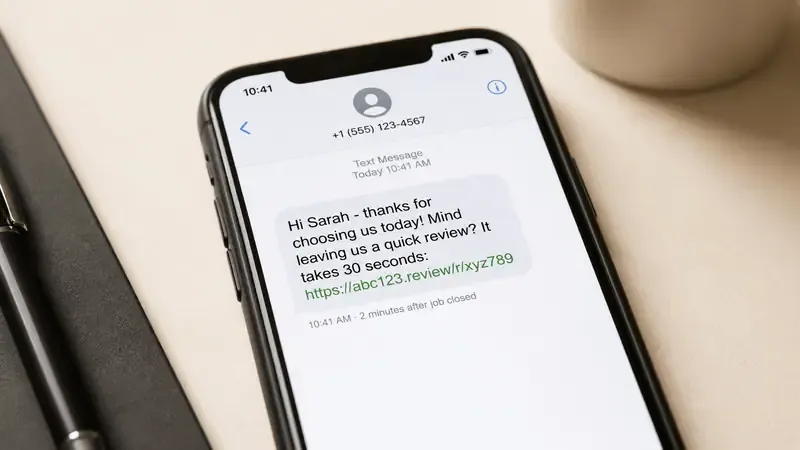
Google reviews are the most underused sales asset in contracting. Every finished job can produce a review that sways the next 50, 100, or 200 homeowners who check your listing before deciding whether to call. Most contractors leave that asset on the table — either they never built a system to ask, or they asked a few times, got a few reviews, and figured they were done.
The gap between a contractor with 18 Google reviews and one with 140 isn't the quality of the work. It's whether the ask happens after every job. And the gap shows up in the bank account: industry data puts contractors with 100+ reviews at roughly 40% more closed jobs from the same inbound leads. Same ads. Same service area. Same prices. More signed work from the calls already coming in.
Reviews do two jobs simultaneously. They influence human decision-making directly — a homeowner comparing two contractors on Google will default to the one with more reviews, all else being equal. And they influence Google's algorithm — LSA rankings, Google Maps position, and organic visibility are all tied to review count, review recency, and response patterns. A review system is not just a reputation play. It is a marketing infrastructure investment.
Why Review Count Matters More Than Rating
The intuitive assumption is that a perfect 5.0 rating is the most powerful trust signal. In practice, it's not. A 4.7 with 140 reviews consistently outperforms a 5.0 with 22 reviews in homeowner evaluations and in Google's ranking algorithm. There are two reasons for this.
First, the psychology of social proof at scale. A 5.0 with 22 reviews reads as either very new or potentially curated. It doesn't signal that hundreds of real people have hired this company and were satisfied. A 4.7 with 140 reviews signals exactly that — volume of experience, enough real customers to produce a realistic rating, and an active business that has served a meaningful number of clients. The slight imperfection in the rating actually reinforces authenticity. Homeowners trust it more, not less.
Second, Google LSA ranking is directly tied to both review count and review recency, not just overall rating. Google's intent with LSA is to surface the most trustworthy and responsive local service providers. A business with 140 reviews has demonstrated sustained client satisfaction over time. A business with 22 perfect reviews has not yet demonstrated that at scale. When Google is deciding which flooring contractor or HVAC company to put in the top three LSA spots, the review count and the recency pattern are weighted signals alongside response time and service area coverage.
The review velocity flywheel: more reviews push your LSA ranking higher, higher LSA ranking generates more inbound leads, more inbound leads generate more booked jobs, more booked jobs generate more review opportunities, more review opportunities generate more reviews. Every part of the system reinforces every other part. The flywheel starts turning when you have a consistent review request mechanism — and it stalls when you don't.
The Review Request Timing Problem
Most contractors who ask for reviews ask at the wrong time. The most common trigger is the invoice — "if you're happy with the work, we'd appreciate a review" printed at the bottom of the bill. That's the worst possible moment. The client is staring at a number they're about to pay. Nobody feels grateful while writing a check. Invoice review requests convert poorly for exactly this reason.
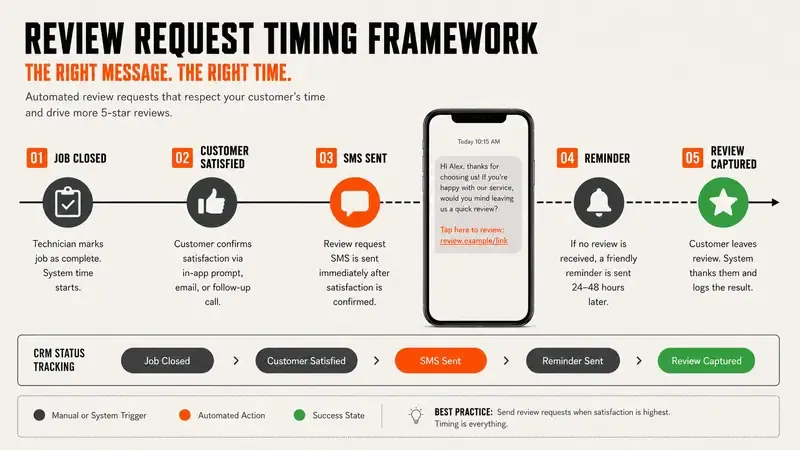
The window that converts best is 24–48 hours after the job wraps. The homeowner is living with the result. The new floors are in. The AC is cooling the house. They showed a neighbor. They're still excited. That's when a short, well-written SMS gets a 28–35% click-through to the review page.
The timing pattern shifts slightly by project type. For larger projects — full kitchen remodel, whole-home HVAC replacement, extensive landscaping install — the 24-hour window is optimal because the homeowner is still freshly experiencing the transformation. For service calls and smaller jobs, the window is shorter — requesting a review the same evening while the service experience is still top of mind converts at higher rates than waiting until the next day.
The Review Automation System: How to Request Without Manual Work
A review system that depends on someone remembering to send a request is not a system. It's a good intention. Good intentions die in busy season — the crew forgets, the office manager has six other fires, the ask never goes out. The review requests that reliably go out are the ones the CRM sends automatically the moment a job is marked complete.
Here is the three-step automated sequence that operates without any manual action after the initial CRM trigger:
The infrastructure required to run this system is a CRM with SMS automation capability and a direct review link for your Google Business Profile. The direct link is generated in your Google Business Profile dashboard — it takes two minutes to find, and it's the difference between a homeowner who clicks and immediately sees the review modal versus one who clicks and has to navigate to leave a review. That friction difference alone can reduce completion rate by 40–50%.
What to Say: The Review Request Message That Works
The SMS review request that converts at 28–35% click-through has three properties: it is short, it is personal, and it explains why the review matters without being manipulative. Here is the message pattern that works across contractor categories:
"Hi [First Name] — glad we could get your [project type] done. If you have 60 seconds, a Google review really helps homeowners in [city] find us. Here's the direct link: [URL]. Thanks a lot — [Your First Name]"
- First name makes it feel personal, not automated — even though it is automated
- "60 seconds" sets a low time expectation — reduces the mental barrier to clicking
- "Helps homeowners in [city] find us" gives the client a reason to act that isn't purely self-serving
- Direct link with zero navigation friction
- Your first name at the end keeps it conversational — not "The Team at XYZ Contracting"
What kills the conversion rate: "If you have time, we'd really appreciate it if you could leave us a review on Google when you get a chance." Every hedged phrase — "if you have time," "when you get a chance," "really appreciate it if you could" — signals low confidence and makes it easy to ignore. Be direct. Tell them what you want, tell them why, give them the link. Done.
Never send review requests by email as the primary channel. Email open rates for transactional messages in home services hover around 20–30%, and the click-through rate on a review link in an email is typically under 5%. SMS open rates for the same message are above 95% and the review link click-through rate is 28–35%. SMS is the channel. Email can be a backup if you don't have a mobile number, but it should not be your primary review request mechanism.
Responding to Reviews: How to Use Your Response as Marketing Copy
Review responses are not just reputation management — they are marketing copy that appears on your Google Business Profile for every future visitor to read. A well-written response to a 5-star review reinforces your positioning to the next homeowner who reads it. A professional response to a negative review demonstrates how your company handles problems, which is itself a trust signal.
Responding to every positive review within 24 hours is a confirmed LSA ranking signal. Google measures engagement with your Business Profile, and owner responses are part of that engagement score. The response doesn't need to be long. It needs to be specific, genuine, and contain one or two details that reinforce your brand positioning. Not: "Thanks for the 5 stars! We appreciate your business." Instead: "So glad the new LVP floors came out the way you envisioned, Maria. Our installation team takes a lot of pride in the subfloor prep — it makes all the difference in how the product sits long-term. Appreciate you taking the time to share."
The specific response contains your service type (SEO value), the client's name (personal), and a detail that positions your quality of work (marketing). That sentence is read by the next 50 homeowners who visit your Google profile. It is free marketing copy that you generate through 45 seconds of typing.
For negative reviews: respond within 24 hours, acknowledge the experience without being defensive, offer to make it right with contact information, and keep it brief. Never argue. Never explain at length. The audience for your response is future homeowners, not the reviewer. A professional, gracious response to a negative review actually increases trust with prospective clients — it demonstrates that you take accountability and that you handle problems like a legitimate business. A combative or defensive response does the opposite.
Using Reviews in Your Marketing Funnel
A Google review that sits on your profile and does nothing else is an underdeployed asset. The same review can be working for you at every stage of the funnel simultaneously. The following placements extract maximum value from review content you've already earned:
- Ad copy: Pull the most specific and compelling quotes from 5-star reviews and use them in Google Ads and Meta ad copy. "They finished in two days and the floors are perfect — exactly what we wanted" is more persuasive than any headline you'll write. Rotate review quotes into your ads monthly.
- Estimate follow-up email: Include a screenshot of two or three reviews in the follow-up email sent after an estimate. The homeowner is comparing quotes at that exact moment — it's the window where a nudge counts most. Real reviews from past clients land right when the decision is being made.
- AI receptionist and phone script: Include "We have [count] reviews on Google averaging [rating]" in the opening of your AI receptionist script. A homeowner who calls and immediately hears that your company has 140 verified reviews starts the conversation with a credibility baseline already established.
- Website embedding: Pull your most recent Google reviews onto your homepage and service pages via the Google Reviews API or a widget. Social proof on the page where a homeowner is deciding whether to fill out your contact form increases form completions by 15–25% in most A/B tests.
- Proposal/estimate documents: Include a "What our clients say" section in your formal estimate document with three to five review excerpts. A homeowner reading your estimate sees the number, the scope of work, and the evidence from past clients all in one place.
Each of these placements costs nothing beyond setting it up once. The review you spent 45 seconds requesting is now doing sales work in your ads, your follow-up texts, your website, your estimate documents, and your phone script. One review, five jobs. That's the difference between a review system wired into the funnel and a pile of reviews sitting on a profile page.
Review Velocity vs. Review Count: The LSA Algorithm's Priority
Contractors who built a strong review count in previous years and then stopped requesting reviews regularly are experiencing a specific ranking pattern: their LSA position is declining even though their total review count looks strong. The reason is that Google LSA weights recency heavily. A contractor with 12 reviews in the last 90 days will outrank a contractor with 80 total reviews and only 4 in the last 90 days in most markets.
The algorithm logic is sound: a contractor who received 12 reviews in the last three months is actively working and actively satisfying clients. A contractor who received 4 reviews in the last three months and 76 reviews over the prior two years may be less active, may have had quality changes, or may simply not have been asking. Recency is a proxy for current reliability. Google wants to recommend businesses that are currently performing well, not businesses that performed well historically.
The minimum velocity target for maintaining LSA ranking advantage in most markets is 3–5 new reviews per month. In competitive markets (large metro areas with 10+ active contractors in your category), 5–8 per month is needed to maintain consistent top-three positioning. These numbers are achievable without any manual effort if your review automation is working correctly. A contractor completing 15–20 jobs per month with a 25–30% review conversion rate on automated requests will hit the velocity target without any manual follow-up.
The practical implication: review system maintenance is not a one-time project. It is an ongoing operational function. The automation runs itself — but the trigger (marking jobs complete in the CRM) must happen consistently, and the system must be checked monthly to ensure the sequences are firing correctly. A review system that quietly breaks and isn't noticed for 90 days will cost you ranking and lead volume that takes 60–90 days of active velocity to recover.
Two contractors. Identical work. Identical prices. One has 140 Google reviews, the other has 18. The one with 140 closes 40% more of the same inbound leads. The reviews are doing sales work that no ad can replicate.
Few marketing investments pay a contractor back like a review system, because reviews compound. Each review makes the next lead a little easier to close. Each review nudges your LSA ranking higher, which brings in a few more leads. Each closed job is a chance at another review. The compounding feels slow for the first 60 days and obvious by month six. Contractors who keep review velocity going for a full year look back and can't believe the same ad spend used to produce half the results. Same ads, same budget — twice the work booked.
Related Articles.
Want this system installed for your trade?
See if your market is still open, then book a 20-30 minute install call. No contracts.