
How to Get More Google Reviews That Actually Convert
Most contractors ask for reviews inconsistently and get mediocre results. Here's the system that fills your Google profile with 5-star reviews and protects your LSA ranking.
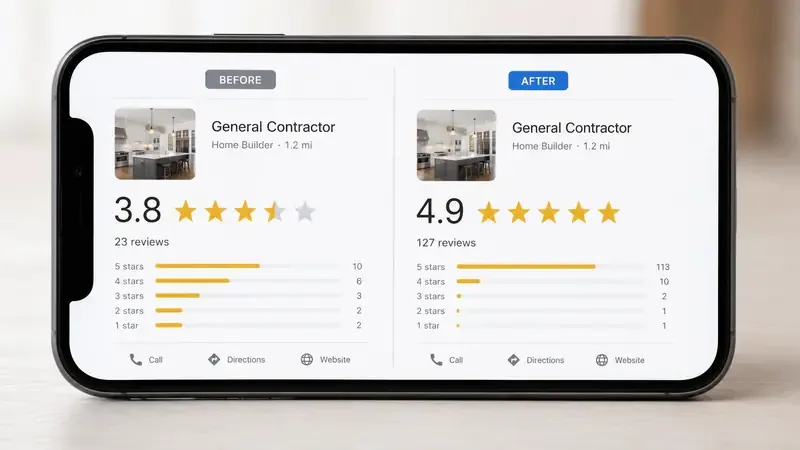
A homeowner searches "roofing contractor near me." Three contractors show up in the Google Local Services Ads block. Two have 4.9 stars and 80+ reviews. One has 4.2 stars and 14 reviews. Without clicking a single website, 80% of search traffic goes to the first two.
Reviews are not a nice-to-have. They are a primary ranking signal for Google Local Services Ads, a trust signal that determines whether homeowners call you or your competitor, and a compounding asset that gets more valuable every month you build it consistently.
Why Reviews Win or Lose Jobs Before the First Call
The buying decision in home services is largely made before any human contact. Three specific review signals drive inbound lead volume:
- ✓ Star rating: 4.7+ is the consideration threshold. Below 4.5 triggers skepticism. The difference between 4.4 and 4.8 isn't marginal — it's the difference between clicking and scrolling.
- ✓ Review count: Volume signals longevity and activity. A contractor with 120 reviews at 4.8 is perceived as dramatically more established than one with 22 reviews at 5.0.
- ✓ Review recency: Google prioritizes recent reviews in both ranking and display. A steady flow of new reviews — even 3–4 per month — signals an active, healthy business to the algorithm and to homeowners.
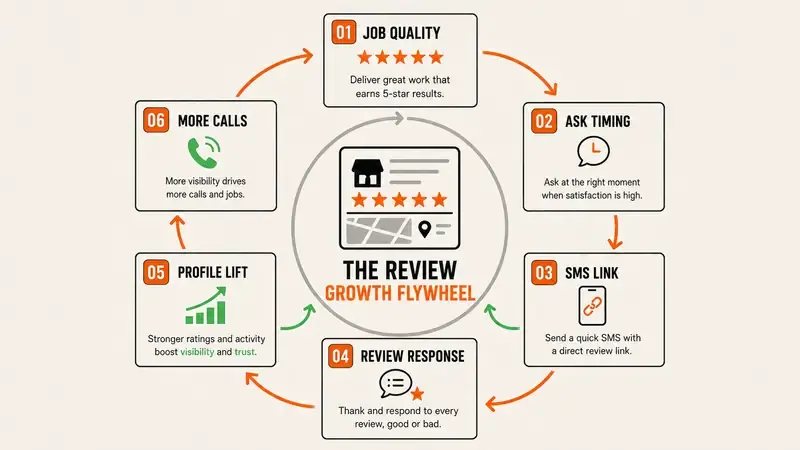
The 4 Moments to Ask for a Review
Timing is everything. A review request sent at the wrong moment gets ignored. The right moment produces a response rate 5–8× higher than a cold ask.
Automating the Review Request Sequence
Manual review requests work until they don't — which is usually when you're busy. The contractors with 200+ reviews didn't ask for each one personally. They built an automated sequence that runs every time a job closes.
The review link matters. Generate a direct review link in Google Business Profile Manager that opens the review dialog in one tap. Every extra click reduces completion rate by 30–40%. Send the direct link — not a link to your Google profile.
Template that works: "Hi [Name] — thanks for trusting us with your [project type]. If we earned it, a quick Google review would mean the world to our team: [direct link]. Takes 30 seconds and helps homeowners like you find us. — [Owner name], [Company]"
Responding to Negative Reviews
Every contractor eventually gets a negative review. How you respond matters more than the review itself. Homeowners reading your reviews aren't looking for a perfect record — they're looking for evidence of how you handle problems.
- ✓ Respond within 24 hours — speed signals that you care and that you're monitoring your reputation.
- ✓ Never argue, never get defensive — even if the review is factually wrong. Potential customers judge your professionalism, not who's right.
- ✓ Move it offline — "We'd like to understand what happened and make it right. Please reach out directly at [phone/email]." This shows accountability and prevents a public argument.
A 4.7 overall rating with one 1-star review and a professional owner response is more trustworthy than a 5.0 profile with no negative reviews and no responses at all. The first looks real. The second looks curated.
How Reviews Compound Over Time
A review request that fires automatically on every completed job — the review engine included in the Deals To Grow Grow plan — means your review count climbs every month you're busy, without anyone on the crew remembering to ask.
Reviews are a compounding asset, not a campaign. The contractor who builds 10 reviews per month for 12 months has 120 reviews and a powerful local authority signal. The contractor who ran a review campaign, got 40 reviews, and stopped has a profile that looks stale 6 months later.
The compounding effect works in two directions. Ranking: Google's LSA algorithm weights review velocity — how quickly you're getting new reviews — alongside total count and rating. Conversion: As review count grows past specific thresholds — 25, 50, 100 — homeowner trust increases non-linearly. Getting from 0 to 25 reviews is the hardest and most impactful phase.
If you're an established trade contractor and you want to see how the review engine fits into the full 9-system infrastructure stack, see the complete stack here or book a scoping call.
Related Articles.
Want this system installed for your trade?
See if your market is still open, then book a 20-30 minute install call. No contracts.