
The Contractor Follow-Up System: Stop Losing Leads
The average contractor makes 1.3 call attempts per lead. Leads take 5–7 touches to convert. That gap is where $200,000+ in annual revenue disappears. Here's the system to get it back.
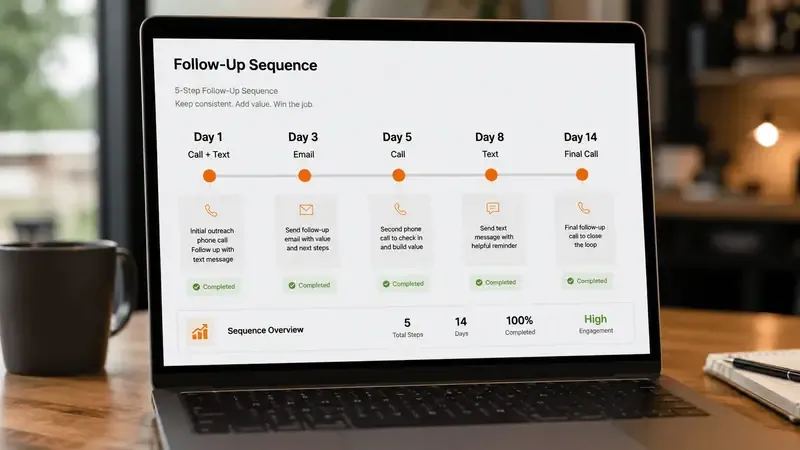
Here's a pattern that repeats across the trades: a roofing contractor spends $3,500/month on Google Ads, generates 40–50 leads per month, and books 8–10 estimates. The math looks like a 20% booking rate — not great, but not unusual. Dig into the follow-up process and the picture changes: each lead gets one call, a voicemail if there's no answer, and an "attempted" mark in a spreadsheet. That's it.
The other 30–40 leads per month aren't dead. They're in a graveyard — people who inquired, got one voicemail, and never heard from the company again. They're still in the market. Some of them have already hired a competitor who followed up four times. Some are still deciding. Some are waiting for a callback that never came a second time. The graveyard is more valuable than the closed pile.
The One-Call Graveyard: How Most Contractors Lose 60% of Their Leads
Industry benchmarking data on home service contractor follow-up habits is consistently grim. The average number of contact attempts per lead across home service trades is 1.3. That includes the contractors who do follow up properly — meaning the median is probably closer to 1 attempt for most operators. The industry consensus on how many touches are required to convert a top-of-funnel lead into a booked appointment: 5 to 7.
The gap between 1.3 attempts and 5–7 required touches is where leads go to die. Not because the homeowner hired someone else — though some did — but because no one bothered to reach them again.
Consider what a lead actually represents when it comes in. A homeowner took time to fill out a form or call a number. They have a project in mind. They're comparing options. They didn't submit a form to never hear from you — they submitted it because they want to move forward. If they don't answer on the first call, they might be at work, on another call, or driving. If no one calls back tomorrow, they assume the company isn't interested or isn't organized. In either case, they move on.
The leads sitting in your one-call graveyard are costing real money. (Speed-to-lead is a separate but related problem — responding in the first 5 minutes dramatically reduces how many leads enter the graveyard in the first place.) At an average ticket of $8,000, a 30% close rate, and 60% booking rate, each unconverted lead represents about $1,440 in lost revenue. At 30 unconverted leads per month, that's $43,000 in monthly lost revenue — over $500,000 annually — from a single process failure.
Contact rates by number of attempts: 1 attempt = 37% contact rate. 6 or more attempts = 93% contact rate. More than half of all leads that convert require 4 or more touches before they can be reached.
The contractor making 1 call is not even reaching the majority of their leads — not because those leads are bad, but because the outreach volume is too low to statistically guarantee contact.
The 14-Day Multi-Touch Follow-Up Cadence
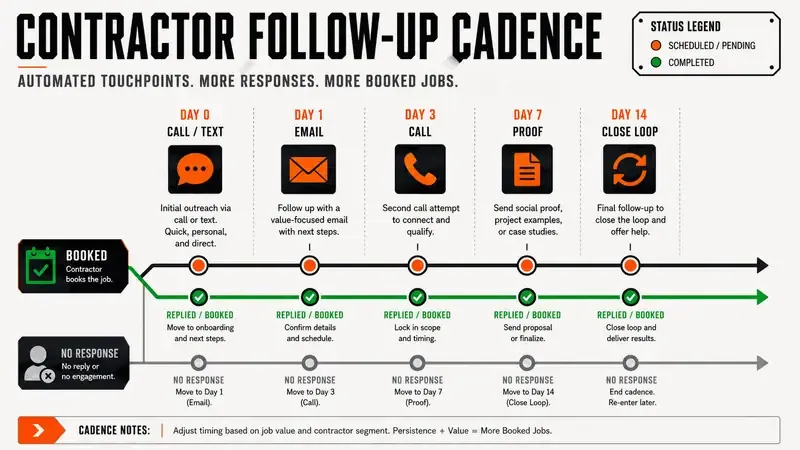
A structured follow-up sequence over 14 days, with 6–7 touch points across multiple channels, captures 30–40% more booked appointments from the same lead volume. Here's the full cadence with the purpose and approach for each touch:
The total time investment for this sequence, when automated, is zero after setup. Each touch fires automatically based on lead entry date. The only manual component is the Day 5 voicemail drop — which can also be automated with voicemail drop tools.
SMS vs. Call vs. Email: Which Channel Works When
Each follow-up channel has a different role in the sequence. Using them interchangeably — or defaulting to one channel for everything — dramatically reduces the effectiveness of the overall system.
SMS (text message) has a 98% open rate and average read time under 3 minutes. It's the highest-reach channel for short, action-oriented messages — booking links, quick check-ins, confirmation requests. SMS is not appropriate for long-form content, detailed proposals, or anything that requires significant reading. Keep SMS to 3 sentences or fewer. Always include a single clear action.
Phone calls have the highest conversion rate of any channel when answered — a live conversation converts to a booked appointment at 3–5× the rate of any digital touchpoint. The challenge is connection rate. The first two call attempts should happen at different times of day (e.g., 5pm and then 10am the next day) to catch the homeowner at different points in their schedule. After the second failed attempt, don't call again until Day 7 or later — the voicemail drop serves the Day 5 touch instead.
Email is the right channel for longer content: portfolio links, educational information, financing details, review collections. Email open rates in home service are typically 25–35%, lower than SMS but sufficient for its purpose. Email should never be used as the primary follow-up channel — it should support and deepen the relationship established by the phone call and SMS sequence.
The sequencing logic: Lead enters → immediate SMS → immediate call → Day 1 call + email → Day 3 SMS → Day 5 voicemail → Day 7 email → Day 10 SMS → Day 14 SMS. Phone calls lead when possible; SMS fills the gaps; email carries the content that builds trust.
Automating the Follow-Up: Why Manual Follow-Up Always Fails
Manual follow-up processes fail for a predictable reason: humans have competing priorities. When a contractor is on a job site, in an estimate, or fielding incoming calls, the follow-up spreadsheet doesn't get touched. Leads sit for three days without contact. By the time someone circles back, the window has often closed.
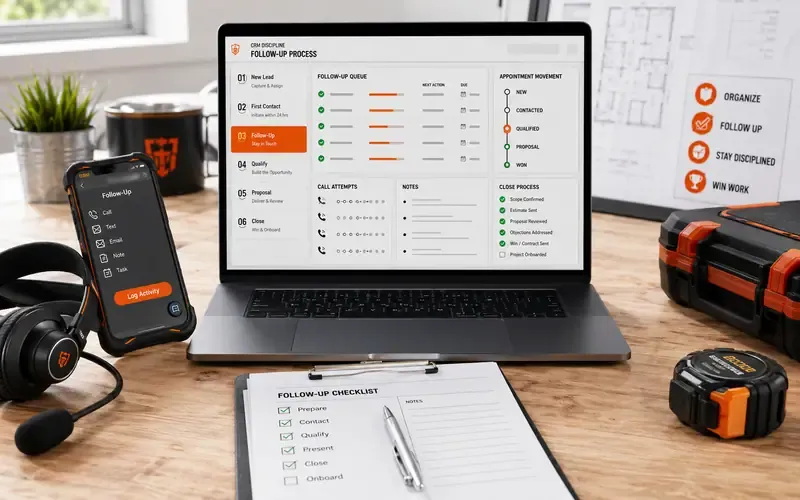
Automation doesn't forget. A CRM-triggered sequence fires at exactly the right time, every time, regardless of how busy the team is. This consistency is the entire value — not the personalization or the creativity of the messages, but the guaranteed execution.
The tools that support automated follow-up for home service contractors:
- Jobber: Built for field service businesses. Solid automated client communication features, good integration with booking and scheduling. Best for companies that need end-to-end field operations management.
- ServiceTitan: Enterprise-grade platform for larger home service companies ($3M+ revenue). Deep reporting, heavy-duty automation, higher cost and implementation complexity. Best for companies ready to invest in a complete platform.
- HouseCall Pro: Mid-market option with solid automation, easier to set up than ServiceTitan. Good for $500K–$3M companies that need more than Jobber but aren't ready for ServiceTitan.
- Standalone CRMs (GoHighLevel, HubSpot): More flexible than trade-specific tools, require more configuration. Best for companies running complex multi-touch ad campaigns that need tight marketing-to-sales integration.
The specific tool matters less than having automation that runs. Any of these platforms, configured correctly with the 14-day cadence, will outperform a perfectly-designed manual process — because the manual process will eventually break when the team gets busy.
Re-Engagement Campaigns: Reviving Old Leads
If you have a database of leads from the past 6–18 months who went through your follow-up sequence and never converted, you have a significant untapped asset. These are homeowners who had a project in mind, were in the market, and simply didn't move forward at the time. Many of them are still thinking about the project.
A quarterly re-engagement campaign sent to dormant leads (30–180 days old) consistently produces a 10–15% conversion rate to re-engaged conversations, with 3–5% ultimately booking an estimate. On a database of 200 dormant leads, that's 6–10 estimate bookings from a single SMS blast — at essentially zero marginal ad cost.
The messaging for re-engagement campaigns needs a specific hook to explain why you're reaching out now:
- Seasonal hook: "Spring is the busiest time of year for [roofing/HVAC/kitchen remodel] — we're booking April and May now. Are you still thinking about your project?"
- Storm/event hook: "With the recent storm system through [city], we've had a lot of calls about [damage type]. If you've been thinking about inspection or repair, now is a good time — we have openings this week."
- Capacity hook: "We wrapped up a big project in [neighborhood] this week and have a rare opening in our schedule — wanted to reach out to homeowners we'd talked with previously."
- Value hook: "We just launched a new financing option — 0% for 18 months — that a lot of our past inquiries asked about. Wanted to let you know it's available."
Re-engagement campaigns should not feel like mass marketing. They should feel like a contractor following up personally — which is exactly what they are. Keep them short (3 sentences max for SMS), specific to the homeowner's trade and general project type, and low-pressure. The goal is to restart a conversation, not close a deal in the first message.
Combined with a working 14-day initial sequence, a quarterly re-engagement campaign means no lead ever truly goes cold. The revenue impact — for a contractor who has been running ads for 12+ months — often exceeds the impact of any change to the ad campaigns themselves.
Related Articles.
Want this system installed for your trade?
See if your market is still open, then book a 20-30 minute install call. No contracts.