
Speed-to-Lead: Why the First 5 Minutes Win or Lose the Job
The research says 5 minutes. The average contractor responds in 4–7 hours. That gap is where the revenue disappears.
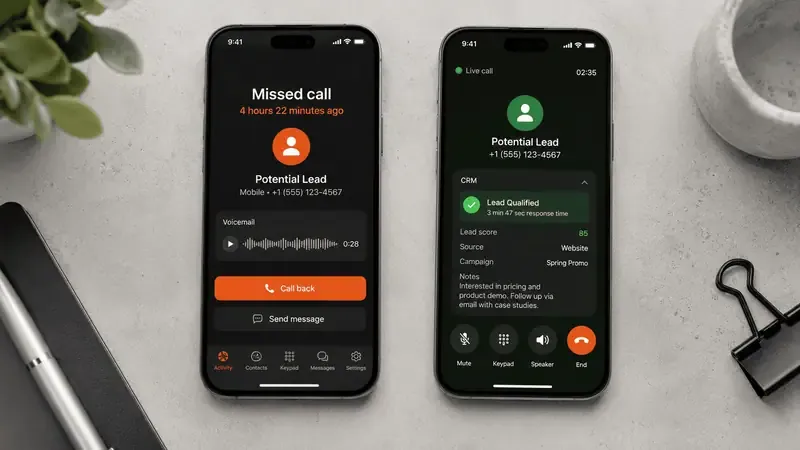
Back in 2007, researchers at MIT and Harvard put a number on something every contractor feels: call a new lead within 5 minutes and you are 9× more likely to qualify them than if you wait 30. Wait an hour, and your odds of a real conversation drop by about 80%.
That study is almost twenty years old. Most trade contractors still call leads back in 4–7 hours. Or never.
That gap costs real money, and you never see it. Nobody tracks "leads that went cold before we called." You see your cost per lead. You see your close rate. You don't see the 60–70% of leads who gave up and hired someone else before you ever spoke to them.
Why the Speed Gap Exists in Contracting
The speed gap is not a character flaw. It's how a trade business is built:
Owners and Estimators Are in the Field
In most shops, the people who handle new leads — the owner, the office manager, the lead estimator — are working during business hours. They're on a roof. They're in a crawlspace. They're running an estimate. A lead notification hits the phone and gets queued for "later." Later is usually after dinner. By then, the homeowner has booked someone else.
After-Hours Leads Go to Voicemail
Industry surveys put 30–45% of home service leads outside business hours — evenings, weekends, and right after a storm rolls through. Those calls hit voicemail. The homeowner hangs up and dials the next company on the list.
There's No System — Just Intention
Most contractors don't have a lead response process. They have a good intention — "I try to call everyone back within an hour" — and a busy schedule that breaks it. On slow days, every lead gets a call. On busy days, leads sit. A lead that lands on the wrong day just disappears.
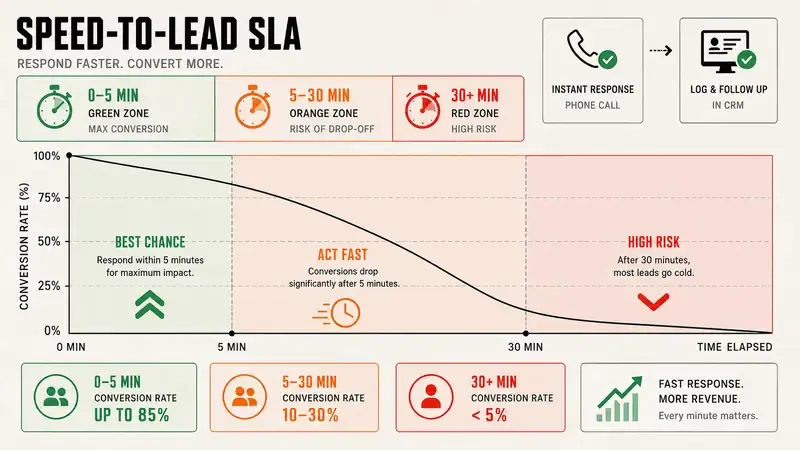
What Fast Response Actually Looks Like in Contracting
A lead reaches you one of two ways:
Scenario A: They Call You
The homeowner calls your main number. If you answer, good. If it rings to voicemail, research shows about 80% of callers won't leave a message. They hang up and dial the next result.
An AI receptionist takes that gamble off the table. It picks up in seconds, every time, day or night. The homeowner gets answers, gets qualified, and gets booked while they're still on the phone — before your competitor's phone even rings.
Scenario B: They Fill Out a Form
The homeowner clicks your ad and fills out a form. Most contractors get an email notification and call back... whenever. A system handles it instead: a text confirmation inside 30 seconds, then an outbound call attempt within 2–3 minutes. No answer? They get a callback within the hour and a text with a booking link.
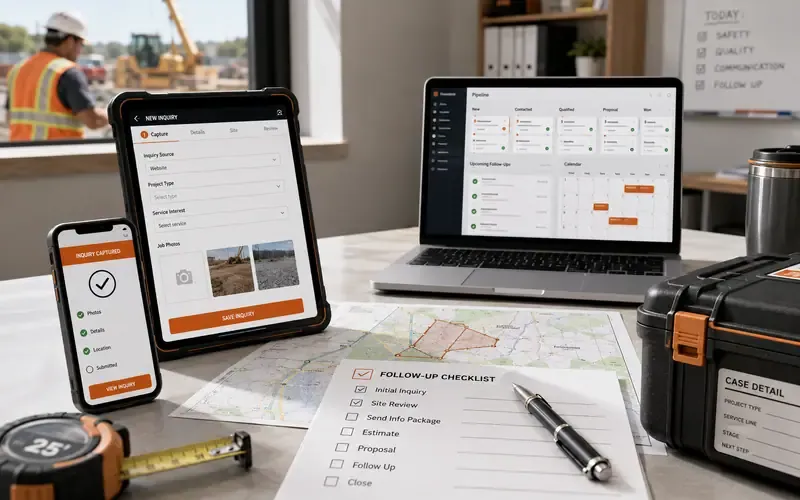
What This Looks Like In Practice
Surfex, a wood flooring operator in Canada (Case File 001), started as a one-man shop. The owner couldn't be on the job and on the phone at the same time — no solo operator can. With a system answering, qualifying, and following up on every lead, he went from working alone to running 3 crews in 6 months. Monthly revenue went from $25K to $75K, with Meta leads coming in as low as $8 each.
His words: "Leads as low as $8 each. We had to hire to keep up." He hired a receptionist and a salesman — not to find work, but to keep up with booked work.
Now run the math on your own numbers. Industry benchmarks put the average booking rate at 30–40% of inbound leads, and the top shops at 60–70%. Say you spend $3,000 a month on ads and get 60 leads. At 30%, that's 18 booked estimates. At 60%, it's 36 — eighteen more estimates from the same ad spend. At a 35% close rate and a $14,000 average ticket, that's about 6 extra signed jobs a month. Nothing about your ads changed. Only the speed of the answer.
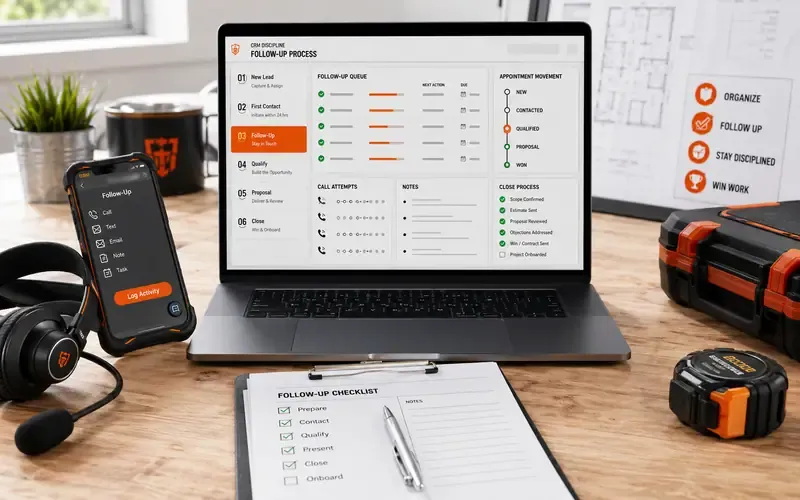
How to Fix the Speed Gap
Three pieces close the speed gap for good:
- AI phone answering: Every inbound call picked up in seconds, around the clock. No ring-to-voicemail. No missed storm-night calls. The lead gets qualified and booked on the spot.
- Form-to-text automation: Every form submission fires an instant text confirmation plus an outbound call attempt within 2–3 minutes.
- Multi-touch follow-up: Leads that don't book on the first contact get a 14-day sequence of texts, emails, and voicemails — not one call and a shrug.
None of this is optional anymore. Every other roofer, HVAC shop, and remodeler in your market is running ads too. You can't out-spend the biggest player in town. You can pick up the phone faster than every one of them.
To see how the full system works, look at the 9-system stack or read the AI receptionist article.
Frequently Asked Questions.
Q.01Why does speed-to-lead matter for contractors?
Because responding within 5 minutes makes you 9× more likely to qualify a lead than waiting 30 minutes, and after an hour your odds of a real conversation drop about 80%. Most contractors call back in 4–7 hours, so 60–70% of leads hire someone else first. Speed, not ad spend, decides who wins.
Q.02How fast should contractors respond to a lead?
Within 5 minutes — ideally seconds. The 2007 MIT and Harvard benchmark found a 5-minute response makes you 9× more likely to qualify a lead than waiting 30 minutes. Best practice is an instant text inside 30 seconds plus an outbound call attempt within 2–3 minutes, since 30–45% of leads arrive after hours.
Q.03Does an AI receptionist improve booking rates?
Yes. About 80% of callers won’t leave a voicemail, and average booking sits at 30–40% versus 60–70% for top shops. An AI receptionist answers every call in seconds, day or night, qualifying and booking on the spot. Surfex used a system like this to grow from $25K to $75K a month.
Related Articles.
Want this system installed for your trade?
See if your market is still open, then book a 20-30 minute install call. No contracts.