
Roofing Company Marketing: Why Your Ads Aren't Converting
Clicks aren't the problem. The problem is what happens after the click — the landing page, the response time, and the follow-up system that most roofers don't have.
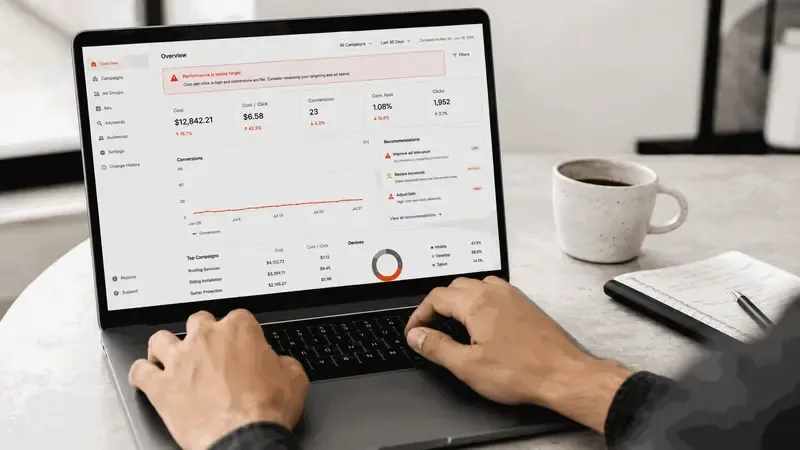
Here's the call we hear over and over. A roofer has been spending $4,000 a month on Facebook ads for six months. The clicks come in. The calls come in. But the calendar shows maybe 3–4 booked estimates a month, and 1–2 closed jobs. The math doesn't work. So they assume the ads are bad.
In almost every case, the ads are fine. The leak is everything after the click: where the traffic lands, what happens when someone calls, and what happens when they don't pick up your callback. Here are the five most common roofing marketing failures — and the fix for each.
Mistake #1: Sending Ad Traffic to Your Homepage
Your homepage is designed to tell a story. It has your company history, your team, your services, your service areas, your reviews, your blog, your contact page. It's trying to do twelve things at once.
Ad traffic needs to go to a page that does exactly one thing: get the homeowner to submit their contact information or call your number. A dedicated landing page for each campaign type (storm response, planned replacement, free inspection offer) should have:
- A single headline matching the ad creative ("Is Your Roof Hail-Damaged?")
- Social proof above the fold: 4.8★ rating, number of reviews, years in business
- A simple form: name, phone, zip code — nothing else
- A click-to-call phone number visible at the top
- No navigation links to other parts of the site — exits kill conversion rates
The impact: Landing page conversion rates for roofing typically run 15–25% vs. 2–4% for homepage traffic. That's 4–10× more leads from the same ad spend.
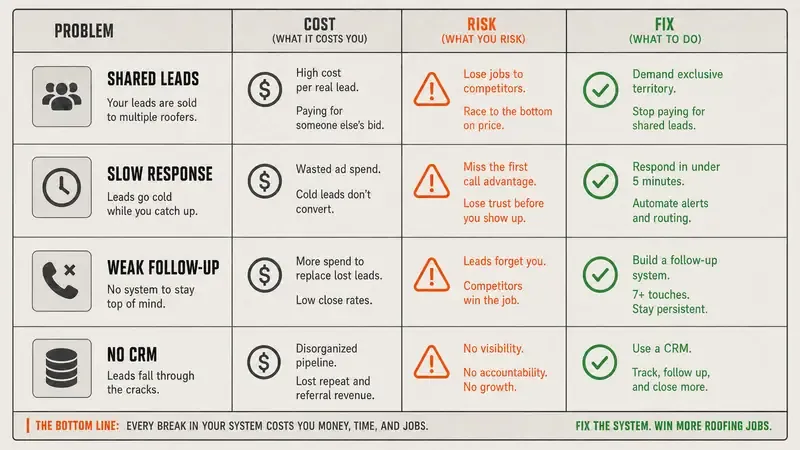
Mistake #2: Slow Response Time
This is the biggest single leak in roofing marketing. A homeowner fills out a form at 6:30pm after a hailstorm. Your office opens at 8am. The call back happens at 8:15am — 14 hours later. The homeowner booked the inspection with someone who called them at 6:35pm.
Contractors who respond within 5 minutes are 9× more likely to qualify the lead than those who respond after 30 minutes. By the time you call back the next morning, the probability of reaching a ready-to-book homeowner drops by roughly 80%.
In roofing — where emergency demand hits on evenings and weekends — this isn't just a conversion problem. It's the primary reason most roofing ad campaigns underperform.
The fix: An AI receptionist that picks up every call in seconds, 24 hours a day — including the 6:30pm storm calls. An automated text confirmation that fires within 30 seconds of a form submission. And an outbound call attempt to every form submitter within 2–3 minutes.
Mistake #3: One Call Attempt, Then Nothing
Most roofing companies make one call to a new lead. If the homeowner doesn't answer, they leave a voicemail. That's it. The lead sits in a spreadsheet or email inbox and goes cold.
Research on home service lead behavior: it takes an average of 5–7 touchpoints to convert a top-of-funnel lead into a booked appointment. A homeowner who submitted a form is interested — they're just busy, or they're comparing multiple companies, or they're waiting to see if their insurance company will cover it. A follow-up sequence that reaches out over 14 days with 5–7 touchpoints captures 30–40% more booked estimates from the same lead volume.
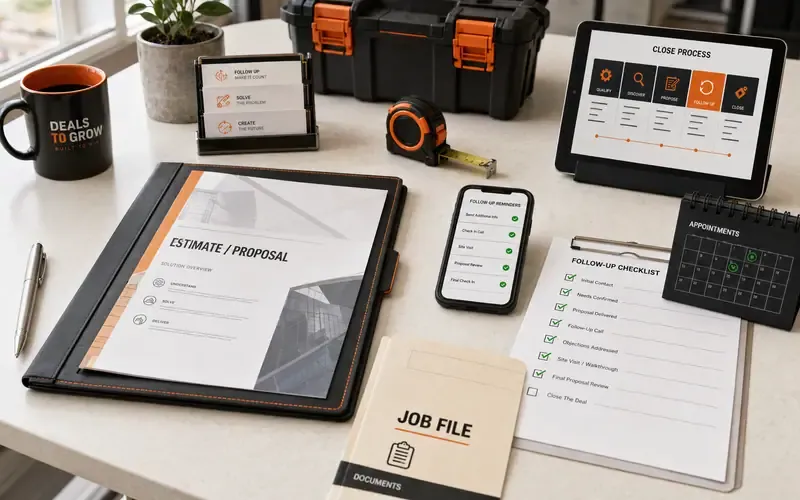
The follow-up for roofing leads should include:
- Day 0: Immediate SMS + call attempt
- Day 1: Second call + email with inspection photos and reviews
- Day 3: SMS with direct booking link
- Day 5: Voicemail drop (personalized audio)
- Day 7: Email with insurance claim information (for storm leads)
- Day 14: Final re-engagement SMS
Mistake #4: Running Only Storm Campaigns
Storm response campaigns are the highest-converting campaign type in roofing — when there's a storm. The problem: you can't control the weather. A company running only storm campaigns has revenue that's entirely weather-dependent.
Planned replacement campaigns — targeting homeowners with roofs 15–20+ years old — run year-round and generate the steady pipeline that fills the calendar between storm cycles. These leads take longer to close (the homeowner isn't in crisis), but they typically have better margins (no insurance adjuster involved) and are easier to plan for operationally.
The winning roofing marketing mix: storm response campaigns (event-triggered, ready to launch on short notice) + planned replacement campaigns (always on, year-round).
Mistake #5: Measuring the Wrong Metrics
Most roofing companies measure cost-per-lead and stop there. Cost-per-lead is a vanity metric unless you know what percentage of those leads become booked estimates, and what percentage of estimates become signed contracts.
The metrics that actually matter in roofing marketing:
- Booking rate: % of leads that become confirmed estimate appointments (target: 60–70%)
- Close rate: % of estimates that become signed contracts (industry average: 30–40%)
- Cost per signed job: Total ad spend ÷ signed contracts (target: less than 3% of average ticket)
- Lead source close rate: Which channel produces leads that actually close (Meta vs. Google vs. LSA)
A company spending $4,000/month on ads with a 60% booking rate and 35% close rate generates more revenue than one spending the same amount with a 30% booking rate and 25% close rate — without changing the ad spend at all.
What a Properly Built Roofing Marketing System Produces
Fix all five — dedicated landing page, instant response, full follow-up sequence, balanced campaign mix, honest measurement — and run the benchmark math on the same budget. A landing page converting at 15–25% instead of 2–4% multiplies your leads. A 60% booking rate instead of 30% doubles your estimates. The same $3,000–4,000 a month that produced 3–4 booked estimates can carry 14–18 — and at a 35% close rate, 5–7 signed jobs. Same ad spend. Different system.
For a full breakdown of what this looks like operationally, see the roofing sales infrastructure page or read the complete roofing lead generation guide.
Related Articles.
Want this system installed for your trade?
See if your market is still open, then book a 20-30 minute install call. No contracts.