
Sales Infrastructure vs. Marketing Agency: What You Actually Need
Agencies deliver leads. Infrastructure delivers a business. The difference determines whether you're still on the hamster wheel in 3 years.

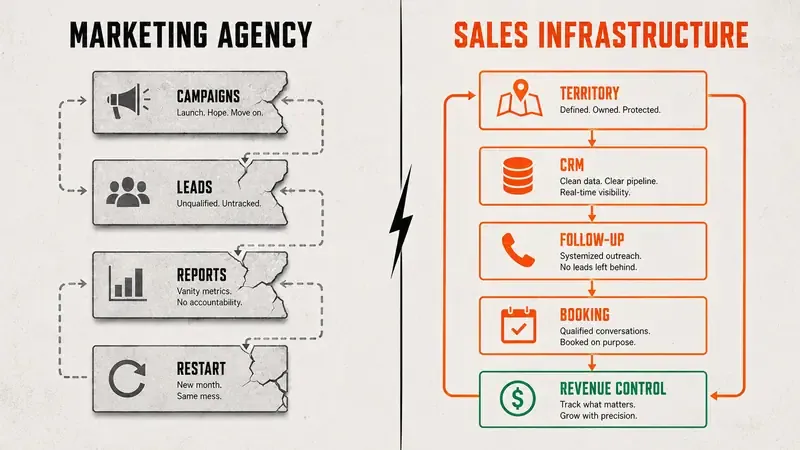
Ask any trade contractor who's hired a marketing agency and you'll hear the same story. They sign a 6-month contract. The agency runs ads. Leads come in — some good, some junk. Results flatten after month two. Nobody can say exactly what's working or why. The reports are full of numbers that don't connect to revenue. Then the contract ends, and the agency keeps the ad accounts, the data, the landing pages, and the audience lists. The contractor starts over from zero.
This is not a story about bad agencies. It's a problem built into the agency model itself.
What the Agency Model Actually Delivers
Marketing agencies for contractors deliver one thing: traffic. They run ads, capture leads, and send you a form submission. Everything after that — answering the phone, booking the estimate, the follow-up, the pipeline — is your problem.
That's the gap. The agency's job ends at the lead. Your job — turning leads into booked estimates and estimates into signed contracts — runs on whatever manual process you have. For most contractors, "manual process" means answering your cell when you're not on a roof, calling leads back the next day, and hoping they haven't already booked someone else.
Three problems are baked into the agency model:
1. You Own Nothing
Leave an agency and what do you keep? Usually nothing. The ad account sits in the agency's Business Manager, not yours. The landing pages live on their platform. The audience lists, the creative, the campaign data — gone. You were renting marketing, not building it.
A contractor who spends $120,000 with an agency over two years and then leaves walks away with nothing. A contractor who puts the same money into owned infrastructure walks away with ad accounts full of data, retargeting audiences, a CRM holding two years of pipeline history, and a system that keeps running the day they stop paying.
2. They Serve Your Competitors
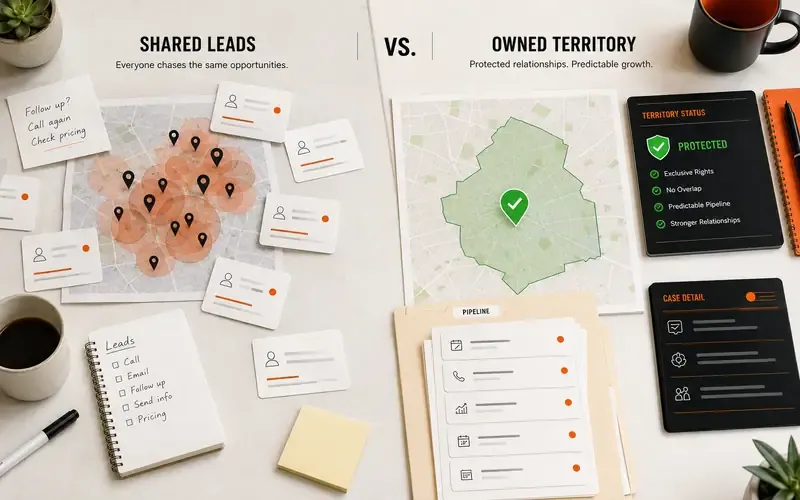
A standard agency offers no exclusivity. The same shop running your roofing campaigns is probably running campaigns for other roofers — maybe in your own market. Your ad spend teaches them what works. They apply the lesson to your direct competitors.
You're not building an edge. You're paying to run the same race as everyone else, with the same playbook, from the same vendor.
3. Their Revenue Model Misaligns With Your Growth
Most agencies charge a percentage of ad spend — usually 10–20%. Think about what that rewards. The more you spend on ads, the more they make. There's no pressure on the agency to cut your cost per lead, raise your close rate, or build systems that make you more efficient. Those wins would shrink your ad spend — and their invoice.
What Sales Infrastructure Is — And Isn't
"Sales infrastructure" is not a marketing term. It's an engineering term. It means the full system — the tools, the process, the automation — that turns a marketing dollar into a signed contract. The difference from an agency is simple: you own it, end to end.
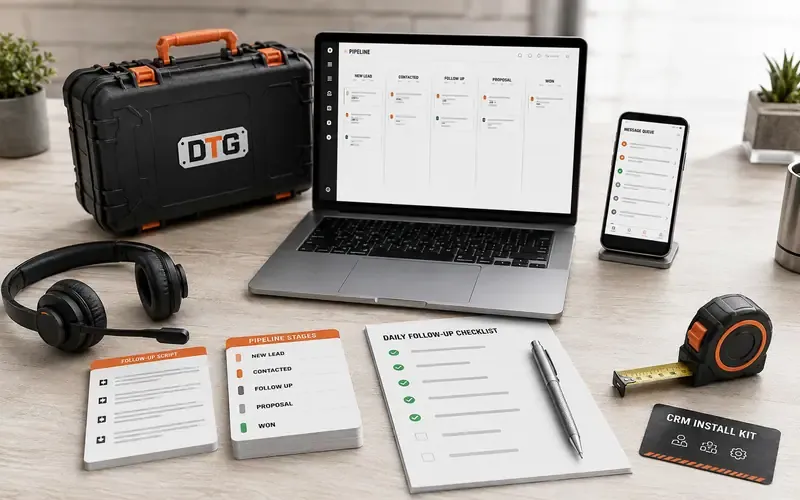
A sales infrastructure stack for a trade contractor includes:
- Lead generation — Meta and Google ad campaigns (the part agencies handle)
- Inbound capture — AI receptionist that answers every call in seconds, 24/7
- Qualification and booking — Lead qualification script and calendar booking flow
- CRM pipeline — Full visibility from lead to signed contract
- Follow-up sequences — SMS, email, and voicemail drop for non-responders
- Authority website — On your domain, built to convert, not hosted by a vendor
- Attribution and reporting — Connect every dollar of ad spend to revenue
- Reinforcement loops — Ongoing fixes when a system dips
The contractor owns every piece of this stack. Ad accounts in their name. CRM in their account. Website on their domain. Data in their database. The vendor builds the system. The system belongs to the operator.
Garage-floor specialists who ran on a single channel before the infrastructure install — now multi-channel and compounding. Result: annual run rate $1.2M → $8M, sales cycle cut from 14–21 days to 3–7 days. In the owner's words: "We did more revenue in May than all of last year." And every account, list, and lead stays in the operator's name.
The Comparison: Agency vs. Infrastructure
| FACTOR | AGENCY | INFRASTRUCTURE |
|---|---|---|
| What you own on exit | Nothing | Everything |
| Exclusivity | None — serves competitors | One operator per metro |
| Revenue model | % of ad spend | Fixed monthly fee |
| AI receptionist included | Rare add-on | Included on Grow & Scale plans |
| CRM setup included | Not included | Configured and owned |
| Full attribution | Often opaque | Complete visibility |
| Time to live | 4–8 weeks | 5 business days |
| Follow-up automation | Not included | Multi-channel sequences |
| Reporting | Agency-generated slides | Live dashboard, yours |
What This Means for Your Business
An agency gets you leads. Infrastructure builds a sales engine that compounds. Every month the stack runs, you're stacking up:
- Audience data — retargeting lists that make your ads cheaper over time
- CRM history — pipeline data that sharpens your close process
- Review volume — social proof that books more estimates on its own
- SEO authority — local content that brings in leads without ad spend
- Process documentation — your whole sales operation, written down and yours to keep
After three years with an agency, you have the leads from the months they ran. After three years with a stack you own, you have a business that makes its own demand.
To see exactly what the infrastructure looks like for your trade, visit the full 9-system stack or compare it directly on the why us page.
Frequently Asked Questions.
Q.01What is the difference between a sales infrastructure company and a marketing agency for contractors?
A marketing agency delivers traffic and leads, then keeps the ad accounts, data, and landing pages when the contract ends. A sales infrastructure company builds the full stack — ads, AI receptionist, CRM, follow-up, and website — in your name. The agency rents you leads; infrastructure builds an asset you own.
Q.02Who helps contractors own their leads instead of buying shared leads?
Deals To Grow installs owned sales infrastructure — Meta and Google campaigns, a CRM, an AI receptionist, and follow-up sequences — all in the contractor’s name, one operator per metro. Every ad account, lead, and record belongs to you, so nothing disappears if you stop paying.
Q.03Do contractors own the leads and accounts?
Yes. With Deals To Grow, the contractor owns every piece — ad accounts in their name, CRM in their account, website on their domain, and all lead data in their database. The vendor builds the system; the operator keeps it, even after they leave.
Related Articles.
Want this system installed for your trade?
See if your market is still open, then book a 20-30 minute install call. No contracts.