
How to Get More Bathroom Remodel Leads That Convert
Referrals are unpredictable. Houzz is expensive. Here's how to build a lead pipeline that delivers 15–20 qualified consultations per month — and how to convert them at the rates that make the math work.
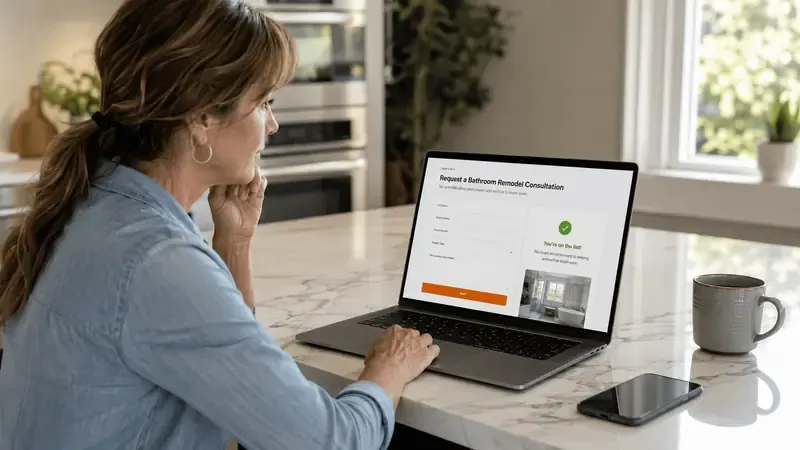
Picture a bath remodel company doing $1.8M a year with a familiar problem: booked 6–8 weeks out in the spring, completely dead in August, and spending most of its sales energy chasing referrals from past clients. They've tried Houzz. They ran Facebook ads for 3 months and gave up. The owner is personally texting former customers asking for referrals.
The quality of their work isn't the issue. Their pricing is competitive. The problem is structural: they've built a business that runs on word of mouth, and word of mouth has a ceiling. To scale past that ceiling — and eliminate the feast-or-famine cycle — you need a machine that generates qualified bath remodel leads on demand. Here's how to build it.
The Referral Ceiling: Why Word of Mouth Stops Working
Referrals are the most efficient lead source in home remodeling — when they're flowing. A referred homeowner already trusts you before the first call. Close rates on referral leads run 50–70% compared to 20–35% on paid leads. There's no ad spend. The cycle time is short.
The problem isn't referral quality. The problem is referral volume. You can't control when former clients decide to mention your name to a neighbor. You can't scale a referral-based business by 40% in a year without a proportional increase in past clients — which means you're always chasing your own tail. The volume is capped by the size of your installed base, and it fluctuates based on factors you have zero control over.
The feast-or-famine cycle that kills bath remodel companies is almost always rooted in referral dependency. Spring and early summer: phones ring because homeowners are renovating. August through October: dead because no one is referring. November through February: desperate because the referral pipeline that always "just worked" has dried up completely.
The answer isn't to stop pursuing referrals. Referrals should be systematized — ask every completed client for a referral at the 30-day follow-up call, send a handwritten note, offer a referral incentive. But referrals should be the bonus revenue on top of a paid lead pipeline, not the foundation of the business. The companies that grow past $2M in bath remodel revenue have built a paid channel that runs alongside referrals and fills the gaps in between.
The Two Channels That Fill Bath Remodel Calendars
Bath remodel marketing works best with two channels running simultaneously: Meta (Facebook and Instagram) for awareness and inspiration, and Google Local Service Ads (LSA) for catching homeowners who are already searching. They do different jobs and they're not interchangeable.
Meta for bath remodel is a visual platform play. Before-and-after photos of completed projects — especially dramatic transformations from outdated tile and vanities to modern, spa-style renovations — stop the scroll. Video walkthroughs of completed bathrooms perform even better. The creative strategy for bath remodel on Meta has two primary angles: design aspiration ("This is what your bathroom could look like") and financing ("$0 down, as low as $149/month"). The financing angle pulls in far more homeowners because it removes the sticker shock from the first interaction. Homeowners who would scroll past an ad showing a $15,000 bathroom remodel will stop and engage when the monthly payment is the headline number.
Google LSA for bath remodel captures homeowners who are already searching. Someone typing "bathroom remodeling contractors near me" or "bathroom renovation cost" into Google has already made the mental leap — they're actively looking for a contractor, not passively browsing Instagram. LSA leads convert at significantly higher rates than Meta leads because the intent is already there. The trade-off is volume: LSA generates fewer leads than Meta, but those leads are further along in the decision process. Target 8–12 LSA leads per month alongside 25–35 Meta leads, and you have a balanced pipeline of both intent levels.
The mistake most bath remodel companies make is choosing one or the other. Meta-only gives you volume but low close rates. LSA-only gives you high close rates but not enough volume to fill the calendar. Running both channels simultaneously — with different follow-up strategies tuned to each intent level — is what produces 15–20 booked consultations per month from a $3,000–5,000/month ad budget.
Slow Response Kills Bath Remodel Leads
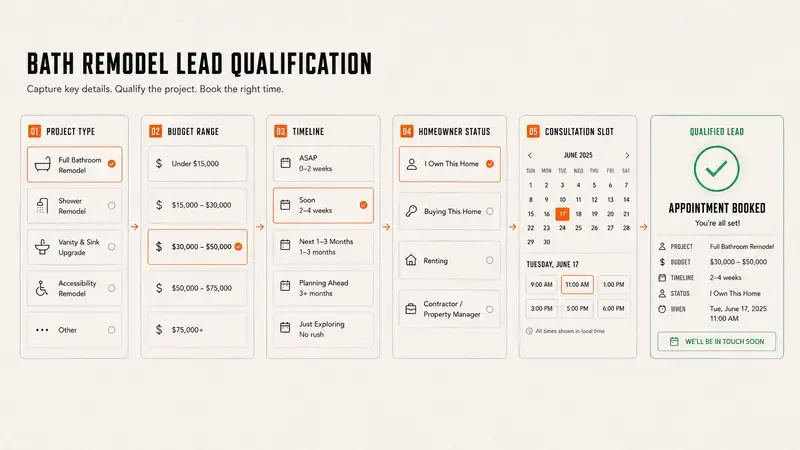
Here is the single most important operational fact about bath remodel lead generation: when a homeowner fills out a contact form or calls your number, they are almost certainly simultaneously contacting two or three other contractors. This is not an assumption — it's how homeowners shop for remodeling projects. They search, they find a few options, they submit their information to all of them. The first contractor to respond professionally wins the appointment. The others get voicemails returned three days later, if at all.
Contractors who respond to a new lead within 5 minutes are 9× more likely to make contact and qualify the lead compared to those who wait 30 minutes or more. After one hour, the probability of reaching a ready-to-book homeowner drops by over 80%.
In bath remodel, where leads come in evenings and weekends when homeowners are browsing renovation inspiration, this isn't a marginal edge. It is the primary variable separating contractors who convert 20% of their leads from contractors who convert 55%.
The fix requires removing humans from the critical first-response window. An AI receptionist handles every inbound call — day, evening, weekend — with a professional greeting, qualifies the caller, captures their information, and schedules a consultation callback. An automated SMS goes out within 30 seconds of any form submission, confirming receipt and setting expectations for a callback within the hour. For form leads, an outbound AI-powered call attempts contact within 2–3 minutes.
This is not about replacing your sales team. It's about ensuring that no lead ever hits voicemail, and no form submission sits unacknowledged overnight. Your sales team closes the deal. The AI infrastructure makes sure the lead is still warm when your sales team picks up the phone.
The 14-Day Follow-Up Sequence for Bath Leads
Bath remodel is not an impulse purchase. A homeowner who fills out a form at 9pm on a Tuesday after scrolling through renovation photos is interested — but they're not necessarily ready to book a consultation tomorrow. They may be 2 months from being ready. They may be comparing 4 contractors. They may have a spouse who isn't on board yet. A single call attempt followed by silence loses all of these homeowners. A structured 14-day follow-up sequence captures them.
The follow-up sequence for bath remodel leads should look like this:
- Day 0 (within 5 minutes): Automated SMS confirming receipt of inquiry + phone call attempt. If no answer, leave a warm voicemail with your name, company, and a specific callback number.
- Day 1: Second call attempt during business hours + email with a curated photo gallery of 6–8 completed bathroom projects. Subject line: "3 bathrooms we just finished near [city]." This email does two things: it reminds them who you are and it makes your work tangible.
- Day 2: SMS with a direct link to your project gallery or a short video walkthrough. Keep it conversational: "Hi [name], wanted to share a few recent projects — we just finished a master bath in [neighborhood] that might give you some ideas."
- Day 5: SMS with a financing CTA. "Did you know we offer financing starting at $0 down? Happy to walk you through options when we connect." This reengages homeowners who were interested but got sticker-shocked when they started researching costs.
- Day 9: Voicemail drop — a pre-recorded, personalized-sounding audio message delivered directly to voicemail without ringing the phone. This gets listened to at 3× the rate of standard voicemails and feels less intrusive than a live call at an inconvenient time.
- Day 14: Re-engagement SMS: "We haven't been able to connect — are you still thinking about a bathroom remodel, or has the timing changed? Either way, no worries — just want to make sure you have our info when you're ready." This low-pressure message consistently generates replies from leads who have been meaning to call back.
This sequence is not pushy. It's persistent and helpful. Every touchpoint adds value — photos, financing information, project examples — rather than just asking "are you ready to book yet?" Bath remodel leads who go through a full follow-up sequence convert at 30–40% higher rates than leads who receive a single call attempt.
The most important operational detail: this sequence needs to be automated. Manual follow-up at this cadence is not sustainable for a team of any size. A CRM with automated SMS, email, and voicemail drop integrations executes the sequence without human intervention until a lead responds — at which point your sales team takes over for the actual consultation booking call.
Metrics That Actually Matter for Bath Remodel Marketing
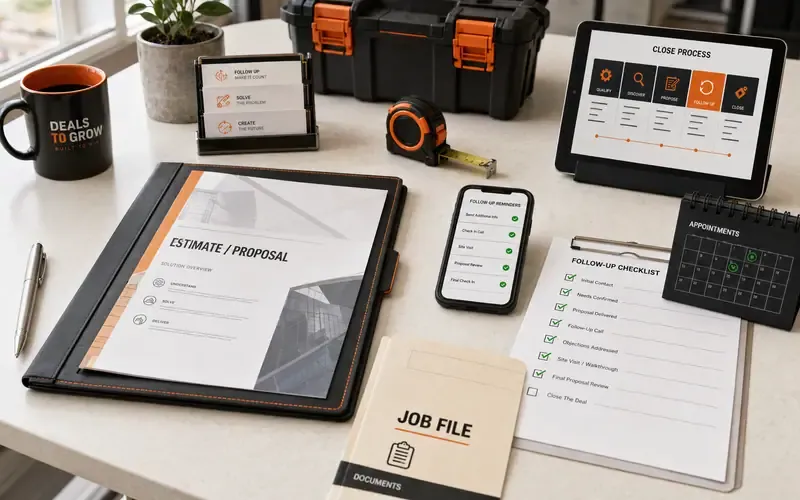
Most bath remodel companies track cost-per-lead and nothing else. Cost-per-lead is a starting point, not a success metric. A $35 lead that converts to a signed contract at 25% is worth more than a $20 lead that converts at 10%. What you actually need to track:
- Booking rate: The percentage of leads that become confirmed consultation appointments. Target: 60–70%. If you're below 50%, the problem is either lead quality or response time — not the ads.
- Show rate: The percentage of booked consultations where the homeowner actually shows up (or is home for an in-home visit). Target: 85%+. Show rate below 75% means your confirmation sequence is broken — homeowners are forgetting or de-prioritizing the appointment.
- Consultation-to-contract rate: The percentage of completed consultations that result in a signed contract. Industry average is 30–40%. Top-performing bath remodel companies running qualified leads and strong in-home sales processes reach 45–55%.
- Cost per signed contract: Total ad spend divided by signed contracts. Target: under 4% of your average ticket. If your average bath remodel is $12,000, your target cost per signed contract is under $480. If you're spending $4,000/month on ads and signing 10 contracts, you're at $400 — well within range.
- Lead source close rate: Track which channel (Meta vs. LSA vs. referral vs. organic) produces leads that actually close. LSA leads typically close at 35–50%. Meta leads close at 20–30%. Referrals close at 50–70%. Knowing this lets you allocate budget to the highest-value channels rather than the highest-volume ones.
The companies that scale bath remodel revenue past $3M are the ones who treat marketing as a numbers game with clear inputs and measurable outputs — not a creative exercise or a relationship-building effort. Build the tracking, measure the metrics, and optimize the funnel systematically. The leads will follow.
Related Articles.
Want this system installed for your trade?
See if your market is still open, then book a 20-30 minute install call. No contracts.