
Epoxy Flooring Business: Scale Past Referrals and Seasonality
Great installs don't automatically generate great lead flow. Epoxy contractors who break out of the referral-and-spring cycle build a system — not just a reputation.
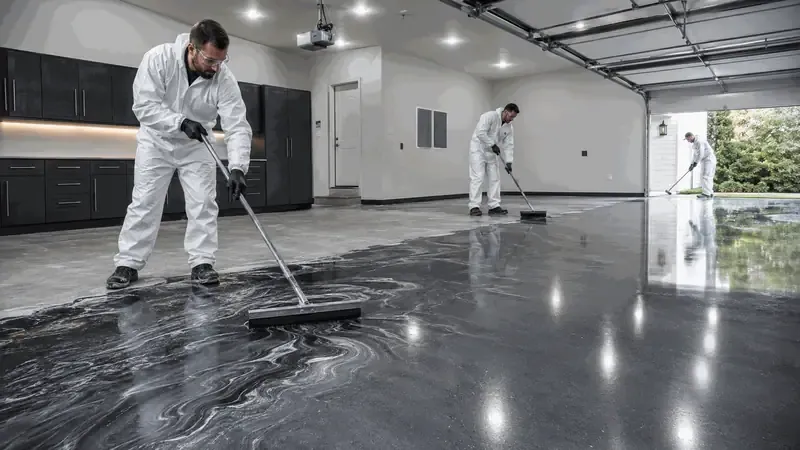
The epoxy flooring operators we talk to almost always have the same profile: excellent installs, strong before/after photos, a handful of raving fans who refer friends — and a calendar that goes from slammed in spring to slow in summer to quiet in winter. The work is good. The system for generating the work is missing.
Referrals and seasonal demand are not a business model. They're a starting point. Here's how to build the marketing infrastructure that turns a great epoxy operation into a consistent, year-round revenue machine.
The Epoxy Seasonality Trap: Why Spring Shouldn't Be Your Only Revenue Month
Epoxy flooring has a pronounced seasonal demand curve. Homeowners think about garage floors when they can keep the garage door open for ventilation and curing — which means spring and early fall in most markets. The spring rush is real: March through May can represent 40–50% of a residential epoxy operator's annual revenue. The problem isn't that spring is busy. The problem is that winter is empty and the company did nothing in December to fill the following spring.
The seasonality trap works like this: you're slammed in spring, too busy to do any marketing. Summer slows down. You start thinking about marketing. Fall picks up with a second wave. Then winter hits and you have no pipeline, no booked jobs, and no marketing running — just the hope that spring comes soon.
Referrals compound the problem because they're weather-dependent by proxy. When neighbors see your install truck in someone's driveway in April, they think about their own garage. In January, nobody is walking past garages and thinking about epoxy. Referrals track the same seasonal pattern as organic demand, which means they don't help you fill the gap.
The break-out strategy is counterintuitive: run your heaviest marketing investment in October through February — when competition is sleeping and cost-per-click is lower. The goal isn't to generate spring revenue in winter. The goal is to fill the spring calendar with booked jobs before the spring rush starts, so you can operate from a position of full capacity rather than scrambling to fill it. Pre-booked spring installs are more profitable than spring installs booked mid-rush because you're not discounting to close them quickly.
Poxy — Montréal garage-floor specialists known for meticulous prep — ran a single channel before installing a full sales system. After: sales cycle down from 14–21 days to 3–7 days, biggest month up from ~$120K to $1M+, annual run rate from $1.2M to $8M. The owner's line: "We did more revenue in May than all of last year."
Meta Ads for Epoxy Flooring: The Visual Platform for a Visual Product
Epoxy flooring is among the highest-converting categories on Meta because the visual transformation is so dramatic. A bare concrete garage floor vs. a finished metallic epoxy or flake system is not a subtle difference — it's the kind of content that stops a homeowner who has thought vaguely about their garage for three years and makes them think about it right now.
The creative that performs best for epoxy on Meta falls into two categories. First, before/after content: split-frame photos or video walkthroughs showing the transformation from bare, stained, or cracked concrete to a finished system. The messier the before, the better the contrast and the higher the engagement. Second, finished-project showcase content: a slow pan across a completed garage showing the system's texture and sheen, ideally with a nice car parked on it. Aspiration sells in residential epoxy — homeowners aren't just buying a floor, they're buying the garage they've always wanted.
For residential, target homeowners by home ownership status, estimated home value ($350K+), and geographic radius around your service area. For commercial epoxy — warehouses, auto dealerships, restaurants, gyms — shift to interest-based and employer-based targeting, or use LinkedIn for higher-ticket commercial prospects. The two audiences are distinct enough that they warrant separate campaigns with distinct creative.
Keep your targeting tight geographically. Epoxy flooring has a real service radius constraint — beyond 30–40 miles, mobilization costs eat margin quickly. A tight geo targeting radius also improves your cost-per-lead because you're only paying to reach homeowners you can actually serve profitably.
Residential vs. Commercial Epoxy: Two Different Funnels
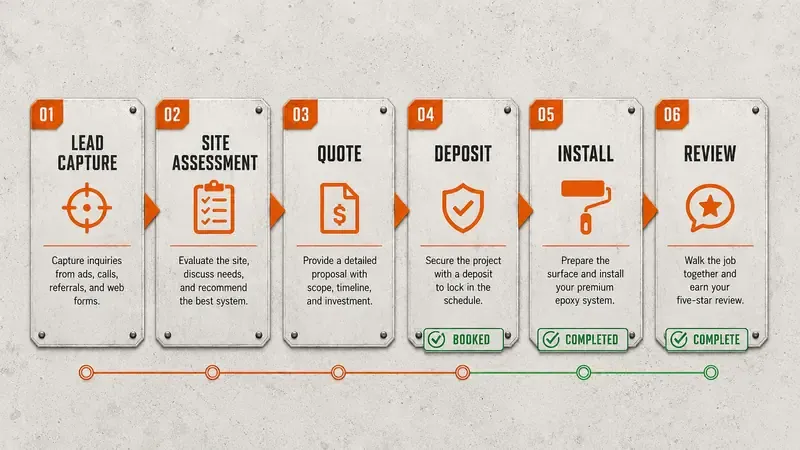
Residential and commercial epoxy jobs look similar on the install side but are completely different sales processes. Treating them the same way in your marketing — and your CRM — leaves money on the table in both categories.
Residential epoxy — garage floors, basement floors, laundry rooms — typically runs $2,000–$6,000 per job. The decision is made by one or two homeowners, usually within a week of first contact, and the emotional driver is pride of ownership: they want a garage that looks as good as the cars in it. Creative should lean into aspiration and identity ("This is what your garage could look like"), and the sales process should be fast — same-day or next-day quote delivery, with a 48-hour follow-up to close.
Commercial epoxy — warehouse floors, auto dealerships, commercial kitchens, gym floors, showrooms — runs $8,000–$25,000+ per job. The decision involves multiple stakeholders, takes 2–6 weeks, and is driven by ROI and durability rather than aesthetics. Creative should highlight longevity, safety compliance (slip resistance, OSHA standards), ease of maintenance, and portfolio evidence of similar commercial projects. The sales process includes a site visit, a formal proposal, and multiple follow-ups across a longer cycle.
Both revenue streams can run through the same CRM backend — you just need separate lead sources, separate pipelines, and separate email/SMS sequences. A homeowner who submitted a form about their garage and a facility manager who submitted a form about a warehouse floor are not the same prospect and should not receive the same follow-up. Tag them correctly from intake and route them to the right sequence.
The Follow-Up Cadence for Epoxy Leads: 5 Touches in 7 Days
The single most common failure in epoxy flooring marketing isn't the advertising — it's the follow-up. Most epoxy operators call a new lead once. If the homeowner doesn't answer, they leave a voicemail. Then they wait. Three days later, if nothing happened, the lead goes cold and gets filed away. This is how a $150 Meta lead becomes a $0 job.
The data on follow-up cadence is consistent across home service categories: most conversions happen on the 4th–7th contact attempt, not the first. A homeowner who submitted a form is genuinely interested — they're just busy, comparing options, waiting to talk to a spouse, or simply missed your first call. A structured follow-up sequence doesn't feel aggressive when the timing and content are right. It feels helpful.
Epoxy flooring contractors who implement a structured 5-touch follow-up sequence over 7 days convert 35–45% more leads into booked estimates compared to single-call follow-up. The difference is not price or reputation — it's persistence and timing.
Most of your competitors are calling once and giving up. The follow-up cadence is where the job is actually won.
The 5-touch follow-up cadence for epoxy leads looks like this:
- Day 0 — immediate SMS + call: SMS confirmation within 60 seconds of form submission ("Thanks for reaching out — we'll call you in the next few minutes"). Outbound call attempt within 2–3 minutes. If no answer, leave a brief, specific voicemail referencing the project.
- Day 2 — before/after gallery: SMS with a link to your best residential before/after photos ("Thought you'd want to see a few recent garage projects near you"). No hard sell — just value and visual proof.
- Day 4 — direct booking SMS: "Still happy to get you a free quote this week — here's a link to pick a time that works: [scheduling link]." Make the next step frictionless.
- Day 6 — financing option: For jobs over $2,500, a brief SMS introducing a financing option ("Many of our customers use 0% financing for 12 months — happy to share details if budget is a consideration"). This re-engages leads who were interested but hesitant about the upfront cost.
- Day 7 — close call: A personal call, not a script. "I've reached out a few times and don't want to be a pest — just wanted to make sure you got the info you needed and to answer any questions before I move on." This framing respects their time, signals scarcity, and often generates a response from leads who went quiet.
After day 7, move the lead to a 30-day re-engagement sequence: one touchpoint per month for three months, with content value rather than sales pressure. Epoxy leads that don't convert in week one often convert 60–90 days later when their project gets prioritized.
Profitability Per Install: The Math That Makes Paid Ads Worth It
The objection we hear most often from epoxy flooring operators considering paid advertising is: "Leads are too expensive." This objection almost always comes from looking at cost-per-lead in isolation without running the math to the installed job. When you run the full calculation, paid lead acquisition in epoxy is typically among the most efficient marketing investments in the trades.
Here's a representative example. Assume a residential epoxy operation with a $3,000 average ticket (garage floor, two-car garage, standard flake system). Meta ads are generating leads at $150 cost-per-lead. With a structured follow-up sequence and a competent estimator, the close rate on these leads is 40%. That means every 10 leads produces 4 jobs, at a cost of $1,500 in ad spend. $1,500 spread across 4 jobs is $375 cost-per-install — 12.5% of the average ticket.
That 12.5% number is your customer acquisition cost as a percentage of revenue. In a business with 45–55% gross margins on materials and labor, a 12.5% CAC is very manageable. And that's the base case. The math improves significantly with two levers:
- Better close rate: Moving from 40% to 55% close rate on the same leads reduces your cost-per-install from $375 to $273 — a 27% improvement in efficiency without changing ad spend
- Higher average ticket: Upselling to metallic systems, commercial projects, or whole-garage packages (floor + walls + storage) moves the average ticket to $4,500–$6,000, which means the same $375 cost-per-install now represents 6–8% of ticket
The math only looks bad when you're tracking cost-per-lead and ignoring close rate and ticket size. When you track the full funnel — spend to lead to estimate to signed contract to installed revenue — paid advertising for epoxy flooring is rarely the problem. The problem is usually the follow-up sequence, the close rate, or both.
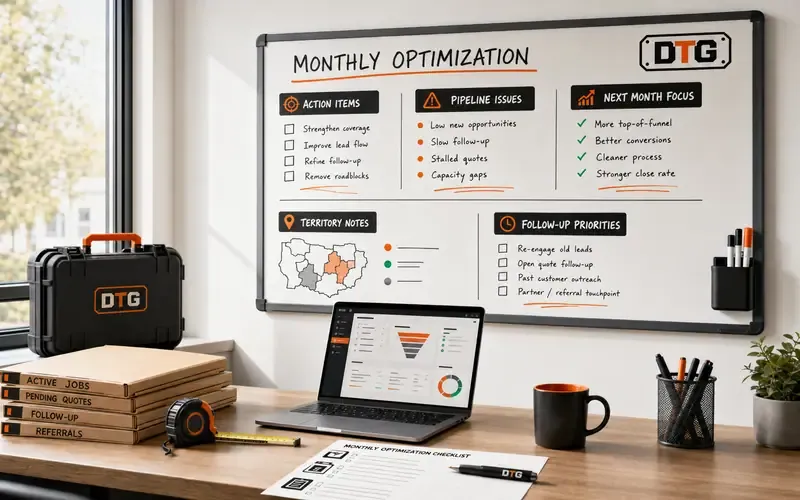
For the CRM infrastructure that makes tracking this data possible, see the CRM for contractors guide. For the speed-to-lead systems that drive close rate improvements, see the speed-to-lead breakdown.
Related Articles.
Want this system installed for your trade?
See if your market is still open, then book a 20-30 minute install call. No contracts.