
Epoxy Flooring Lead Generation: Own Local Search.
Epoxy flooring has a 7–21 day sales cycle and homeowners who search for it are ready to hire. Here's how to dominate local search, respond faster than your competition, and convert every inbound inquiry.
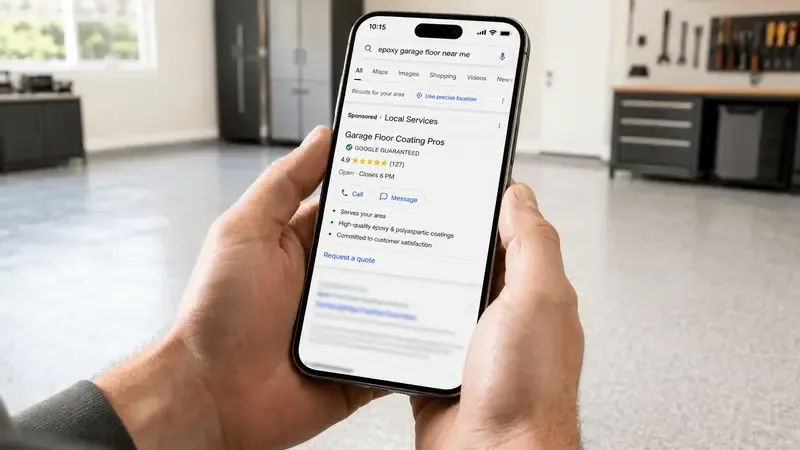
Epoxy flooring buyers are highly qualified by the time they search. They've already moved past the research phase — they've watched the YouTube videos, looked at the Instagram reels, and decided they want epoxy. What they're doing now is selecting a local installer. They're comparing two or three options in your market, and they will hire the first company that responds to them professionally, gives them a clear quote, and shows up when they say they will. This is not a category where the best salesperson wins. It's a category where the fastest, most professional responder wins.
That makes epoxy flooring one of the highest-conversion categories in home improvement — when the response system is built correctly. When it isn't, leads land in an email inbox, get a callback 6 hours later, and have already booked a competitor. The following system addresses every step from search visibility to signed contract to upsell, and gives epoxy contractors a repeatable process for keeping their calendar 30 days out at all times.
The Epoxy Buyer Profile: Why Speed Wins This Category
The typical epoxy flooring buyer has a short decision cycle — 7 to 14 days from first search to hire decision — and contacts multiple contractors simultaneously. This is not a buyer who submits a form and waits patiently for a callback. This is a buyer who submits a form on your site, then opens a second tab and submits on your competitor's site, then calls the third company they found. The company that calls back within 5 minutes — before the homeowner has even finished submitting to competitors — wins 65% or more of these inquiries.
The 5-minute response window is not a suggestion — it is the competitive threshold for epoxy flooring. Studies across home services consistently show that lead contact rates drop by 10× between 5 minutes and 30 minutes, and by 100× between 5 minutes and 24 hours. An AI receptionist configured to handle epoxy inquiries — confirming receipt, gathering project details, and booking an estimate — achieves this response time automatically, even for leads that come in at 9 PM on a Sunday.
Google LSA and Search: The Primary Channel for Epoxy Leads
Google is the dominant lead source for epoxy flooring, and within Google, Local Services Ads (LSA) and the map pack capture the highest-intent traffic. When a homeowner searches "epoxy garage floor [city]" or "garage floor coating near me," they are at maximum purchase intent. LSA places your business at the very top of that result with a Google Screened badge that immediately communicates legitimacy.
The core keyword targets for epoxy contractors in Google Search:
- Primary intent keywords: "epoxy garage floor [city]," "garage floor coating near me," "epoxy floor installers [city]," "epoxy flooring contractor [city]"
- Product-specific keywords: "metallic epoxy floor [city]," "flake epoxy floor [city]," "polyaspartic floor coating [city]," "concrete floor coating [city]"
- Commercial keywords: "epoxy floor for warehouse," "commercial epoxy flooring [city]," "epoxy floor for gym [city]," "restaurant kitchen floor coating"
- Negative keywords to exclude: "DIY," "how to," "kit," "self-leveling," "paint" — these indicate buyers who want to do it themselves, not hire you
LSA rankings for epoxy contractors are driven by the same three factors that govern all LSA categories: review volume, review recency, and response speed. An epoxy contractor with 50 reviews and a habit of responding to leads in under 5 minutes will consistently outrank a competitor with 150 reviews who responds in 4 hours. Review velocity matters — build an automated review request into your post-project workflow, triggered by SMS 24 hours after job completion.
The Google Business Profile is the foundation. For epoxy contractors specifically: upload 15–20 project photos organized by type (garage floor, metallic, commercial, etc.), list your specific services at the line-item level ("garage floor epoxy," "metallic epoxy flooring," "polyaspartic coating," "commercial epoxy"), and post a new project photo at minimum twice per month. The combination of frequent posting, high review count, and fast response rate produces map pack dominance in most local markets.
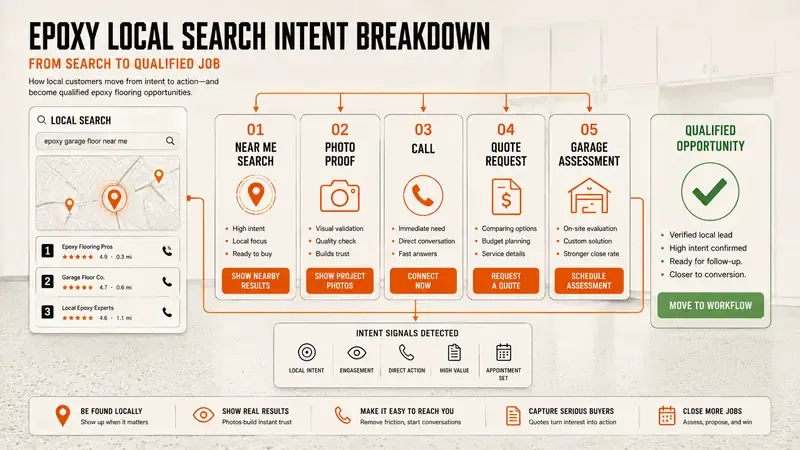
Meta Advertising for Epoxy: The Before/After Visual Play
Epoxy flooring is one of the most visually dramatic home improvement transformations available — a dull, cracked, oil-stained concrete floor becomes a glossy, showroom-quality surface in a single day. This makes it almost uniquely suited to Facebook and Instagram advertising, where before/after content consistently outperforms text-only ads by 3–5× in click-through rate and conversion rate.
The highest-performing Meta ad format for epoxy contractors is a 30–60 second video that opens on the "before" state — a weathered, unremarkable garage floor — and then shows the installation process in time-lapse, ending on the finished result. No voiceover needed. The visual tells the story. A simple text overlay that says "Epoxy Garage Floor — [City] — Free Estimate This Week" combined with a "Book Now" button generates leads at $15–$40 each in most suburban markets.
Audience targeting for epoxy Meta ads should layer multiple homeowner signals:
- Homeownership: Target homeowners (not renters) in your service area — Meta allows homeownership targeting as a demographic signal
- Home improvement interest: Layer in home improvement, DIY, HGTV, home renovation interest targeting to reach homeowners who are actively thinking about their home
- Suburban geography: Suburban zip codes with detached single-family homes with garages — this is your primary buyer; urban/condo targeting wastes budget
- Remarketing: A separate ad set targeting website visitors who did not submit a form — a before/after video reminder ad with a limited-time offer brings back homeowners who were interested but didn't convert on first visit
Budget allocation for epoxy Meta: start at $30–$50/day per campaign, optimize for lead form submissions rather than link clicks, and shift budget to the ad sets producing leads under $35. The target CPL for residential epoxy through Meta is $25–$45. Run the real math to the closed job: at a 40% close rate, ten $35 leads cost $350 and produce four jobs — $12,000–$24,000 in installed revenue from $350 of ad spend.
Residential vs. Commercial: Running Parallel Revenue Streams
Most epoxy contractors start in residential — garage floors, basement floors, laundry rooms — because the ticket is accessible ($3K–$9K), the sales cycle is short, and the visual results photograph well for marketing. But residential epoxy has a ceiling: the homeowner market is transactional and one-time by nature. Commercial epoxy — warehouses, manufacturing facilities, retail stores, restaurant kitchens, gyms, healthcare facilities — has a dramatically higher average ticket ($8K–$80K+), recurring maintenance revenue, and a much lower competitor density in most markets.
The pricing and sales approach for commercial epoxy are different from residential:
- Commercial pricing: Bid on square footage with floor prep, coating system, and timeline as separate line items — facility managers expect detailed scope breakdowns and are not surprised by $15–$25/sq ft for industrial-grade systems
- Commercial decision-making: The buyer is often a facility manager or operations director, not a homeowner; the decision process involves multiple stakeholders and may include a formal bid process for larger projects
- Commercial lead sources: LinkedIn targeting by job title (facility manager, operations manager, property manager), commercial real estate brokers, and direct outreach to industrial parks and retail center property managers are the most effective commercial channels
- Recurring maintenance: Commercial epoxy floors require regular maintenance (recoating, repair, cleaning) — a maintenance contract at $200–$600/month per facility creates a recurring revenue base that stabilizes cash flow
Running residential and commercial in parallel does not require a separate team. A two-person epoxy crew can handle both. The primary adjustment is marketing messaging — residential and commercial buyers respond to entirely different content, so maintain separate landing pages, separate ad campaigns, and separate inquiry flows for each segment.
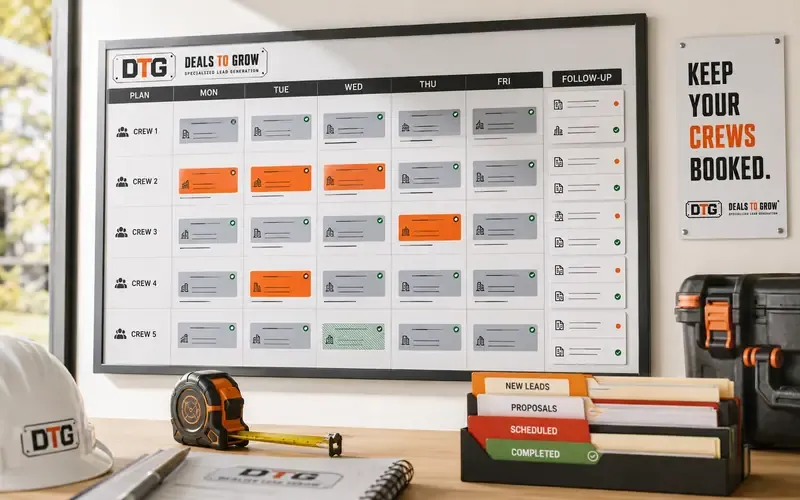
The Upsell System: From Garage Floor to Full Package
The homeowner who books a standard 2-car garage floor epoxy — the base product at $2,800–$3,500 — is already in buying mode. They've decided they want epoxy, they've decided to hire a professional, and they've decided to hire you. This is the moment to present the full package. An upsell system presented during the estimate, and reinforced through the follow-up sequence, consistently increases ticket size by 40–60% with no additional lead generation cost.
- ✓ Present three package tiers at estimate: Base (single broadcast color), Standard (full flake system with clear topcoat), Premium (metallic or custom chip with UV topcoat) — let the homeowner self-select up
- ✓ Offer cove base as a standard add-on ($400–$600) — "we recommend this for moisture management at the wall joint" — most homeowners accept it when it is framed as a best-practice recommendation
- ✓ Introduce wall coating as an option for homeowners with finished or semi-finished garages ($800–$1,400) — "we can coat the lower 4 feet of wall to match the floor for a fully finished look"
- ✓ Add drain covers and floor marking (safety striping, parking spots) for an additional $150–$300 — low cost to install, high perceived-value add-on
- ✓ Offer a garage storage and shelving system referral partnership — you refer to a local storage company, they refer back; homeowners who want epoxy often also want storage
- ✓ Follow up 48 hours after the estimate with a "your project summary" email that includes base price, Standard upgrade price, and Premium upgrade price — this gives homeowners time to upgrade at their own pace
The upsell presentation should happen during the estimate walk, not after the price quote. "While I'm looking at the space — have you considered the metallic finish? The standard broadcast is $3,200 for this size floor; the metallic system is $4,800 and it completely transforms the look. I'll include both in the quote so you can compare." This framing makes the upgrade a natural comparison rather than a hard sell, and it dramatically increases the rate at which homeowners choose the higher-tier system.
Epoxy buyers are not window-shopping. They searched, they found you, and they contacted you because they want a quote. If your response takes 4 hours, they're already scheduled with someone else.
Frequently Asked Questions.
Q.01What is the best way for epoxy flooring contractors to get leads?
Own the two channels epoxy buyers use: Google LSA and the map pack for high-intent searches, plus Meta before/after video ads — paired with an AI receptionist that answers within 5 minutes. Because epoxy buyers decide in 7–14 days and contact several installers, the fastest professional responder wins 65% or more of inquiries.
Q.02What cost per lead can epoxy contractors expect?
Through Meta before/after video ads, residential epoxy leads typically run $25–$45 each, and as low as $15–$40 in many suburban markets. At a 40% close rate, ten $35 leads — about $350 of ad spend — produce four jobs worth $12,000–$24,000 in installed revenue.
Q.03How do epoxy contractors shorten the sales cycle?
Respond within 5 minutes. Epoxy buyers decide in 7–14 days and contact multiple installers, and contact rates drop 10× between 5 and 30 minutes. An AI receptionist confirms receipt, gathers project details, and books the estimate instantly — even at 9 PM on a Sunday — so you become the frontrunner.
Related Articles.
Want this system installed for your trade?
See if your market is still open, then book a 20-30 minute install call. No contracts.