
Flooring Company Marketing: Building Predictable Pipeline
Builder relationships and word-of-mouth built your business. They won't scale it. Here's how flooring contractors build an inbound pipeline that doesn't dry up with one slow season.
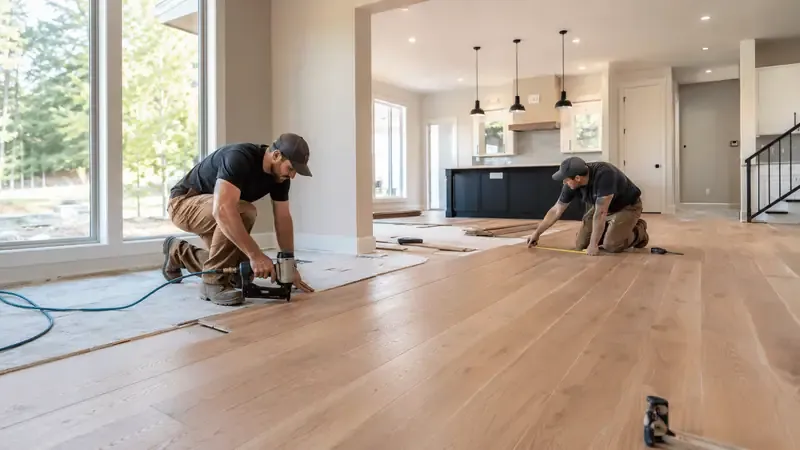
Most flooring companies we talk to are good at flooring. They're not good at marketing — and they've gotten away with it for years because referrals and builder relationships filled the calendar. Until they didn't.
A housing market slowdown, a builder who found a cheaper sub, a key referral source who retired — any of these can cut incoming work in half with almost no warning. The flooring contractors who survive that moment are the ones who built a second engine: an inbound pipeline that doesn't depend on who you know or what the market is doing.
Single-Channel Risk: What Happens When the Builder Calls Stop
Builder work feels like a great business until you look at it closely. The volume is steady, sure. But you bid against other subs on every job. The margins are the thinnest in the trade. And the homeowner never learns your name. If the builder switches subs or slows production, your calendar empties overnight — and you have no customer list to fall back on.
Referrals have a different problem: a hard ceiling. A satisfied homeowner refers maybe one or two people per year, in the best case. If your referral base is 40 past clients and 30% of them refer one job annually, that's 12 referral jobs per year. That's a floor — not a growth strategy.
The bigger problem: you can't control either channel. You can't turn referrals up when the calendar has gaps. You can't pick which jobs come in. You can't predict next month's revenue. When all your work comes from one or two sources you don't control, a slow quarter isn't a marketing problem — it's a payroll problem.
The flooring companies that break out of this build a second engine: ads that reach homeowners directly, with no builder in the middle. It takes 60–90 days to produce steady lead volume. But once it's running, it's an asset you own. It can't retire, and it can't find a cheaper sub.
The Visual Funnel for Flooring Leads
Floors sell with photos. That makes Meta (Facebook and Instagram) the natural channel for flooring leads. A dated tile kitchen turned into polished LVP, or a carpeted living room replaced with wide-plank hardwood, stops a homeowner mid-scroll. A text ad never will.
The campaigns that perform best in flooring are split by room type and material. A generic "flooring installation" ad aimed at every homeowner gets mediocre results. A carousel of kitchen LVP befores-and-afters, aimed at homeowners in the $400K–$700K range, converts 2–3× better. The homeowner already wants that exact floor. The ad just shows them you build it.
A well-structured flooring Meta campaign architecture looks like this:
- Campaign 1: LVP and luxury vinyl — kitchen, bathroom, and whole-home transformation content; target homeowners 35–65 in your service zip codes
- Campaign 2: Hardwood (new install and refinish) — living room and open-concept content; slightly higher home value targeting ($500K+)
- Campaign 3: Tile (kitchen and bath) — renovation-specific creative; target homeowners searching for kitchen or bath upgrades
- Retargeting campaign: anyone who visited your website or watched 50%+ of a video ad in the last 30 days
Each campaign sends traffic to a dedicated landing page for that material type — not your homepage. The landing page has one job: get the homeowner to request a free in-home measurement and sample consultation.
Speed-to-Lead for Flooring: Why Fast Wins Over Fancy
When a homeowner decides they want new floors, they don't call one company. They fill out two or three forms, maybe call one shop directly, and wait to see who answers. The company that responds first gets the appointment — not the one with the nicest showroom or the most awards. And the company that gets the appointment usually closes the job.
The industry numbers are blunt: contractors who respond to a lead within 5 minutes book the consultation at roughly 3× the rate of contractors who call back the next business day. That is not a small edge. Reach the homeowner before anyone else does, and the other two companies never get a phone call back.
Flooring contractors who contact a new lead within 5 minutes of form submission are more than 3× more likely to book the consultation appointment than those who respond the next business day. In a category where most homeowners request quotes from 2–3 companies simultaneously, the first response is frequently the only response that gets a live conversation.
An AI receptionist that answers calls instantly and triggers an automated outbound call within 2–3 minutes of a form submission is the single highest-ROI infrastructure investment a flooring company can make.
The practical implementation: every form submission triggers an immediate SMS confirmation ("Thanks — we'll call you in the next few minutes to schedule your free measurement"), followed by an automated outbound call attempt within 2–3 minutes. During off-hours, an AI receptionist handles inbound calls immediately and books consultations for the following morning. No leads sit overnight waiting for the office to open.
Sample Kit and Measurement Appointment Funnel
Flooring leads convert differently than roofing or HVAC leads. The homeowner wants to see and touch the material before they sign anything. Your funnel has to make room for that — without letting the deal drag for weeks.
The intake form should ask three things: room type (kitchen, living room, bedroom, whole home), rough square footage, and preferred material if they know it (LVP, hardwood, tile, carpet). Those three answers do two jobs. They let you send the right before/after photos in your follow-up. And they let your rep walk in already knowing the project, instead of starting from zero at the kitchen table.
The offer that converts best in flooring is a free in-home measurement with samples. Not a discount. Not a coupon. The free measurement works because it feels like a service, not a pitch — the homeowner gets real square footage and samples in hand without agreeing to buy anything.
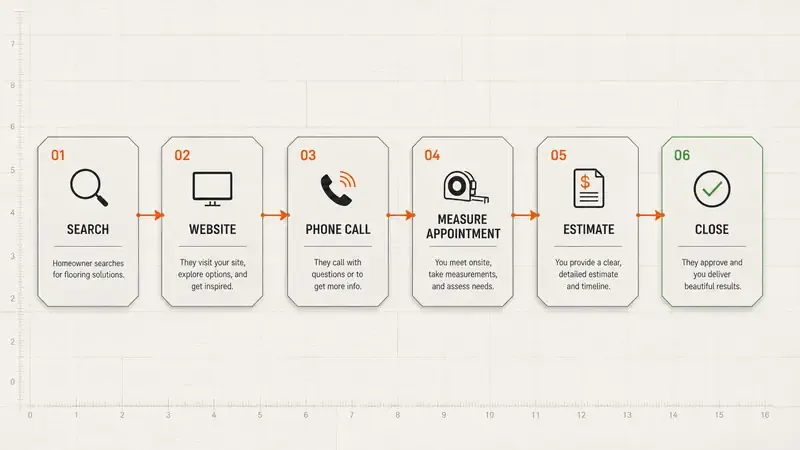
The funnel looks like this:
- Step 1: Meta ad (before/after creative by room type) → dedicated landing page
- Step 2: Landing page form (room type, sq ft estimate, material preference) → immediate SMS confirmation + outbound call
- Step 3: Measurement appointment booked — this is the conversion event, not the sale
- Step 4: At the appointment, samples are presented on-site; quote is delivered during or immediately after
- Step 5: Follow-up sequence for leads who didn't book or who went cold after booking
The measurement appointment is the event that matters. Once your team has been in the home, samples on the floor, quote in hand, your close rate should run 50–65%. That's where the job is won or lost — not on the ad, not on the landing page.
Tracking What Matters: Cost per Installed Square Foot of Revenue
Most flooring companies that run ads track cost per lead and stop there. Cost per lead is a useful warning light, but it doesn't tell you if the ads make money. A $35 lead that never books a measurement is worth less than a $90 lead that closes a $9,000 whole-home LVP install.
The number that tells you whether your marketing works is cost per signed contract — total ad spend divided by signed jobs, split by channel. Track ticket size by channel too. Meta leads for tile bathrooms might average $4,200 while whole-home LVP leads average $8,800. The same ad budget can look cheap or expensive depending on which jobs it's actually bringing in.
The attribution framework that works for flooring:
- Meta ads: track from ad click → form submit → appointment booked → signed contract → installed ticket value
- Google LSA / local search: separate pipeline, typically higher intent, lower volume
- Referrals: track in CRM as a separate source — you need to know their close rate vs. paid leads
- Builder/sub work: tracked separately, with margin flagged, so it doesn't inflate your paid channel numbers
With clean tracking, you can price your marketing per installed square foot: total ad spend ÷ total installed square feet from paid channels. Say you spend $3,500/month on Meta and install 4,200 square feet at an average of $6.50/sq ft — that's $27,300 in revenue, or $0.83 of marketing cost per installed foot. An 8:1 return on ad spend. Nobody argues with that number at the end of the month.
For a full breakdown of the CRM and lead tracking infrastructure that makes this attribution possible, see the CRM for contractors guide.
Related Articles.
Want this system installed for your trade?
See if your market is still open, then book a 20-30 minute install call. No contracts.