
Flooring Sales System: Book the Measure Before They Call Someone Else.
Flooring buyers contact 3–4 installers and hire the first one who responds professionally and shows up to measure. Here's how to build the system that wins that race consistently.
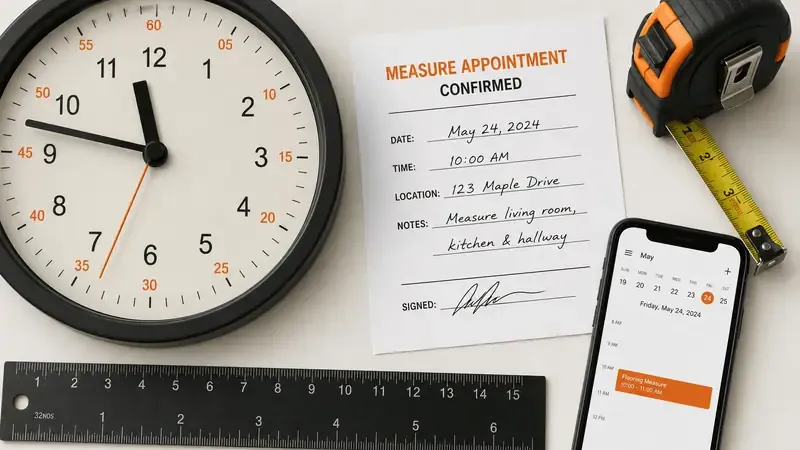
Flooring is one of the most fought-over trades in any local market. When a homeowner decides to replace their floors, they don't call one company and wait. They search, find three or four options, fill out contact forms, and see who answers first. The company that books the measure wins the job most of the time — not the company with the best email, not the one with the nicest website.
That stings if you believe the work speaks for itself. Quality matters. Reviews matter. Price matters. But none of it counts if you lose the race to book the measure. Once a homeowner has a measure on the calendar with Installer A, they're done shopping. They rarely cancel to keep looking. They sit through the measure, get the quote, and sign — unless Installer A gives them a reason not to. That reason almost never shows up.
The system below is built to win that race — and to present your company well enough that the homeowner stops looking. Those aren't two goals. They're one goal, executed at different steps.
The Flooring Buyer's Journey: A 72-Hour Decision Timeline
Most flooring projects are decided within 72 hours of the first search. Something kicks it off — a new home, a floor wrecked by a leak, a renovation already underway — and the homeowner goes from "someday" to "this week." Knowing what they do during those 72 hours tells you exactly where your system has to show up.
The lesson from this timeline is simple. Until the measure is booked, your pricing, your materials, and your installation quality don't matter — the homeowner never sees them. What wins is your response system. Speed and professionalism in the first hour decide whether you ever get to compete on anything else.
Google LSA and Local Search: How Flooring Contractors Dominate the Map Pack
Flooring searches are high-intent and geographically specific. "Flooring installation near me," "hardwood floor installation [city]," and "LVP flooring contractor [city]" are searches made by homeowners who have already decided to hire someone — they are just choosing who. Google Local Services Ads appear above every other result for these searches, with a Google Guaranteed badge that signals credibility before a homeowner has read a single review.
LSA performance in flooring is driven by three factors: review volume, review recency, and response time. A flooring company with 65 Google reviews and a median response time of 8 minutes will consistently outrank a company with 200 reviews and a 2-hour response pattern. Google measures and rewards the behaviors that homeowners reward — quick, professional responses from well-reviewed businesses.
The review-response-time flywheel works like this: fast response generates more booked measures, more booked measures generate more completed projects, more completed projects generate more review requests, more reviews push your LSA ranking higher, higher ranking generates more leads, more leads mean more booked measures. Every part of the system feeds every other part. The bottleneck that breaks the flywheel is slow response time — because a lead that doesn't convert into a booked measure generates no review and no revenue.
To compete on LSA in flooring, you need to be specific in your service and area listings. Your service list should include distinct entries for hardwood installation, LVP and luxury vinyl installation, tile installation, carpet installation, subfloor repair, and floor refinishing — these are separate search terms, and matching them directly increases LSA match rates. Your service area should list every zip code you actively serve, not just your headquarters city.
- Response time target: Under 10 minutes on LSA leads during business hours; under 5 minutes is the gold standard that separates top-ranked companies
- Review velocity target: 3–5 new Google reviews per month minimum; this recency signal is weighted heavily by the LSA algorithm
- Profile photos: 15+ project photos showing finished installs; update monthly with new project work
- Dispute rate: Respond to every lead in LSA — disputed or uncharged leads still affect your ranking if ignored
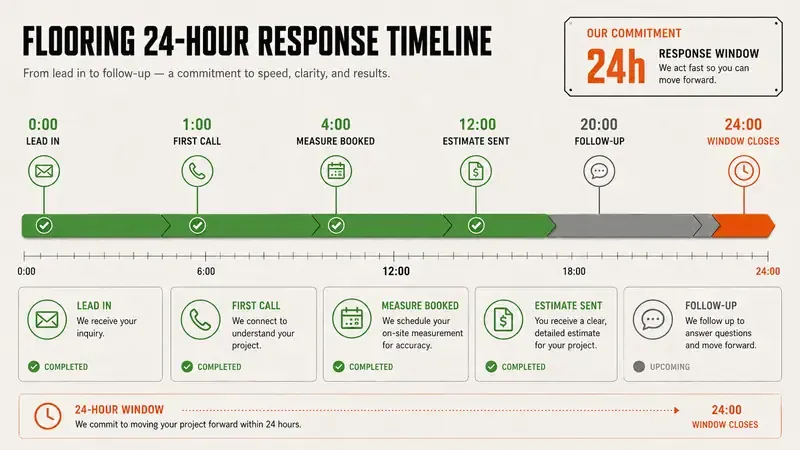
The Measure Appointment: Your Actual Conversion Event
Most flooring contractors treat the measure as a preliminary step before the real sales process begins. That's backwards. The measure is the close. The homeowner has invited you into their home. They're standing on the floor they want gone. Their excitement is at its peak. No other moment in the sales cycle gives you this much ground — and most contractors waste it by treating the measure as data collection instead of a sales call.
The measure that converts has a specific structure. First, the measurer (whether it's the owner, a salesperson, or a trained installer) walks the space with the homeowner and asks questions that deepen commitment: "What's your vision for how this space will feel?" "Are you doing this room only, or is the hallway on your list too?" "What's driving the timing — are you entertaining this summer?" These questions are not idle conversation. They build emotional investment in the project and surface adjacent work that expands the scope.
Second, material selection happens at the measure, not after. Arrive with samples, lookbooks, or a tablet with your product catalog. Walk the homeowner through the Good/Better/Best options for their stated project while you're standing on the floor you're about to replace. This is the moment when they're most engaged — use it. A homeowner who selects a material during the measure is vastly more likely to sign than one who is sent home with samples to "think about it."
Third — and this is the part that matters most — the quote goes out before the measurer leaves, or within 2 hours by text or email. Not "we'll get back to you in a few days." A same-day digital quote with a simple e-signature converts far better than a quote that lands 48–72 hours later. It reaches the homeowner while they're still excited. And it beats the other installers whose measures are coming later in the week.
The four elements that turn a measure into a signed contract before the homeowner's second installer arrives:
- Walk the space with questions that build emotional investment
- Present material options with physical samples or digital catalog during the visit
- Capture material selection before leaving — don't leave them with samples to "think about"
- Send digital quote same-day with e-signature and a clear expiration or incentive
Material Selection: How to Stop Losing Deals at the Sample Stage
One of the most common flooring lead loss patterns is not a pricing problem or a speed problem — it's a material selection problem. The homeowner gets overwhelmed. They're handed a stack of samples, told to pick what they like, and sent home to think about it. They go to three flooring showrooms and a big-box store. They Google LVP versus hardwood for two evenings. They lose confidence in their own taste. Eventually they stop responding to follow-up because the project has become stressful rather than exciting.
The solution is curated packages. Instead of presenting an infinite catalog of options, present three pre-curated packages per product category — Good, Better, Best. Each package specifies a product tier, a price per square foot installed, and a short description of the benefits and ideal use case. For a homeowner replacing floors in a family home with kids and pets, you present three LVP packages. For a homeowner doing a formal dining room in an older home, you present three engineered hardwood packages. You make the decision simple by eliminating irrelevant options.
The package structure also benefits your business. Curated packages pull homeowners toward higher-margin products because the "Better" and "Best" tiers are naturally more interesting when presented with context. A homeowner who would have defaulted to the lowest-cost option because they didn't know what differentiated the tiers will often self-select to the middle or top tier when the difference is explained clearly. Your average ticket increases without any additional pressure.
After the measure, if a homeowner needs more time on materials, the follow-up sequence should be tied to material selection rather than the quote. The sequence looks like this: Day 1 — digital lookbook with the three package options customized to their project emailed to them. Day 3 — follow-up text: "Were you able to look through the options? Happy to answer any questions or bring a few more samples by." Day 7 — follow-up call to discuss and close. The material selection is the obstacle; remove it specifically.
The Price-Shopper Problem: Why You Keep Losing to Lower Bids
Flooring contractors who lose on price consistently are almost always losing for a reason other than price. The actual problem is that they haven't given the homeowner a reason to pay more. When two installers both show up, measure the same space, and deliver similar-looking quotes with no differentiation in how they present themselves or their work, the homeowner defaults to price. That's a rational decision, not a loyalty problem.
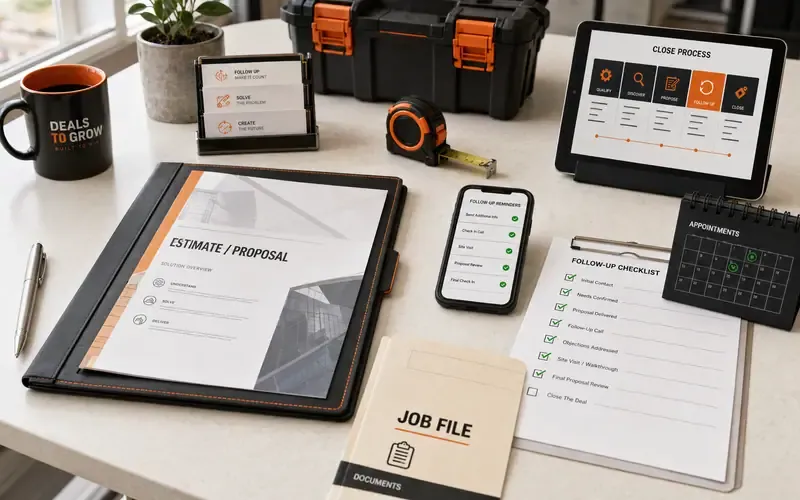
The estimate presentation is where price-shopping is prevented — not after the fact with discounting, but before the fact with positioning. Your quote should include four things that a price-shopping homeowner cannot easily compare across installers: a written quality guarantee (specific language, not boilerplate), a timeline guarantee with a completion date, your review score and review count prominently displayed, and a brief explanation of what's included in your installation that may not be included in a lower bid (subfloor prep, transition strips, furniture moving, disposal of old flooring).
When you make those four elements explicit, price comparison becomes harder. A homeowner comparing $4,200 (your quote) to $3,700 (the competitor) is now comparing guaranteed completion by a specific date and 87 Google reviews versus an unlabeled contractor who gave them a number. That's not an apples-to-apples comparison. Most homeowners, when they see it framed this way, will pay the $500 difference.
The other dimension of the price-shopper problem is follow-up timing. Contractors who lose price-shopping leads almost always lose them because they followed up too slowly. A lead that received your quote and then got a lower quote from a competitor three days later has already decided. The same lead, followed up within 4 hours of quote delivery with a personalized message from the person who measured — "Hi [Name], wanted to make sure the quote came through clearly. Happy to answer any questions or walk you through the scope if anything needs clarification" — converts at a significantly higher rate before a competitor quote even arrives.
Referrals in Flooring: Turning Every Install Into Three More
Flooring installers have a physical marketing advantage that most other contractors don't: neighbors see the work truck. When your crew is in front of a home for two or three days installing floors, every neighbor who walks or drives by knows work is being done. That visibility is a marketing asset — and most flooring contractors let it evaporate without taking any action.
The post-install referral ask should be a routine, not a thing you remember sometimes. At project completion, after the walkthrough and before the crew loads the truck, the project lead says directly to the homeowner: "We appreciate you trusting us with your floors. If any of your neighbors or friends are looking for flooring work, we'd love an introduction — and we'll send you a $150 gift card for any referral that turns into a job." Direct, specific, immediately actionable. Not "feel free to refer us," which results in zero referrals.
The door-hanger campaign for nearby homes is a tactic that works specifically well for flooring because the visual impact of a finished floor is appealing and the installation disruption is visible to neighbors. A simple door hanger dropped on the 10–15 nearest homes after every install: "We just finished a floor installation at [Street Address]. Here's what it looked like — and here's what we can do for your home." Include a before/after photo (with client permission), a QR code to your Google profile, and a "neighbor discount" offer. The conversion rate on these is low in absolute terms but the cost is minimal — design, print, and 15 minutes of crew time — and the leads that come from them are pre-qualified by proximity and social trust.
Before/after content from every project also serves a different purpose: neighborhood targeting on Meta. A before/after Reel showing a dated tile kitchen floor transformed into modern LVP, targeted at homeowners within 10 miles who are in the age and income demographic that buys flooring, is inexpensive and highly effective. Flooring is aspirational — people who see a beautiful finished floor and think "my floors look nothing like that" are your best audience. Every completed project is content. Use it.
Flooring buyers don't wait. They search, they contact a few companies, and they go with whoever books the measure first. If your response takes 6 hours, they already have a Wednesday measure scheduled with someone else.
The flooring sales system is not complicated. Five parts: a fast response that books the measure before anyone else calls back, a measure appointment that gets material picked and a quote delivered same-day, a Good/Better/Best menu that keeps homeowners from drowning in options, a quote that sells quality instead of racing to the lowest number, and a referral-and-content routine that turns every install into the next one. None of it takes a big technology budget. It takes doing the same things on every job — and deciding to win the race instead of hoping the homeowner circles back after shopping around.
Related Articles.
Want this system installed for your trade?
See if your market is still open, then book a 20-30 minute install call. No contracts.