
HVAC Company Marketing: Why Ads Fail in the Off-Season
Turning off your ads when the weather is mild doesn't save money — it builds a revenue rollercoaster. Here's the system for year-round HVAC marketing that fills both your emergency and planned-replacement pipelines.
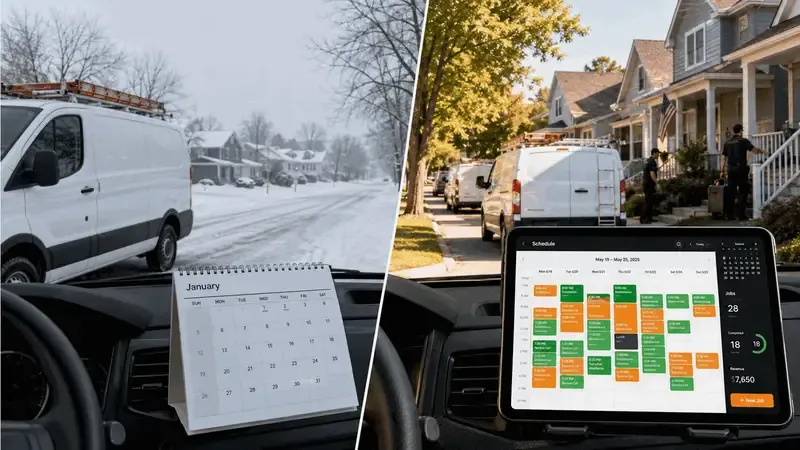
We talk to HVAC companies every month who pause their Google Ads in March and April, then scramble to ramp back up in June when the AC calls start flooding in. Same pattern in reverse at the end of summer: pull back in September, restart in December when the heat breaks. The logic seems sound — run ads when demand is highest. The result is a revenue rollercoaster that makes it nearly impossible to plan labor, hire technicians, or project cash flow.
The problem isn't the seasonality of emergency demand. The problem is that most HVAC companies are only running one type of campaign, aimed at one type of customer, with one urgency level. Here's what a complete year-round HVAC marketing system actually looks like.
The Seasonality Mistake: Only Running Ads When It's Hot
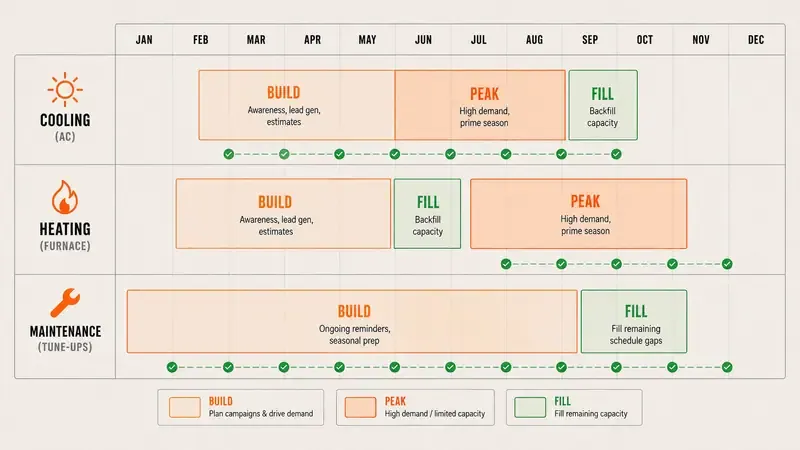
Emergency HVAC demand is genuinely seasonal. AC calls spike in June, July, and August. Heating calls spike in December and January. Those patterns are real and shouldn't be ignored — but they account for roughly 60% of your annual revenue opportunity. The other 40% is planned replacement demand, and it doesn't follow the same seasonal curve.
A homeowner with a 14-year-old system doesn't wait until it fails on a 98-degree August afternoon to think about replacement. They start thinking about it in February, research in March, and often pull the trigger in April or May before the busy season — when contractors are available and can sometimes offer better pricing. HVAC companies that shut off ads in spring are invisible during exactly the window when planned-replacement buyers are actively researching.
The compounding problem: when you turn ads off and then back on, you lose algorithm optimization history, spend weeks rebuilding campaign momentum, and pay higher CPLs during ramp-up than you would have with a consistent presence. The "savings" from pausing aren't real — you're just moving spending to a less efficient period.
Year-round HVAC marketing doesn't mean spending the same amount in February as you do in July. It means never going to zero, keeping your campaigns optimized, and adjusting budget allocation seasonally rather than running binary on/off cycles.
The Two HVAC Campaigns You Need Running Simultaneously
There is no single HVAC campaign that works for both emergency repair demand and planned replacement demand. These are different customers with different urgency levels, different decision timelines, and different emotional states. Treating them identically is why most HVAC ads feel generic and underperform.
Campaign 1: Emergency/Repair (Google LSA + Google Search)
A homeowner whose AC failed at 9pm on a Tuesday is not browsing Facebook. They're on Google, searching "AC repair near me" or "HVAC emergency." Local Service Ads and Google Search are the right channels for this customer. Creative should be high-urgency: "Same-Day AC Repair," "Emergency HVAC Service," "Available Now." Your offer needs to include explicit availability — 24/7 service, same-day response. This campaign requires a 24/7 answering capability. If someone calls at midnight and gets voicemail, they call the next company on the list.
Campaign 2: Planned Replacement (Meta/Facebook)
Homeowners on Meta are in discovery mode, not emergency mode. The planned-replacement campaign targets homeowners whose systems are 10+ years old, using age-based creative ("If your HVAC system is 10 or older, read this"), financing angles (often $0 down), and seasonal reminder hooks ("Beat the summer rush — replace before June"). This campaign should run year-round with higher budget in late winter/early spring, when purchase intent peaks among the replacement-ready segment. Lead gen ads with a short form work well — keep the ask minimal (name, phone, rough system age) and qualify during the follow-up call.
These two campaigns are not interchangeable. Keep the budgets, creatives, landing pages, and conversion goals separate, and track performance independently. A lead from an emergency campaign needs a same-day callback. A lead from a replacement campaign can go into a longer nurture sequence.
Maintenance Plan Attach Rate: The Hidden Revenue Multiplier
Most HVAC companies have a maintenance plan — spring/fall tune-up visits for a recurring annual or monthly fee. Most also have a 5–10% attach rate, meaning roughly 9 out of 10 service calls end without a maintenance plan sale. That's not a product problem. It's a process problem.
Companies that run deliberate maintenance plan attach funnels hit 40–60% attach rates. The difference isn't the pitch — it's the system. Maintenance plan conversions happen at three moments: at the point of service (the technician makes a specific offer), in the follow-up email/SMS within 24 hours of a service visit, and in a dedicated reactivation sequence for past customers who've never been asked.
The math on maintenance plan attach rate is compelling. At 200 service calls per month with a $200/year plan, moving from 10% to 40% attach rate is the difference between $40,000 and $160,000 in annual recurring revenue — from the same call volume. That recurring revenue is what stabilizes cash flow through the slow months, covering technician salaries and overhead while emergency call volume dips.
From a marketing standpoint, maintenance plan members are also your highest-value replacement leads. When their system fails or ages out, they call you first. The retention economics alone justify building the attach system — the replacement lead pipeline is the bonus.
LSA for HVAC Done Right
HVAC is one of the most competitive LSA categories in most U.S. markets. In major metros, a dozen or more verified HVAC companies are competing for the same few visible slots. Understanding what actually drives LSA ranking is essential before you invest significant budget.
The primary ranking factor in HVAC LSA is review velocity — not just total reviews, but how recently they were received. A company with 180 reviews and 20 in the last 90 days will consistently outrank a company with 400 reviews and 2 in the last 90 days. Building a post-service review request system (automated SMS within 1 hour of job close) is the single highest-ROI activity for improving LSA position.
Realistic cost-per-lead expectations for HVAC LSA range from $35–90 depending on market size, competition density, and your current review standing. New LSA profiles take 60–90 days to accumulate the review history needed for competitive positioning. Don't evaluate LSA performance in the first 30 days — the ranking hasn't stabilized yet.
Fraudulent lead disputes are a real issue in HVAC LSA. Google's dispute process credits back leads that clearly don't match your service type (wrong geography, wrong service, disconnected numbers). Disputing bad leads consistently keeps your per-lead costs honest and signals to Google's algorithm that your campaign is well-managed. Assign someone to review and dispute leads weekly — it's a 20-minute task that meaningfully affects cost efficiency over time.
Response Time in HVAC: The Emergency Advantage
No other home service trade is as time-sensitive as HVAC emergencies. A homeowner with a broken AC in August is not doing comparison research. They are calling companies one at a time until someone answers. The first HVAC company to answer a live call — or respond to a form within a few minutes — wins the job the majority of the time.
HVAC contractors who respond to emergency inquiries within 5 minutes win approximately 78% of emergency bookings. Response time is the single largest variable in emergency job capture rate — more than price, reviews, or brand recognition.
An AI receptionist that answers calls in under 12 seconds, 24 hours a day, is the most direct investment an HVAC company can make in emergency revenue. During peak summer months, this single capability can be worth 15–25 additional booked jobs per month from the same ad spend.
The infrastructure for HVAC emergency response needs three components: an AI receptionist that answers every call in under 12 seconds (no hold time, no voicemail), an automated SMS that fires within 30 seconds of a form submission confirming receipt and providing a callback number, and a 15-minute outbound call attempt to any form submitter who hasn't already been reached. After 15 minutes on a summer emergency, the probability of booking drops significantly.
For planned replacement leads, the urgency is lower but the economics of fast response still apply. A homeowner who submitted a form comparing three HVAC companies will form a strong impression of each based on how quickly and professionally they followed up. Being first with a professional response — even for a non-emergency — anchors the relationship and often shortcircuits the comparison process entirely.
The HVAC companies hitting $3M–5M+ in annual revenue consistently share one operational characteristic: they never miss an inbound inquiry. Every call is answered. Every form gets a response within minutes. The marketing system is designed around that guarantee, not as an afterthought to the ad campaign.
Related Articles.
Want this system installed for your trade?
See if your market is still open, then book a 20-30 minute install call. No contracts.