
Landscaping Lead Generation: Year-Round Pipeline Strategy
Landscaping companies that go quiet in winter are competing from behind every spring. Here's how to build a pipeline system that generates bookings year-round — not just when the ground thaws.
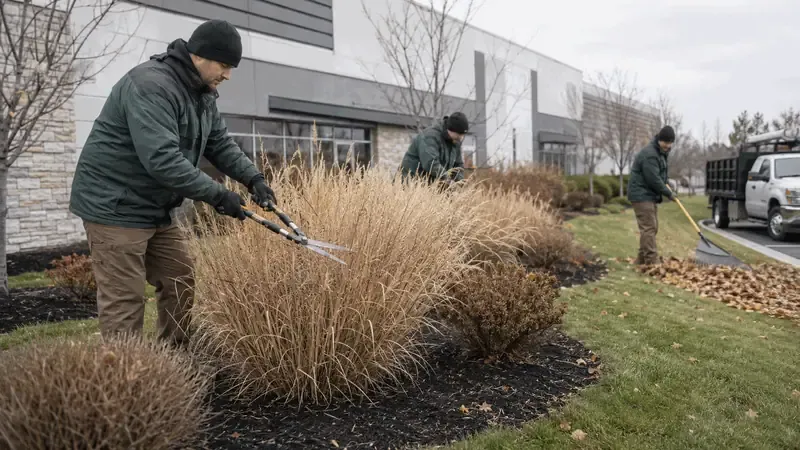
Most landscaping companies run the same way. Spring hits, the phone rings, the crews stay slammed through summer. Fall brings a second rush of cleanup work. Then winter arrives and everything stops. They call it seasonality — as if the cycle were a law of nature instead of a choice.
The operators who break the pattern aren't doing anything exotic. They market year-round instead of only when it's already warm. They turn one-time install clients into monthly maintenance clients. And they use the slow months to fill the busy months instead of waiting for the busy months to show up. Here's how each piece works.
The Feast-or-Famine Cycle: Why Most Landscapers Live Quarter to Quarter
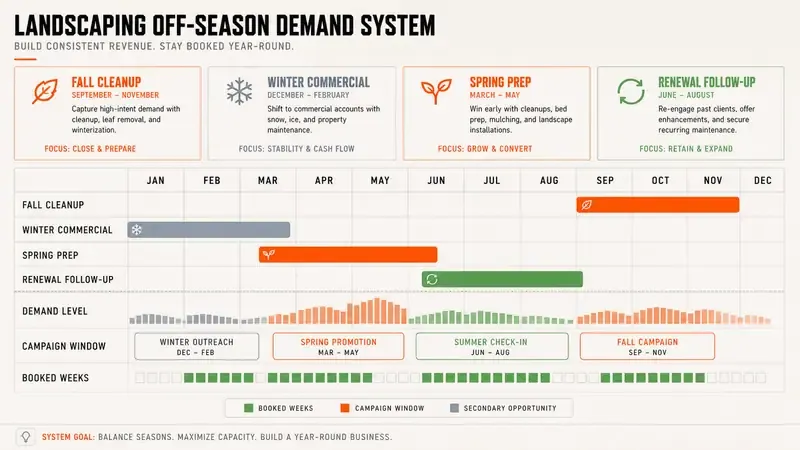
Every landscaper knows the revenue curve. A spring rush from March through June when install demand peaks. A summer plateau where maintenance work carries the load but new bookings slow down. A fall surge for cleanup and prep. Then a December-through-February dead zone where you wait for the phone to ring.
The cycle is predictable — but nature doesn't cause it. Your marketing does. When the phone rings in spring, you don't market because you don't have to. When summer slows, you start thinking about it. When fall picks up, you stop again. By the time winter hits and the calendar is empty, it's too late. The homeowners who wanted spring installs already booked with the companies that reached them in February.
The companies with year-round pipelines do one thing differently: they never stop marketing. The message changes with the season — spring availability in February, fall cleanup packages in August, early-bird spring bookings in November — but the engine never shuts off. Spring revenue stops being a hope and becomes a schedule.
There's a second piece to the feast-or-famine problem: job mix. A company that only does one-time installs starts every month at zero. A company that has converted 25–30% of its install clients into monthly maintenance retainers starts every month with cash already booked. That recurring base is what keeps the trucks running and the crews paid when install work dips.
Google LSA for Landscapers: Local Intent, Local Dominance
When a homeowner types "landscaping company near me" or "landscape design [city]" into Google, they're ready to hire. They're not browsing for ideas — they're picking a company. They'll call two or three in the next 30 minutes. Google Local Services Ads (LSA) put your business at the very top of those results, above paid search and above organic listings, with a "Google Screened" or "Google Guaranteed" badge next to your name.
Landscaping searches spike hard from March through May in most markets, with a second bump in September and October. The companies that own LSA during those peaks grab the ready-to-hire homeowners right when demand is highest. There is no higher-intent traffic in the landscaping category.
Three things drive LSA rankings: review volume, review recency, and response time. A company with 80 Google reviews that answers leads within 5 minutes will outrank a company with 200 reviews and slow callbacks. Winning at LSA isn't about outspending anyone — it's about stacking fresh reviews and answering the phone fast.
Your Google My Business profile is the foundation that supports LSA performance. Key optimization steps:
- Service areas: List every zip code you actively serve — LSA uses this to match you with local searches
- Services list: Be specific — "landscape design," "sod installation," "retaining walls," "seasonal cleanup," "mulch installation" each as separate services
- Photos: 20+ project photos minimum; update with new project photos monthly
- Review request automation: Trigger a review request SMS to every completed job within 24 hours of invoice; this is the fastest way to build the review velocity that LSA rewards
Spring Booking Campaigns: Starting the Season in February
Here's the part most landscapers get backwards: the spring campaign launches in February, not March. By the time spring actually arrives and homeowners start calling everyone at once, the companies that started in February already have their spring calendar 60–70% full. They book the last slots from scarcity — "our last few spring install slots" — which beats "call us anytime" every time.
The February campaign has two parts. First, Google and Meta ads aimed at homeowners in your service area with a specific spring message. Not "we do landscaping." This: "We're booking spring landscape installs for March–May. Limited slots — get your free design consultation before the schedule fills."
Second, a push to your own client list. Past install clients are the warmest audience you have. A February email or text to every client from the last three years — "We're building our spring schedule. If you have a project in mind this year, now is the time to lock in your slot" — pulls in homeowners who were going to call you in April anyway. You just moved that call up by 6–8 weeks.
The early-bird offer that works best in landscaping is deposit-to-hold: a locked-in rate for homeowners who put down a deposit before a set date. It turns interest into commitment early, fills the schedule, and kills the spring scramble. It also separates the tire-kickers from the homeowners ready to move — which protects your estimator's time.
Maintenance Retainer Upsells: The Recurring Revenue Play
A one-time install client pays you once. A maintenance retainer client pays you every month, refers neighbors more often because they see your truck on the street every week, and rarely shops your competitors — canceling a maintenance relationship takes effort, while simply not re-booking an install takes none.
Run the math on a retainer client versus a one-time install:
A one-time install client with a $5,000 project is worth $5,000 — unless they come back. A maintenance client at $350/month is worth $4,200 a year, and at a typical 3-year retention, $12,600 from the same relationship. Convert 25% of your install clients into retainers and the whole business runs on different math.
The upsell doesn't need a separate sales process. It needs the right moment — and a package ready to present.
The best moment to offer a retainer is the day the install wraps. The crew finishes, the client walks the yard with your project manager and loves it, and the PM says: "Glad you love it — we have a seasonal maintenance program to keep it looking this way. Want the details?" The client just watched your quality go in. That pitch lands ten times easier than a cold call in January.
Package the maintenance offer in three tiers so the decision is simple:
- Essential: Monthly mowing and edging + spring/fall cleanup — $199–$299/month
- Standard: Essential + monthly mulch refresh + bed maintenance — $349–$449/month
- Premium: Standard + seasonal color rotations + fertilization program — $549–$699/month
Tiers change the question from "should I sign up?" to "which one?" The middle tier typically takes 50–60% of sign-ups. Present it as your recommendation and let the client move up or down from there.
The Winter Nurture: How to Fill the Spring Calendar During December
December through February is the window that separates the landscapers with fully booked springs from the ones who scramble every year. The first group isn't taking winter off. They're marketing to the homeowners who will make landscaping decisions in 60–90 days.
The winter nurture has three parts. First, a monthly email to your entire past client list — not a sales pitch, content. Design ideas for spring projects. Before-and-after showcases from last year. A piece on what's coming in outdoor living next season. The goal is simple: when a homeowner starts thinking about spring projects in January, your company is the first name in their head.
Second, a direct early-bird offer for past clients and subscribers: "Book your spring project before February 15th and we'll lock in this year's pricing with a 5% early-booking discount." This turns the warm audience your emails built into actual bookings. Send it mid-January — early enough to beat the rush, late enough that spring is on their mind.
Third, a December referral push to your maintenance retainer clients. They're your most loyal clients and your best referral source. A holiday offer — "Refer a neighbor, get one month of maintenance free" — rides on the goodwill of a strong relationship and on neighborhoods where your trucks are already parked every week. Referrals from retainer clients tend to become retainer clients themselves, and the recurring base compounds.
The landscapers with 70–80% of their spring calendar full before March 1st didn't get lucky. They ran the winter sequence, made early-bird offers to their own list, and stayed visible while their competitors went dark. The spring rush pays a lot better when you're not filling it from scratch.
Related Articles.
Want this system installed for your trade?
See if your market is still open, then book a 20-30 minute install call. No contracts.