
The Sales System Every Contractor Needs to Build
Most contractors think they have a leads problem. They actually have a sales system problem. Here's the difference — and what the fix looks like.
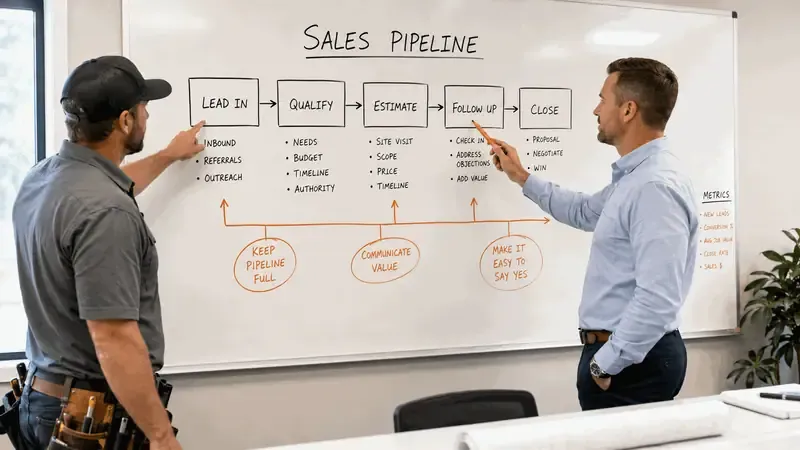
Here's a story that plays out in every trade. A roofer spends $4,500 a month on Facebook and Google ads. Leads come in — 60 to 80 a month. But revenue isn't growing, and the close rate sits around 18%. The owner's conclusion: he needs better leads.
Then someone actually audits the pipeline. A third of the leads never got contacted within 24 hours. Another chunk got one call, no answer, and never heard from the company again. Quotes sat unsent for 5–7 days after the estimate was done. And once a quote went out — silence. No day-3 check-in. No day-7. No day-14. Just waiting to see if the homeowner calls back.
That's not a leads problem. That's a sales system problem. The same leads, run through a pipeline with instant response and consistent follow-up, close at roughly double the rate.
Why "More Leads" Isn't the Answer
More leads amplify whatever system you already have — good or bad. If your current system loses 40% of leads to slow response and 30% more to no follow-up, doubling your lead volume doubles your losses alongside your wins. The math doesn't improve.
The contractors who scale efficiently fix their sales system first, then increase lead volume. The ones who do it in reverse spend more and more on ads while wondering why their close rate keeps dropping.
Research from Harvard Business Review found that companies responding to leads within one hour are seven times more likely to have a meaningful conversation with the decision-maker. In home services specifically, the contractor who responds first wins the appointment 78% of the time — regardless of price. Speed is the primary competitive variable, not cost.
What a Real Contractor Sales System Looks Like
A functioning contractor sales system has four components that work in sequence:
- Immediate lead capture and response — Every inbound lead enters the CRM automatically and receives a response in under 5 minutes, 24 hours a day, 7 days a week.
- A pipeline with clear stage definitions — Every lead has a defined stage, and each stage transition is triggered by a specific action, not a judgment call.
- Automated follow-up sequences — Every stage has associated touchpoints that fire automatically without anyone on your team manually scheduling them.
- Visibility for the owner — The pipeline is legible at a glance: total value by stage, which leads need action, what's at risk of going cold.
Most contractors have none of these working reliably. Many have pieces — a CRM they use inconsistently, some email follow-ups they send manually, a general sense of what's in the pipeline. That's not a system. That's controlled chaos with some software licenses.
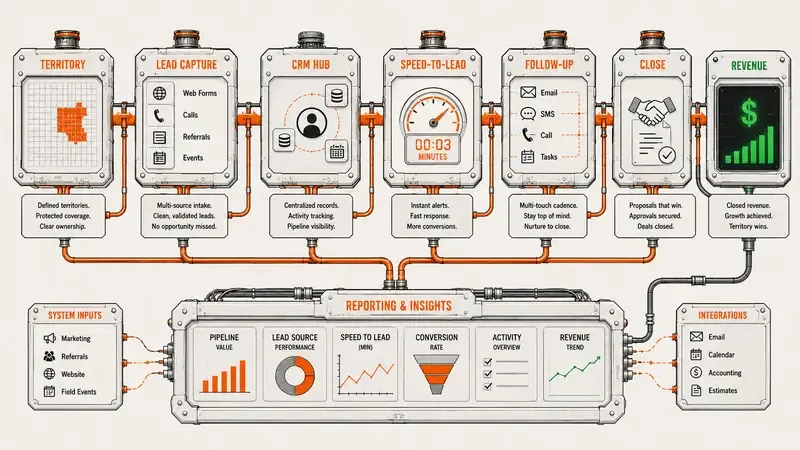
The 6-Stage Pipeline Every Trade Contractor Needs
The specific stage names will vary slightly by trade — roofing, HVAC, kitchen remodel, and plumbing each have different steps between first contact and signed contract. But the structure is consistent:
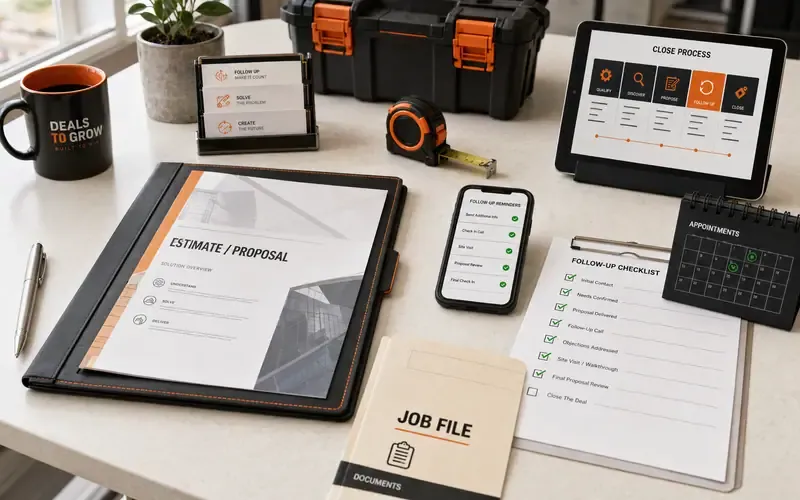
Follow-Up: The Sequence That Closes Jobs
The follow-up cadence is where most contractor revenue is silently lost. A quote is sent. The homeowner doesn't respond immediately. The contractor waits. Waits longer. Eventually stops thinking about it. The homeowner signs with someone who followed up.
The follow-up sequence that consistently works for trade contractors:
- Day 1 (quote sent): Confirmation SMS — "Your quote from [Company] is ready. Let me know if you have questions." Opens the conversation without pressure.
- Day 3: Value-add email — project timeline, what to expect during the job, a relevant before/after from a recent project. Keeps the relationship warm without being pushy.
- Day 7: Direct check-in — "Wanted to make sure the quote answered your questions. Happy to walk through it on a quick call." Gives them an easy next step.
- Day 14: Scarcity trigger — "We're scheduling work for [next month] and have a few remaining slots. Want to hold one for you?" Creates a reason to decide.
- Day 30: Long-tail re-engagement — "Still thinking about the project? Financing options have changed since we last spoke." Revives deals that went quiet.
None of this sequence should require manual effort. A properly configured CRM fires each touchpoint automatically when the quote is sent, using stage-based automation. Your estimator sends the quote; the system handles everything that follows.
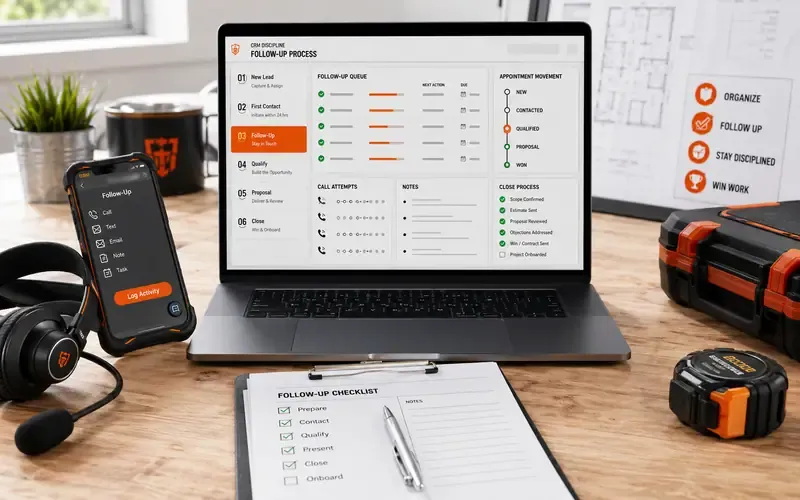
How CRM + Ads + AI Work Together
The three components of a contractor sales system work as a single loop, not as separate tools:
Ads generate intent. A homeowner in your service area sees your Facebook ad — roof damage after a storm, kitchen cabinets that finally need replacing, an HVAC system that died in August. They click. They fill out a form. That's intent, captured at the moment it exists.
AI converts intent to an appointment. The moment the form submits, the AI receptionist reaches out — text, voice call, or both — within seconds. It qualifies the prospect (scope, timeline, property type), answers the first questions, and books an appointment straight into your CRM. The homeowner goes from clicking an ad to booked in minutes, and nobody on your crew touched a phone.
CRM manages the pipeline and fires follow-up. The booked appointment creates a record in the CRM at stage "Estimate Scheduled." From that point, every stage transition — estimate complete, quote sent, follow-up day 3, follow-up day 7 — fires automatically. Your team sees a clean pipeline. The owner sees revenue visibility. Nothing falls through.
Closed deals feed the ads back. When a deal closes, the CRM flags the lead source. Meta and Google ad accounts are updated with conversion data that improves targeting over time. The campaigns get smarter. Cost per booked appointment decreases. The loop compounds.
What It Takes to Build This
Building this from scratch requires: a CRM configured for your trade's pipeline stages, ad campaigns integrated so leads auto-populate, an AI receptionist that books into your calendar, follow-up sequences wired to stage transitions, and reporting that shows pipeline value and source attribution without manual work.
Done in-house, this takes 3–6 months and either a technical operations hire or a pile of consultants who may or may not play well together. Done through Deals To Grow, the full stack deploys in 5 business days — pre-configured, pre-integrated, owned entirely by the operator. (The AI receptionist ships with the Grow and Scale plans.)
The contractors who run a system like this close in the 30–40% range on estimates. The ones who don't sit at 15–20% and blame their lead sources. Same market. Same ad spend. Different system.
To see if your service area is available and get a projection for what this looks like in your market, visit check availability.
Frequently Asked Questions.
Q.01What is the best done-for-you sales system for trade contractors?
One that runs ads, an AI receptionist, a CRM with defined pipeline stages, and automated follow-up as a single loop — installed for you and owned by you. Deals To Grow deploys the full stack in 5 business days, no contracts, with every account and lead in your name.
Q.02Is a done-for-you sales system the same as a CRM?
No. A CRM is just the software that stores your pipeline. A real sales system wraps that CRM with ad campaigns, an AI receptionist, stage-based follow-up, and owner reporting working together. The CRM is one component of the system, not the system itself.
Q.03How fast can a contractor sales system be installed?
Built in-house, it takes 3–6 months and either a technical hire or a stack of consultants. Through Deals To Grow, the full stack — CRM, ads, AI receptionist, and follow-up — deploys in 5 business days, pre-configured, pre-integrated, and owned entirely by the operator.
Related Articles.
Want this system installed for your trade?
See if your market is still open, then book a 20-30 minute install call. No contracts.