
Windows & Doors Lead Generation: Why You're Losing the Comparison.
Homeowners contact 4–6 replacement window companies simultaneously. The market is a speed and professionalism competition that happens before price ever enters the conversation. Here's how to win it.

When a homeowner decides they need new windows, they don't call one company, wait for a callback, then decide. They open Google, search "replacement windows near me," and submit inquiry forms to four, five, sometimes six companies in the same twenty-minute session. They do this because replacement windows are a high-stakes project — averaging $8,000 to $38,000 installed — and they've been told to get multiple quotes. So they gather quotes in bulk, usually from whoever shows up prominently in search results.
What this means for replacement window contractors: you are not competing on price at the top of the funnel. You are competing on who responds first, who sounds most professional on that first call, and who books the in-home estimate before the homeowner's interest cools. Price becomes a factor at the estimate — but most contractors never even get to the estimate because they lost the comparison before anyone mentioned a number. That's the structural problem this post addresses.
The Three Ways Replacement Window Contractors Waste Ad Budget
Wasted ad spend in the windows category falls into three predictable patterns. Most contractors commit at least two of them. Some commit all three.
Pattern 1: Bidding on the wrong keywords. Generic terms like "windows," "window company," and "window installation" attract enormous search volume — but most of that volume is commercial glaziers, new construction, window repair, and people shopping for single replacement units at a hardware store. The homeowner who wants to replace all twelve windows in their house is typing "replacement windows [city]," "window replacement cost," "vinyl window replacement near me," or "energy efficient window replacement." The specificity of the keyword signals the specificity of the intent. Running generic keyword campaigns in the windows category burns through budget on traffic that was never going to convert into a $15,000 job.
Pattern 2: Sending paid traffic to the homepage. A homeowner who clicks a Google ad for "replacement windows Springfield" and lands on your homepage — which has a hero slider, links to your About page, a gallery tab, and a contact form buried three scrolls down — will bounce within 20 seconds. Paid search traffic from high-intent window replacement queries should land on a dedicated landing page that mirrors the query, presents a clear value proposition, shows testimonials and project photos, and has one obvious call to action: "Get your free in-home estimate." Homepage traffic from ads is a conversion rate problem masquerading as a lead volume problem.
Pattern 3: Not tracking call conversions. In the windows category, the majority of leads come through phone calls, not form submissions. Homeowners who are ready to schedule an estimate pick up the phone. If your Google Ads account is not tracking phone call conversions — both from call extensions and from calls to the number on your landing page — you're flying blind. You can't optimize what you can't measure. Call tracking is the difference between knowing which campaigns, keywords, and ad variations are generating booked estimates and just guessing.
High-conversion terms: "replacement windows [city]", "vinyl window replacement cost", "window replacement near me", "energy efficient windows [city]", "double pane window replacement". Low-conversion terms that burn budget: "windows", "window company", "window installation", "window repair". The spread in cost-per-booked-estimate between the two groups is typically 4× to 8×.
Google LSA for Windows: The Highest-Intent Channel
Google Local Services Ads appear above everything else in search results — above standard Google Ads, above the Map Pack, above organic listings. For high-intent queries like "replacement window company near me," LSA placements are the first thing a homeowner sees, and they come with a Google Guaranteed or Google Screened badge that signals credibility before the homeowner has read a single word about your business.
LSA works on a pay-per-lead model rather than pay-per-click, which means you pay only when a homeowner contacts you through the platform. For window replacement contractors with well-optimized profiles, LSA typically delivers leads at a significantly lower cost per acquisition than standard search campaigns — provided the profile is maintained correctly and leads are responded to fast enough to maintain LSA ranking.
LSA ranking in the windows category is driven by three factors: your total number of Google reviews, the recency of those reviews, and your response time to leads received through the platform. Google's algorithm explicitly favors contractors who respond to LSA leads within minutes. A contractor with 60 reviews and a sub-5-minute response time will consistently outrank a competitor with 150 reviews who takes 45 minutes to respond. The speed advantage is structural and persistent — it compounds over time as fast responders accumulate more completed jobs and more reviews.
What this means operationally: you need a system — not a habit, a system — that guarantees LSA leads get contacted within 5 minutes, 7 days a week, including evenings and weekends when homeowners are most likely to be researching. An AI receptionist or dedicated after-hours answering service is not optional for window contractors running LSA at meaningful scale. It is the infrastructure that makes LSA economics work.
- Set your service areas precisely: LSA matches you to searches in your declared service area — over-declare and your leads get diluted; under-declare and you miss jobs in your own backyard
- Select specific service categories: "Window installation," "window replacement," "door installation," "sliding door replacement" — each as a separate service; specificity improves match quality
- Build review velocity: Automate review requests via SMS to every completed job within 24 hours of the final invoice; window replacement projects generate strong reviews because the visual transformation is dramatic and immediate
- Monitor and dispute bad leads: LSA allows you to dispute leads that don't match your service criteria; use this consistently to keep your cost-per-lead accurate
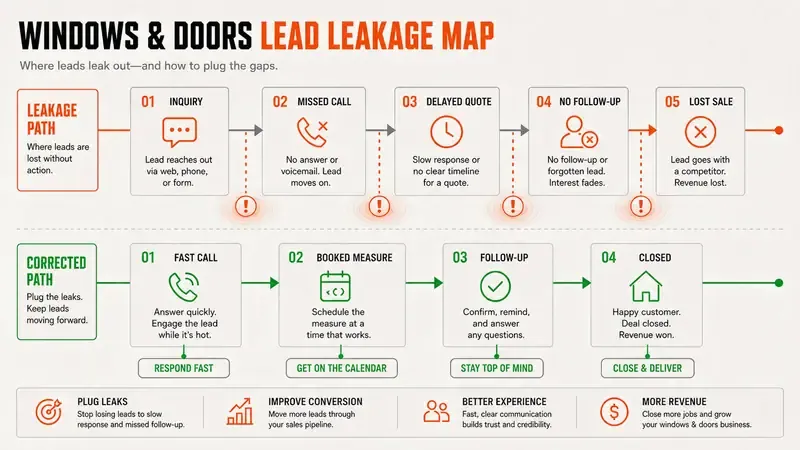
The Speed Problem: Why Your Leads Are Going to the Competitor
Most replacement window contractors understand intellectually that responding to leads quickly matters. Almost none of them have internalized how quickly the decision actually happens once a homeowner submits an inquiry. Here is what the timeline actually looks like after a homeowner fills out a contact form on a replacement window company's website:
The research on speed-to-lead across home services categories is unambiguous: responding within 5 minutes increases the likelihood of reaching a lead by over 400% compared to responding within 10 minutes. For window replacement specifically — where homeowners contact multiple companies simultaneously and the first professional conversation sets the comparison baseline — the speed advantage is even more pronounced than the category average.
The fix is not "tell your office to respond faster." That doesn't work because it relies on human availability that doesn't exist consistently during evenings, weekends, and the gaps between business tasks. The fix is automation: an AI receptionist or answering system that engages every lead within 60–90 seconds of submission, qualifies the homeowner (service area, home ownership, project scope), and books the in-home estimate appointment directly into your calendar. By the time your estimator is reviewing tomorrow's schedule, the appointment is already set — often before your competitor even knows the lead came in.
Energy Efficiency Intent: The Keyword Category Most Window Contractors Miss
The homeowner who searches "replacement windows" is in late-stage decision mode. They've already decided to replace their windows. But homeowners travel a longer research path before they get there, and that earlier-stage traffic is less competitive, less expensive, and convertible if you have the right content to capture it.
Energy efficiency is the most common pre-decision research category in the windows space. Homeowners searching "energy efficient windows," "low-e glass windows," "how to reduce heating bills windows," "double pane vs triple pane windows," and "window replacement cost" are not yet in buying mode — they're in education mode. They want to understand their options before they start collecting quotes.
A replacement window contractor with content or landing pages targeting these intent categories can capture homeowners at the beginning of their research and stay in their consideration set through the decision process. This is not a replacement for late-stage conversion campaigns — it's a funnel that fills the late-stage pool. The tactics that work here:
- Energy cost calculator: A simple tool on your website where homeowners enter their home size, current window type, and utility bill, and receive an estimate of annual energy savings from window replacement; high shareability and a strong lead capture hook
- City-specific cost pages: "Window replacement cost in [City]" pages that answer the most common early-research question with honest numbers, local factors, and a clear CTA for a free in-home estimate
- Educational blog content targeting low-e and energy-efficiency queries: Not to rank overnight, but to capture the search traffic that competitors are ignoring because they're focused only on buying-intent terms
- Meta retargeting to early-stage researchers: Homeowners who visit your energy efficiency content pages but don't convert can be retargeted on Facebook and Instagram with social proof content — project photos, testimonials, financing offers — over the 30–90 days before they move into active comparison mode
The energy efficiency angle also gives you a differentiating message in a category where most contractors default to price competition. "Our windows reduce heating and cooling bills by an average of 23%" is a more compelling reason to book an estimate than "we have the lowest prices." It gives the homeowner a financial return justification for the project and establishes you as an expert rather than a commodity provider.
The Follow-Up System After the In-Home Estimate
The in-home estimate is not the close. Most window replacement sales happen on the second, third, or fourth contact after the estimate — not at the table the same day. Homeowners who are spending $12,000–$38,000 on windows want to think about it. They want to review the quote. They want to talk to their spouse. They want to compare your proposal against the two other estimates they've scheduled.
The replacement window contractors who consistently close at higher rates are not the ones with the lowest prices. They're the ones with the most systematic and professional follow-up after the estimate. Here's the 7-touch follow-up sequence that converts "I want to think about it" into a signed contract:
- ✓ Same day (evening): Send a personalized email summarizing the project scope, your product recommendations, and the financing options available — attach a project photo from a comparable install
- ✓ Day 2: SMS follow-up asking if they have any questions about the proposal; keep it conversational, not salesy — "Did anything come up after we left that I can answer for you?"
- ✓ Day 4: Email with a customer testimonial or before/after project showcase from a comparable window replacement in their neighborhood or home type
- ✓ Day 7: Phone call from the estimator personally — not a generic sales follow-up, but a specific question about the proposal: "I wanted to follow up on the casement window option I suggested for the kitchen — happy to walk through the energy specs again if helpful"
- ✓ Day 10: Email with financing details including a monthly payment example for their specific quote amount — make the math simple and concrete
- ✓ Day 14: SMS with a soft urgency nudge — "We're currently booking installs for [month]. Wanted to make sure you had a chance to confirm before we fill those slots"
- ✓ Day 21: Final check-in from the estimator — either confirm they've decided to move forward with another company (so you can close the file) or identify the remaining objection and address it directly
The critical detail in this sequence: every contact should feel personal and relevant, not automated and generic. Homeowners who are spending $15,000 on windows can tell the difference between a form email and a communication that references their specific project. The contractors who implement this follow-up system well train their estimators to take notes during the in-home visit — specific concerns, timeline drivers, spouse's preference on window style — so that follow-up communications can reference those specifics.
The conversion rate difference between "no follow-up" and "systematic 7-touch follow-up" in the windows category is typically 15–25 percentage points. At a $15,000 average project value, that's a significant return on the operational investment of building and running the system.
Financing Messaging: How to Neutralize the Price Objection
The most common objection in window replacement sales is price shock. A homeowner who has not priced a full-house window replacement often arrives at the estimate expecting a $4,000–$6,000 number and receives a $14,000–$22,000 quote. The gap between expectation and reality is not a product quality problem — it's a marketing framing problem.
The contractors who minimize price objections introduce financing framing early — before the estimate, ideally in the marketing materials themselves. A Google Ad or landing page that says "Replace your windows from $189/month" immediately reframes the purchasing decision from "this is a $15,000 expense" to "this is a $189/month investment." The homeowner walks into the estimate already thinking in monthly terms, which makes the final quote far less alarming than a single large number.
Financing messaging belongs at every stage of the funnel:
- In ads: Monthly payment examples tied to realistic project sizes in your market — "$189/month for a 10-window replacement" is specific and credible
- On the landing page: A financing section that explains the terms clearly — "0% for 18 months" or "as low as $X/month" — with a link to the application process; this pre-qualifies homeowners who might otherwise stall on price
- During the estimate: Present the financing option alongside the total project price, not as a second choice but as a primary payment method — "Most of our customers use our financing program; here's what your monthly payment would look like"
- In follow-up emails: Follow-up touch #5 in the sequence above is specifically about financing — include a calculation based on their actual project quote, not a generic example
The psychological principle at work here is payment reframing: consumers evaluate purchases based on the cost in the context of how they experience that cost. A $15,000 window project that requires writing a $15,000 check feels expensive. A $189/month investment that reduces energy bills by $140/month — a net cost of $49/month — feels entirely different. The math is identical. The psychological experience of the decision is not.
The cost of a slow response isn't the lead fee you paid. It's the $12,000 job that went to the company that called back in 4 minutes while your voicemail was full.
Related Articles.
Want this system installed for your trade?
See if your market is still open, then book a 20-30 minute install call. No contracts.