
Bathroom Remodel Marketing: Closing the Consultation Gap.
Bath remodel contractors lose more jobs between consultation request and signed contract than anywhere else in the funnel. Here's how to fix the conversion gap with a system that stays present and compelling throughout the 21–45 day decision window.

Bath remodel contractors tend to have a lead problem that isn't actually a lead problem. The inquiries are coming in. Consultations are being scheduled. Estimates are going out. And then — nothing. The homeowner goes quiet. A few days pass, then a week, then two weeks. Eventually the contractor follows up once and learns the homeowner "went with someone else." The question is not why the lead count is low. The question is what happened in the 21–45 days between consultation and decision.
The answer, almost universally, is that the contractor had no system to stay visible and relevant during that window. The homeowner — who was comparing 3 to 5 contractors, finalizing the scope, calibrating the budget, and working through the design decision — continued their process and made a choice based on whichever contractor felt most present and most like a partner rather than a vendor. The bath contractors who consistently win are not the cheapest. They're the ones who are still in the conversation at day 21.
Why Bath Remodel Buyers Take 3–6 Weeks to Decide
The bath remodel purchase is not an impulse decision. For most homeowners, it represents a $14,000–$28,000 expenditure, a 2–4 week disruption to a primary bathroom, a series of design choices they may not feel confident making, and a trust decision about which contractor to let into their home for an extended period. The 21–45 day consideration window is not procrastination. It's a necessary process, and the contractors who understand this — and support the homeowner through it rather than pestering them — close at dramatically higher rates.
The buyer goes through five distinct phases during this window:
- Scope finalization: The homeowner is still figuring out exactly what they want — full gut renovation, cosmetic refresh, partial upgrade, accessibility modifications. The scope often changes after the first estimate as the homeowner understands what's realistic within their budget.
- Design selection: Tile choices, fixture selections, vanity style, lighting — homeowners who haven't done a renovation before are often surprised by how many decisions they need to make. This is where the process stalls most often.
- Budget calibration: The initial budget in the homeowner's head rarely matches actual contractor quotes. The 21–45 days is partly the homeowner adjusting their expectations about what their budget buys, or deciding to expand their budget for the right project scope.
- Contractor comparison: Three to five contractor quotes means three to five different approaches, price points, and personalities to evaluate. The homeowner is not just comparing prices — they're comparing how each contractor made them feel about the project.
- Decision timing: Many homeowners want to start a bath remodel by a specific date — before a family event, before a listing, during a school break. The contractor who knows this timing and references it in follow-up is demonstrating attentiveness that most contractors never show.
The implication for your follow-up system: each touch should address one of these five phases directly. Not "checking in to see if you've made a decision" — but providing something genuinely useful for the phase the homeowner is in. A design options email addresses phase two. A project timeline overview addresses phase four. A financing option addresses phase three. This is the difference between useful follow-up and pestering follow-up.
Google LSA for Bath Remodelers: Capturing the Decision-Stage Buyer
Bathroom remodel searches are some of the highest-intent queries in the home improvement category. A homeowner searching "bathroom remodel near me" or "bathroom renovation contractor [city]" has already decided they want a professional contractor — they're not asking whether to do the project, they're selecting who will do it. Google Local Services Ads (LSA) place your business at the top of these searches with a Google Screened badge that pre-establishes credibility before the homeowner clicks.
The keyword strategy for bath remodel LSA and Google Search:
- Primary intent terms: "bathroom remodel near me," "bathroom renovation contractor [city]," "bath remodel contractor [city]," "bathroom renovation company [city]"
- Cost-intent terms: "bath remodel cost [city]," "bathroom renovation cost [city]" — these capture homeowners in the budget calibration phase; a well-structured landing page addressing cost ranges converts this traffic effectively
- Scope-specific terms: "master bath remodel [city]," "walk-in shower conversion [city]," "bathroom tile replacement [city]," "tub to shower conversion [city]"
- Negative keywords: "DIY," "how to," "vanity only," "toilet installation," "plumber" — these filter out non-project-level searches that waste budget
Winning the Google Screened badge for bath remodelers requires consistent attention to three operational factors. First, response time — LSA heavily rewards contractors who respond to leads within 5–15 minutes; an AI receptionist configured for bath remodel inquiries achieves this consistently. Second, review velocity — aim for 3–5 new reviews per month from completed projects; a post-project SMS review request sent within 24 hours of job completion is the most reliable mechanism. Third, dispute resolution — LSA penalizes contractors with unresolved disputes; address any negative feedback immediately and publicly.
The Pre-Consultation Experience: Standing Out Before You Quote
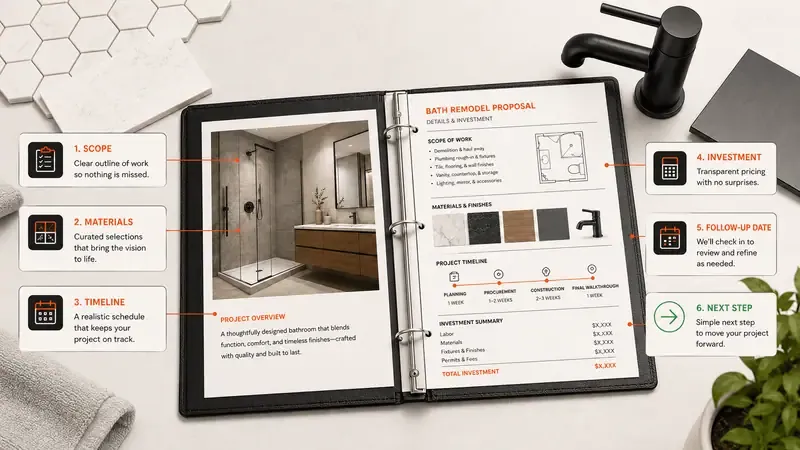
Most bath contractors show up cold to the consultation. The homeowner opens the door, the contractor walks in, looks around the bathroom, asks some questions, takes some measurements, and says they'll email a quote. This experience is identical across most of the 3–5 contractors the homeowner is evaluating. There is nothing in it that creates a memorable impression or establishes professional differentiation.
The contractors who consistently win bath remodel projects prepare the homeowner for the consultation before they arrive — and in doing so, shift the homeowner's frame from "this is one of several vendors I'm evaluating" to "this is the expert partner I'm considering for my project." The pre-consultation experience consists of three components sent via email or text 24 hours before the appointment:
Contractors who implement the pre-consultation packet report a consistent pattern: homeowners greet them differently at the door. They've reviewed the materials, they have questions prepared, and in their mind this contractor already ranks above the ones who just showed up. The consultation becomes a conversation between a professional and an engaged client rather than a pitch from a vendor to a skeptical buyer.
The Follow-Up Sequence: The 21 Days After the Estimate
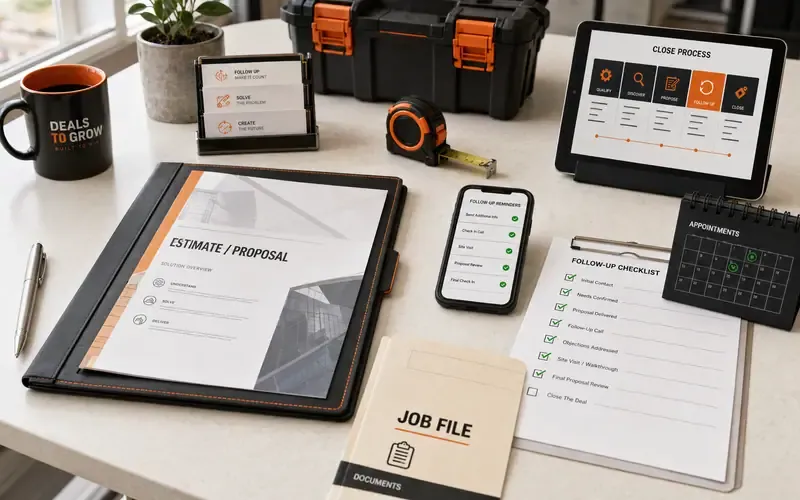
This is where most bath remodel projects are won or lost, and where most bath contractors have no system at all. The estimate goes out, a single follow-up call happens at day 3 or 4, the homeowner says "we're still deciding," and the contractor's system ends. The homeowner continues their 21–45 day decision process with no further meaningful contact from that contractor. By day 21, they've chosen someone else — not necessarily the cheapest, but the one who stayed engaged.
A structured 7-touch follow-up sequence covers the full decision window without feeling aggressive, because each touch delivers something genuinely useful:
Design-Build Positioning: How to Justify a Premium Price
Bath remodelers who offer design services — even basic design selection guidance, not a full interior design engagement — command 20–35% higher prices than contractors who position themselves purely as construction operators. The reason is straightforward: the homeowner is not just buying construction labor. They're buying a reduction in complexity. The design-build contractor takes the decision burden off the homeowner's plate. That reduction in cognitive load and decision fatigue has real monetary value, and homeowners who have gone through a renovation before understand this intuitively.
You do not need to hire a designer or get a design certification to offer this positioning. What you need is a structured material selection process that guides the homeowner through the decisions rather than leaving them to figure it out independently. A practical design-build system for bath remodelers has three components:
- Material selection guide: A curated selection of 3 options in each category — tile, fixtures, vanities, lighting — at three price points. Homeowners choose from a pre-vetted menu rather than browsing an unlimited showroom. Fewer choices, faster decisions, better outcomes.
- Design consultation add-on: A 60-minute pre-project design session (in-home or virtual) to finalize all selections before work begins. Charge $250–$500 for this session, but offer to credit it toward the project if they sign. This filters out tire-kickers, creates a commitment, and allows you to finalize materials before scheduling begins — which eliminates the most common cause of project delays.
- Supplier partnerships: Established relationships with 1–2 local tile showrooms and fixture suppliers who will give your clients preferred pricing. Your clients get a better selection experience; you get referral leads from the showroom. This adds perceived value to your service without additional cost.
The pricing justification for design-build is simple: "Our process includes design consultation, material selection guidance, and project management — you're not managing this project, we are. The additional investment covers the time and systems that ensure the project runs on schedule and on budget." Homeowners who have been through a renovation disaster understand exactly what this is worth.
Financing in the Bath Remodel Funnel: When and How to Introduce It
A $14,000 bath remodel is a large, lump-sum decision. A $289/month payment for 48 months is a utility-bill-sized recurring expense. These are the same financial commitment presented differently, but the psychological impact is completely different. Financing changes the mental math of the purchase decision, and bath remodelers who integrate financing into their sales process close at materially higher rates — not because homeowners can't afford the project, but because financing makes the decision easier to say yes to.
When to introduce financing in the bath remodel sales funnel:
- Pre-consultation: Mention financing availability on your website and in any pre-consultation materials. "We offer 0% financing options for qualified buyers" on the project questionnaire tells the homeowner this is an option before they've even done budget math on their own.
- At the estimate: Include a financing section at the bottom of every estimate. List the monthly payment at 24, 36, and 48-month terms. Do not make the homeowner ask — put the numbers in front of them as a standard part of the estimate document.
- In the follow-up sequence: The Day 8 financing touch in the follow-up sequence (described above) specifically targets homeowners who are in the budget calibration phase. This is the single best moment to introduce financing because the homeowner has likely already received multiple quotes and knows the price range they're working with.
A homeowner with a $14,500 bath remodel quote is looking at a $14,500 decision. With financing at 6.9% for 48 months, the same project is a $344/month decision. With 0% promotional financing for 24 months, it's a $604/month decision — still psychologically closer to a car payment than a lump-sum investment. Contractors who present financing as a standard option see 20–30% of clients choose it — which means 20–30% of sales that might not have closed at all now close, at full margin.
The financing cost (typically 3–6% of the financed amount, paid by the contractor to the lender) is recoverable through the higher close rate and average project value it enables.
The bath remodel contractor who sent a pre-consultation design guide, followed up twice after the estimate, showed a similar project on Day 12, and offered financing on Day 16 is not being pushy. They're being professional. And they're winning the project 3× as often.
Related Articles.
Want this system installed for your trade?
See if your market is still open, then book a 20-30 minute install call. No contracts.