
Contractor Website Design: What Converts
Most contractor websites look fine and convert terribly. Here are the 5 design elements that separate a brochure from a revenue engine — and why mobile speed is the single biggest lever most contractors miss.
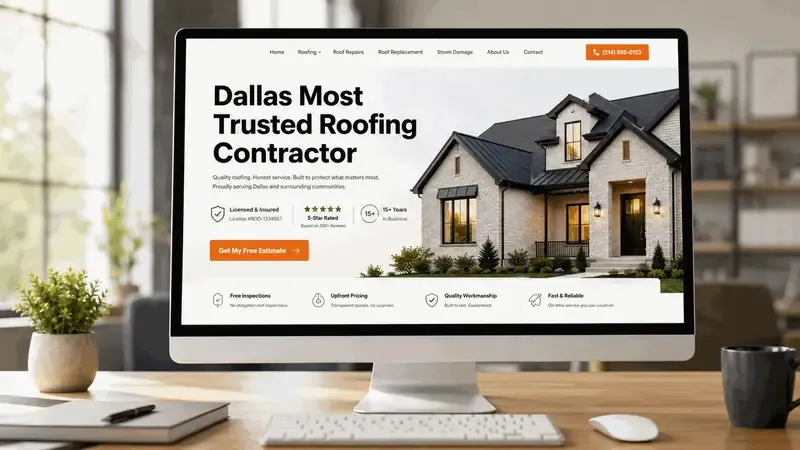
A contractor spent $4,200 on a new website last year. It looks clean, loads reasonably, has a contact form. It generates approximately zero inbound leads from organic or paid traffic — every lead still comes from referrals and word of mouth.
This is the norm, not the exception. Most contractor websites are digital business cards — they exist to confirm you're a legitimate business, not to actively generate revenue. The difference between a brochure site and a conversion machine isn't budget. It's architecture and intent.
Why Most Contractor Websites Don't Convert
The problem isn't usually design aesthetics. Contractor websites fail to convert for predictable structural reasons:
- ✓ The homepage is about you, not the homeowner — "Family-owned since 1987" tells visitors nothing about whether you can solve their problem.
- ✓ Multiple calls-to-action compete with each other — when everything is a priority, nothing is. Visitors make no decision and leave.
- ✓ Mobile experience is an afterthought — the site was designed on a desktop and is difficult to navigate on the phone where 85%+ of contractor clicks happen.
- ✓ Social proof is buried or missing — a review widget in the footer isn't social proof. Homeowners need trust signals immediately, before they scroll.
- ✓ No clear friction-free next step — a 12-field estimate form loses most visitors before the first field.
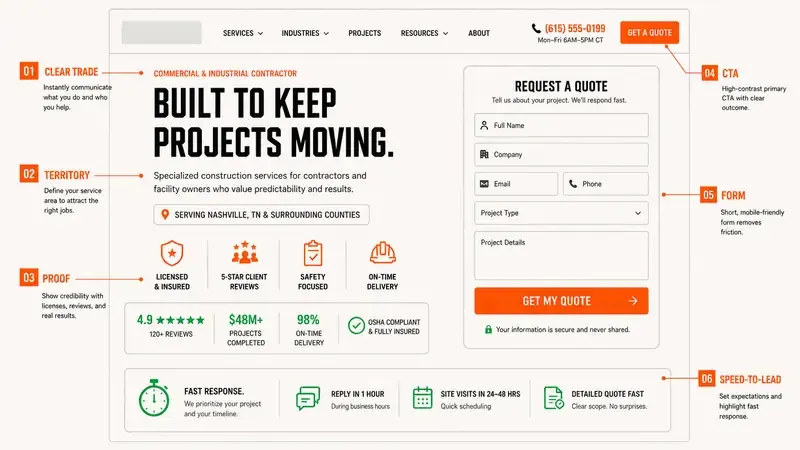
The 5 Elements of a High-Converting Trade Site
What Homepage Traffic Costs You
Most contractor paid ad campaigns send all traffic to the homepage. This is one of the most expensive mistakes in contractor marketing — and the most common.
When a homeowner clicks an ad for "HVAC repair Dallas," they have specific intent. Sending them to a generic homepage breaks the intent match — the visitor has to reconstruct the relevance you just destroyed. High-converting campaigns use dedicated landing pages that match the ad exactly. Conversion rates are typically 2–3× higher on matched landing pages vs. homepage traffic.
Each major service + city combination should have its own landing page. "HVAC repair Dallas," "HVAC repair Houston," "HVAC replacement Dallas" — each is a distinct intent that deserves a dedicated page with matching headline, social proof, and CTA.
Mobile Speed as a Revenue Variable
Of contractor search traffic now comes from mobile devices. A site that loads in under 2 seconds on mobile converts at 2.1× the rate of a site that loads in 4+ seconds — at identical ad spend.
The common causes of slow contractor sites:
- ✓ Unoptimized images — 10MB hero photos scaled down via CSS instead of properly compressed and sized
- ✓ Page builders (Wix, Squarespace, WordPress with 40 plugins) that load excessive JavaScript
- ✓ Third-party widgets that block rendering — live chat, review sliders, video embeds
- ✓ Cheap shared hosting with slow time-to-first-byte
The Authority Portfolio That Prices Out Competition
The contractors who consistently win at premium price points have documented proof of exceptional work — not gallery photos, but proof. An authority portfolio goes beyond before/after images:
- ✓ The specific problem the homeowner faced — not just "new roof needed," but why, what the scope revealed, what was at risk
- ✓ The approach — why that roof system, why that material, for that specific home
- ✓ Timeline, any challenges encountered, and the outcome
- ✓ Project location (neighborhood or city) — builds local relevance and long-tail SEO
This kind of documented expertise does two things: for homeowners comparing quotes, it justifies a higher price because they're comparing an expert to a commodity. For Google, deep project content generates long-tail organic traffic from specific, high-intent searches.
The Deals To Grow Authority Website is built specifically for trade contractor conversion — lightweight, fast-loading, with trade-specific landing pages, a project portfolio system, and a homepage built to one job: the booked estimate. It's a recommended add-on, owned by the operator permanently.
If you want to see what a contractor website built to convert looks like and how it ties into paid ads, the AI receptionist (Grow and Scale plans), and the full sales stack, see the complete infrastructure or book a scoping call.
Related Articles.
Want this system installed for your trade?
See if your market is still open, then book a 20-30 minute install call. No contracts.