
General Contractor Lead Gen: Win on Trust, Not Price.
GCs who win on price don't survive. GCs who win on trust, professionalism, and speed-to-respond build the kind of pipeline that supports $500K+ annual revenue. Here's the system.

There are two kinds of GCs in every market. One kind competes on price: lowest bid wins, margins stay thin, and one bad project means a cash flow crisis. The other kind charges more, books 60–90 days out, rarely discounts, and keeps a waiting list for the good projects. Same market. Same trade. The difference isn't skill — it's how they show up, how fast they call back, and how they run the buying experience from first contact to signed contract.
Which kind you are is a choice. It's not your market, and it doesn't take a rebrand or a new website. It takes a system for how every lead gets handled from the moment they reach out. This article walks through that system — Google ads, the consultation, the qualification filter, referrals — and how the pieces fit together to win bigger projects without underbidding.
The High-Value GC Lead: What They Actually Look For
A homeowner planning a $50,000 or $100,000+ renovation doesn't shop like someone pricing a $2,000 fence. The timeline is longer. The stakes are higher. And what actually decides the hire is not what most GCs assume. Know this buyer first — then build the lead system around them.
Industry research keeps landing on the same three things homeowners weigh on $50K+ projects before price ever gets serious: how fast and how professionally you respond, whether your portfolio shows projects like theirs, and how the consultation itself feels. Price comes fourth — and it only decides the job when the first three are a tie. They almost never are, because most contractors ignore all three.
Put plainly: if you call back late, your portfolio lives on a camera roll, and your consultations are winged on the spot, you are losing big projects to GCs who can't out-build you. They're just out-running you on process.
Google Search for GC Leads: Intent-Matching Your Ad Copy
Not every Google search is worth the same money, and treating them all the same is one of the most expensive mistakes GCs make with paid search. Someone typing "contractor near me" might want a handyman, a GC, a plumber, or just an idea of cost. Someone typing "kitchen addition contractor [city]" has already picked the project, the scope, and the kind of company they need. The second search is worth 10× the first.
The keyword strategy for high-value GC leads focuses on specificity and project type intent:
- High-intent project keywords: "kitchen addition contractor [city]," "home addition contractor [city]," "whole home renovation contractor [city]," "commercial tenant improvement contractor [city]"
- Budget-signal keywords: "large renovation contractor," "luxury remodel contractor [city]," "high-end contractor [city]" — these self-select for budget-aware buyers
- Negative keywords to exclude: "cheap," "affordable," "low cost," "DIY," "how to," "small," "repair" — these filter out searches that are not aligned with $50K+ project buyers
- Match types: Use phrase match and exact match, not broad match, for high-intent terms; broad match will drain budget on irrelevant queries
Your ad copy should pre-qualify budget before the click. An ad headline that says "General Contractor — Free Estimate" attracts everyone, including people whose budget is a fraction of your minimum project size. An ad headline that says "Home Addition & Full Renovation — Projects from $75K" signals your positioning and ensures the clicks you're paying for are from buyers who can afford your services. The click-through rate may be lower; the conversion rate and average project value will be significantly higher.
Landing page alignment is the second half of the paid search equation. The page a paid click lands on should match the keyword and ad copy precisely. A "kitchen addition contractor [city]" searcher who clicks your ad should land on a page dedicated to kitchen additions — with relevant portfolio images, a clear process overview, and a direct consultation request form. Sending all paid traffic to your homepage is the fastest way to waste your ad budget.
The Consultation Experience: How to Close Before You Quote
Most GCs lose projects at the estimate stage — not because their price is too high, but because the consultation was undifferentiated. The homeowner met with three contractors. Two of them showed up, walked around, took some notes, and said they'd email a quote in a week. One of them showed up with a pre-consultation questionnaire the homeowner had filled out in advance, spent 20 minutes reviewing similar projects from their portfolio, explained exactly how the project would be managed from demolition to final walkthrough, and asked specific questions about the homeowner's design preferences before ever discussing price. Which contractor do you think the homeowner called first when the quotes arrived?
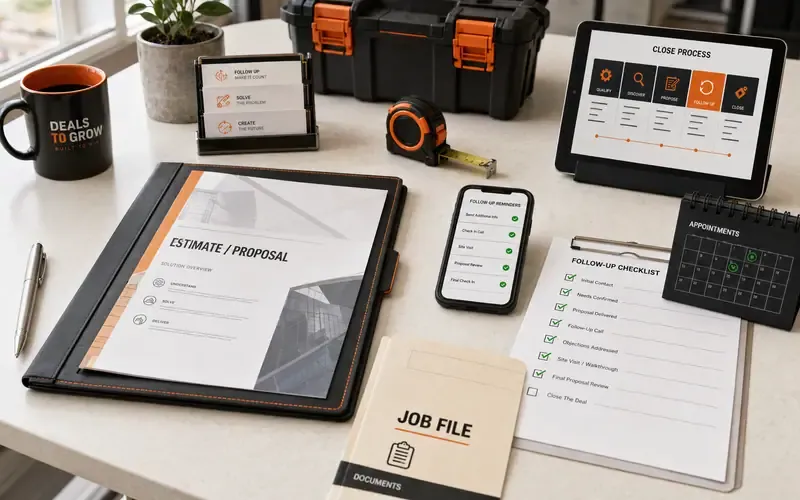
The pre-consultation packet is the one tool that moves GC close rates more than anything else. Three pieces, sent to the homeowner 24 hours before the appointment:
- Project questionnaire: Scope description, timeline, approximate budget range, decision timeline, are you the property owner, have you worked with other contractors on this project — 8–10 questions that the homeowner answers in writing before you arrive
- Portfolio PDF: 5–8 similar completed projects with scope descriptions, timelines, and before/after photos — sent as a PDF or shared via a link, reviewed by the homeowner before the meeting
- Process overview: A one-page document explaining your project management process — how decisions get made, how changes get handled, how communication works, and what the homeowner should expect at each phase
What happens in the first 15 minutes of the consultation determines the outcome more than price. If you spend those 15 minutes reviewing the questionnaire the homeowner filled out, referencing specific projects from your portfolio that are similar to their scope, and walking through your process — the homeowner's mental frame shifts from "comparing bids" to "evaluating whether this person can run my project." That is the frame in which the highest-margin GCs win. It is the frame in which price becomes secondary to fit, capability, and trust.
Portfolio Marketing: Using Past Projects as a Lead Generation Engine
Your completed projects are your most powerful marketing asset, and most GCs leave them sitting on a camera roll. Every completed project should produce a structured set of marketing outputs: a Google Business Profile post, an Instagram carousel, and a case study page on your website. Each format serves a different part of the buyer journey, and together they build a body of proof that compounds over time.
Google Business Profile project posts are underused by most GCs. A post with before/after photos, a project scope description ("$135,000 full primary suite addition — 600 sq ft, custom tile work, radiant floor heat, walk-in closet"), and the neighborhood or city drives local search visibility while directly demonstrating project capability. Homeowners who are planning similar projects and searching locally will find these posts, click to your profile, read your reviews, and contact you — having already done most of the qualification work themselves.
Instagram before/after content for GC projects performs well for a specific reason: home renovation is one of the highest-aspiration content categories among homeowners. A 4-photo carousel showing demolition, rough-in, finish work, and final result tells a story that text cannot. The caption should include project scope, timeline, and a call to action ("Planning a similar project in [city]? Link in bio for a free consultation"). Instagram content drives both direct inquiries and referrals — homeowners share content from contractors who did work for their neighbors.
Building authority in a specific project niche accelerates lead quality faster than general portfolio breadth. A GC known specifically for high-end kitchen additions will attract better-qualified leads at higher ticket values than a GC who markets themselves as doing "everything." Choose the two or three project types where you do your best work, have the strongest portfolio, and command the best margins — and build your portfolio marketing strategy around those.
The Qualification Filter: How to Stop Wasting Time on Tire-Kickers
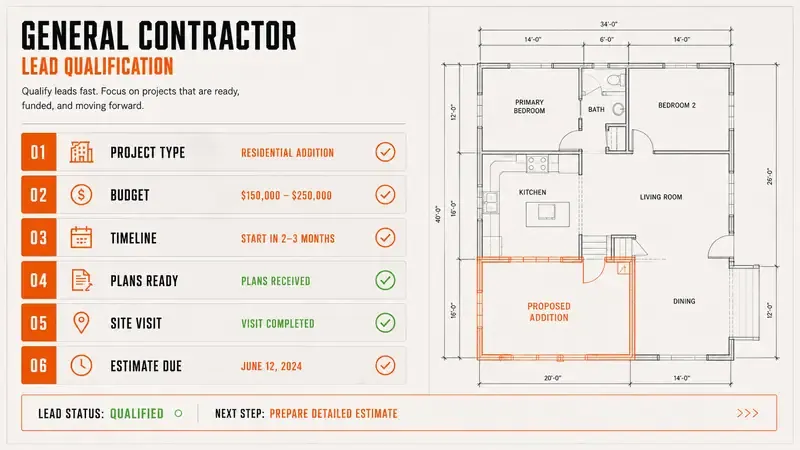
The most common complaint from GCs who start spending on marketing: more leads, same number of contracts. The leads aren't converting because too many of them were never real buyers. The fix isn't spending less. The fix is a qualification filter between the inquiry and the consultation, so every meeting you drive to is with someone who has a real project, a real timeline, and a budget in range.
An AI receptionist configured for GC qualification handles this at scale without requiring your time. When a lead submits a form or calls in, the AI receptionist collects:
- Project type: What kind of project are you planning? (Addition, full renovation, kitchen, bath, commercial)
- Scope description: Tell me a bit more about the project — what's the general scope?
- Timeline: When are you hoping to start? When do you need the project completed?
- Budget range: Do you have a budget range in mind for this project? (Offering ranges: under $30K, $30K–$75K, $75K–$150K, $150K+)
- Property ownership: Is this a property you own? (Filters renters without owner approval)
Leads who provide a timeline within 90 days and a budget in range are booked directly into your consultation calendar. Leads who are outside your budget range or timeline are sent a polite response with appropriate resources — freeing your time and ensuring your consultation calendar is filled with qualified prospects only.
The counterintuitive result: this process typically reduces raw inquiry volume by 20–30% while increasing close rate by 40–60%. Fewer consultations, more contracts. The math on this improvement is significant — if you were running 15 consultations per month at a 20% close rate (3 projects), a qualification filter might reduce you to 10 consultations at a 40% close rate (4 projects), with higher average project values because you're only meeting with buyers who have real budgets.
Referral Systems for GCs: Making Word-of-Mouth Systematic
Referrals are the number one lead source for most established GCs — and almost all of them happen by accident. A happy client happens to mention your name to a neighbor who happens to be planning a project. You did nothing to cause it. You got lucky on timing. That's why referral volume swings wildly from month to month and can't be forecast or improved.
A referral system takes the same underlying mechanism — satisfied clients telling people they know about your work — and makes it predictable through process. The three components:
Step 1 — Post-Project NPS: Seven days after project completion, send every client a short survey (3–5 questions) including a Net Promoter Score question ("On a scale of 0–10, how likely are you to recommend us to a friend or family member?"). Clients who score 9–10 are your promoters. The NPS survey serves two purposes: it identifies your warmest referral sources, and it opens a conversation that makes a direct referral ask feel natural rather than transactional.
Step 2 — Direct Referral Ask with Incentive: Within 48 hours of receiving a 9–10 NPS score, a personalized follow-up message goes to that client. "We're glad the project exceeded your expectations. We build most of our business through referrals from clients like you — if you know anyone planning a similar project, we'd love an introduction. As a thank-you, we offer [one month of free maintenance / a $250 gift card / a priority scheduling benefit] for every referral that results in a project." The incentive should be meaningful but not transactional-feeling. A credit toward a future project works better than a cash payment.
Step 3 — Referral Tracking in CRM: Tag every lead with a referral source in your CRM. When a referred lead converts to a project, trigger a thank-you message to the referring client, deliver the promised incentive, and add a note to the referrer's contact record. This closes the loop, reinforces the referring behavior, and gives you data on which clients are your top referral sources — so you can prioritize those relationships for future outreach.
A referral system built on these three components generates consistent, trackable referral volume instead of sporadic, unpredictable word-of-mouth. GCs who implement this typically see referral volume increase 40–70% within the first 90 days — without any additional ad spend.
You're not losing jobs because your price is too high. You're losing them because the other GC sent a pre-consultation questionnaire, showed up with a portfolio booklet, and called back within 4 hours. You're competing on professionalism whether you know it or not.
Related Articles.
Want this system installed for your trade?
See if your market is still open, then book a 20-30 minute install call. No contracts.