
General Contractor Marketing: Win More Bids at Premium Prices
GCs who compete on price are fighting a race they can't win. Authority positioning is how you justify premium pricing before the bid — and close at higher rates because of it.

A general contractor calls us after losing three bids in a row to competitors they know are cheaper and — in their honest assessment — less skilled. They're doing great work. Their past clients rave about them. But the homeowners evaluating three bids don't know that. All they see is a number, a generic website, and a folder of before/after photos that looks more or less identical across all three GCs.
This is the commodity trap in GC marketing. When a homeowner cannot differentiate between contractors before the job, they default to price. Authority positioning is the strategy that breaks you out of that trap — by making your quality, process, and credibility visible and compelling before the estimate appointment ever happens.
The Bid Commodity Trap: Why GCs Lose on Price When They Shouldn't
A homeowner deciding on a $40,000–$200,000+ renovation has a problem: they can't judge a contractor's quality in advance. They can look at photos, read reviews, check licenses — but the real quality of your work only shows after it's done. Too late to help them hire. So they grab the one number that feels solid: price.
That's why, when two GCs look the same on paper — similar websites, similar photo galleries, similar five-star reviews that all say "great company" — the lower bid wins by default. The homeowner isn't cheap. They just have no reason to pay more. They don't know why you're worth the premium, so they don't pay it.
Template websites make this worse. A GC site built from a generic contractor template tells the homeowner you're a generic contractor — average quality, average process, average results — no matter how good your work actually is. When three GCs bid and two have template sites, the one with detailed project case studies and a clearly explained process starts ahead before anyone says a word.
Authority positioning means putting your quality, your process, and your proof in front of the homeowner before the estimate appointment. You don't need the lowest price. You need enough evidence that your price makes sense. The homeowner should walk into your estimate already half-sold on you.
The Authority Website: Your Most Important Sales Tool
For a general contractor, the website is not a brochure. It either builds confidence or it doesn't — and on a six-figure job with a 90-day decision, confidence is everything. Most GC websites fail here because they were built to look professional, not to prove anything.
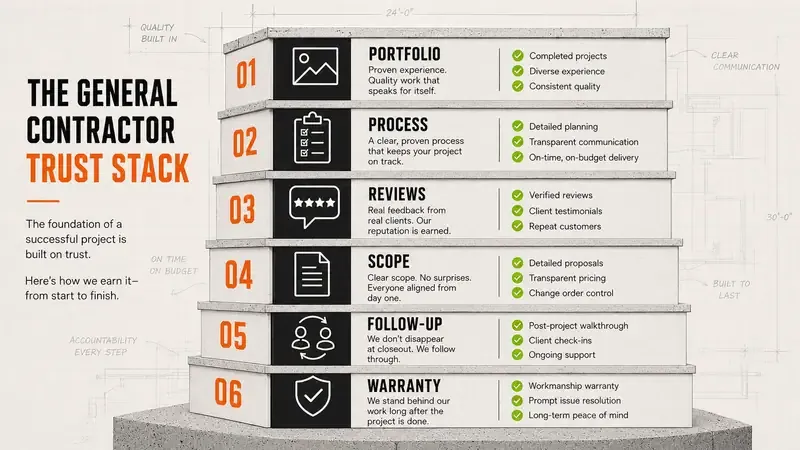
An authority website for a GC has three parts. First, written project case studies — not just photo galleries. A case study tells the story: what the homeowner wanted, the scope and timeline, the calls you made during construction and why, and the finished result with photos. A homeowner reading a case study about a project like theirs is watching you solve their problem before they've hired you. A photo gallery can't do that.
Second, testimonials that are specific rather than generic. "Great company, highly recommend!" is noise. "We hired [GC] for a full first-floor renovation — 1,800 sq ft, $165,000 budget, 14-week timeline. They hit the timeline exactly, were on budget, and communicated daily without us having to chase. The finished product is better than we imagined." That testimonial answers the exact questions a prospective client is asking: Can I trust this company to stay on budget? Will they communicate? Will they finish on time? Collect testimonials with prompts that elicit specific answers to these questions.
Third, a process explainer that demystifies the GC experience. Most homeowners have heard horror stories about contractor relationships — unexpected costs, slow communication, projects running 3 months over timeline. A clear, step-by-step explanation of your process from initial consultation through project completion and final walkthrough directly addresses these fears and differentiates you from contractors who don't bother to explain how they work.
GCs with detailed editorial websites — project case studies, specific testimonials, and a clear process explainer — close competitive bids at 45–55% higher rates than GCs with template sites presenting the same quality of work. The differentiator is not price and not the estimate itself. It's the confidence the homeowner has before the estimate appointment even starts.
The website is where premium pricing gets justified or lost. An authority website is not a luxury — it's the foundation of every downstream marketing investment you make.
The Long-Cycle Nurture: Staying Present Through a 90-Day Sales Process
General contracting has one of the longest sales cycles in the residential trades. A homeowner planning a $100,000+ kitchen and primary bath renovation can take 60–120 days from first research to signed contract. They collect estimates, sit on them for weeks, look up the companies, talk it over with their spouse, check their finances, and change the scope twice. That's not stalling. That's normal for a job this size.
The GC who wins that job is rarely the one with the best first impression. It's the one who stayed in front of the homeowner for the whole 60–120 days. Most GCs hand over an estimate, follow up once or twice, and go quiet. Then the homeowner decides, and the GC either gets the call or doesn't — and never learns why.
A long-cycle nurture system changes this dynamic. The mechanics are relatively simple: after an estimate is delivered, the prospect enters an email and retargeting sequence that keeps you visible without being pushy. The content is value-driven rather than promotional — project case studies relevant to their project type, an article about common renovation mistakes to avoid, a piece about how to evaluate GC bids fairly, a before/after of a recently completed project similar to theirs. Eight to twelve pieces of content delivered over 90 days is not aggressive; it's helpful.
Retargeting ads on Meta and Google amplify the effect by keeping your brand visible in the homeowner's digital environment. A homeowner who received your estimate and then sees your project photos on Instagram three times over the following month is far more likely to remember you favorably than one who only interacted with you at the estimate appointment. The retargeting cost is small — $150–$250/month for a tight custom audience — and the impact on recall and preference is significant.
The nurture sequence also serves a qualification function. Homeowners who engage with the content — opening emails, clicking through to case studies, watching project videos — are actively signaling interest. That engagement data tells your sales team where to focus follow-up energy during a long decision cycle.
Referral Amplification: Turning One Satisfied Client Into Five Leads
Referrals are the best leads in GC marketing. They arrive pre-sold, vouched for by someone they trust, and ready to move faster than any cold lead. The problem: most GCs leave referrals entirely to chance. A happy client might mention you. Or might not think of it. Or might mean to and forget.
Turning happy clients into a steady referral source takes three things. First, ask at the right moment. The worst time is mid-project, when dust is everywhere and everyone's tired. The best time is the final walkthrough, when the client is standing in a finished space they love. That's when the ask feels natural and the answer is almost always yes.
Second, making the Google review request automated and immediate. Within 24 hours of the final walkthrough, every completed client should receive an automated SMS with a direct link to your Google review page. The message is brief and personal: "Really glad you're happy with how the project turned out. If you have 2 minutes, a Google review would mean a lot to us — here's the link." Most satisfied clients are happy to leave a review when the request is timely and frictionless. Review velocity directly improves your Google Search and LSA rankings, which generates more inbound leads from your review investment.
Third, a structured referral program with explicit incentives. A GC referral program doesn't need to be complicated:
- $250 referral credit applied to the referring client's next project (or a gift card for clients without ongoing work)
- Announcement at project close: "We have a referral program — if anyone you know is thinking about a renovation, we'd love the introduction and we'll take care of you for it"
- Reminder at the 90-day mark: A check-in call or email that's genuinely about how the finished project is working for them — and naturally creates an opening to ask if they've recommended you to anyone
A GC with 40 past clients and a systematic referral program generating 2–3 referrals per client per year has 80–120 high-quality referral leads annually without any additional ad spend. That's a meaningful pipeline from a base that already exists.

Qualifying Inbound Leads: Protecting Your Estimator's Time
Every estimate site visit costs you real money. A senior estimator or PM spends 2–3 hours on the visit, then more hours building the proposal — $400–$800 in labor before a dollar comes in. When that estimate goes to a homeowner with a $30,000 budget for a $120,000 project, or a tire-kicker who's "just getting quotes," that money is gone.
Lead qualification is the system that protects your estimator's time by filtering out unqualified leads before the site visit. The qualification happens in two stages. First, the intake form captures the information needed to make a basic go/no-go decision: project type and scope, budget range (offer ranges rather than an exact number — "under $50K / $50K–$100K / $100K+" — to make it easier for homeowners to answer honestly), desired timeline, and property ownership. A lead with a $25K–$35K budget for a full kitchen renovation in a market where that scope costs $75K+ is not a good use of your estimator's time.
Second, an AI receptionist or phone screening step speaks with the lead before the estimate is booked. The AI receptionist can confirm project details, ask budget and timeline questions in a conversational way, and gather information that the intake form may have missed. This layer catches leads who provided vague or incomplete form answers and either qualifies them further or routes them to a more appropriate service level.
The result of a proper qualification system is that your estimator's site visits have a much higher conversion rate — because every appointment is with a genuinely qualified prospect rather than a mix of qualified and unqualified leads. A GC estimator with 8 visits per month at 55% close rate closes 4–5 jobs. The same estimator with 5 visits per month at 75% close rate (because all 5 are qualified) closes 3–4 jobs from less work. Scale the qualified visit volume and the output scales proportionally.
For the full breakdown of the sales infrastructure that supports GC lead qualification and follow-up, see the sales infrastructure vs. marketing agency comparison.
Related Articles.
Want this system installed for your trade?
See if your market is still open, then book a 20-30 minute install call. No contracts.