
How to Scale a Kitchen Remodel Company Without Hiring More
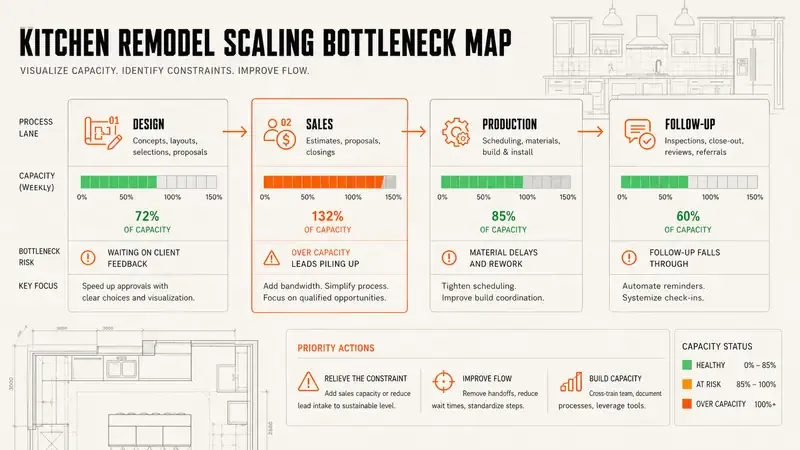
The bottleneck in kitchen remodel is almost never crew capacity. It's the front end — the sales pipeline that decides which projects reach your estimator and which fall through.

Kitchen remodel is one of the highest-ticket, longest-cycle trades in home improvement. Average ticket: $18,000–$80,000. Average sales cycle: 60–120 days. Homeowners research for months before they sign. The money on the table is enormous — and the gap between remodelers who grow every year and those who plateau is almost always the sales process, not the craft.
Most kitchen remodel companies hit a ceiling when the owner is both the primary estimator and the primary closer. They're physically limited by how many design consultations they can run per week. The instinct is to hire: another estimator, a sales coordinator, an office manager. But in most cases, the actual bottleneck is upstream — leads who should become booked estimates are falling through the cracks before they ever reach the estimator.
The Real Bottleneck: The Sales Pipeline
Here's what a typical kitchen remodel sales funnel looks like without a proper system:
- Homeowner fills out a form or calls after seeing an ad
- Office manager (or owner) calls back the next day
- Homeowner doesn't answer — gets a voicemail
- No follow-up after the first call attempt
- Lead sits in a spreadsheet or email inbox and goes cold
That's a $60,000 kitchen remodel lost — not because the owner couldn't do the work, but because the callback took 24+ hours and nobody tried twice. The lead cost $80–200 to generate. It died after one missed call.
Fix the pipeline before you hire. The system should handle qualification, booking, and follow-up on its own — so your estimator's calendar fills with qualified consults while nobody in the office lifts a finger.
What an Automated Kitchen Remodel Pipeline Looks Like
Immediate Response (T+0 to T+5 min)
The moment a homeowner submits a form or calls your number, three things happen automatically:
- SMS confirmation: "We received your kitchen remodel inquiry for [address]. Our design consultant will reach you within the hour."
- If they called: AI receptionist answers in under 12 seconds, qualifies the project (scope, timeline, budget range), and books the consultation directly
- If they filled out a form: automated outbound AI call attempts to reach them within 2 minutes
The Qualification Layer
Not every kitchen remodel lead is a good fit for every company. A proper qualification step filters for:
- Budget: "Do you have a rough budget in mind for the project — are we talking $25,000–$50,000, or more in the $50,000–$100,000 range?" This alone filters premium projects from budget shoppers.
- Timeline: Homeowners planning to start in 6+ months are added to a nurture sequence, not a consultation booking flow.
- Ownership: Confirming the inquirer is the homeowner (or has decision authority) saves wasted estimate time.
- Scope: Full gut remodel vs. cosmetic refresh sets accurate expectations for the estimate visit.
The Follow-Up Sequence
For leads who don't book on first contact (60–70% of them), a multi-touch follow-up sequence over 14 days captures significant volume:
- Day 1: SMS with a direct booking link for the design consultation
- Day 3: Email with portfolio photos, client reviews, and "available this week" messaging
- Day 7: Second call attempt (voicemail drop if no answer)
- Day 14: Final SMS: "Wanted to check — are you still planning your kitchen renovation?"
Different trade, same front-end math. After the full pipeline went in, Poxy's sales cycle dropped from 14–21 days to 3–7 days, and the company went from a $1.2M to an $8M run rate. The owner's words: "We did more revenue in May than all of last year." When the pipeline stops leaking, the same crew closes more work.
Increasing Ticket Size Without Selling Harder
One of the most counterintuitive levers in kitchen remodel is ticket size. A qualification layer tends to raise average ticket on its own — not because you raise prices, but because it filters out the low-budget inquiries that eat estimator hours and never sign.
When your estimator is spending half their time on $12,000 kitchen refresh jobs that don't close, they have less time for $55,000 full gut remodels that do. A CRM with proper lead scoring surfaces the high-value opportunities and nurtures the low-budget inquiries separately — so your estimator's calendar is filled with projects worth their time.

The Long-Cycle Problem — and the Fix
Kitchen remodel has a 60–120 day sales cycle. Homeowners research multiple companies, get multiple quotes, sit on the decision, and often postpone by 30–60 days. Without a structured pipeline, leads from 90 days ago are forgotten.
A CRM with automated re-engagement handles this. Every quote that didn't close gets a systematic re-engagement at 30, 60, and 90 days. The message: "We wanted to follow up on your kitchen project — have you made a decision yet? We have an opening in our schedule in [month] if you're ready to move forward."
Kitchen remodel companies that run proper re-engagement sequences close 15–25% of "lost" quotes within 90 days. That's significant revenue from leads already in your pipeline.
When to Actually Hire
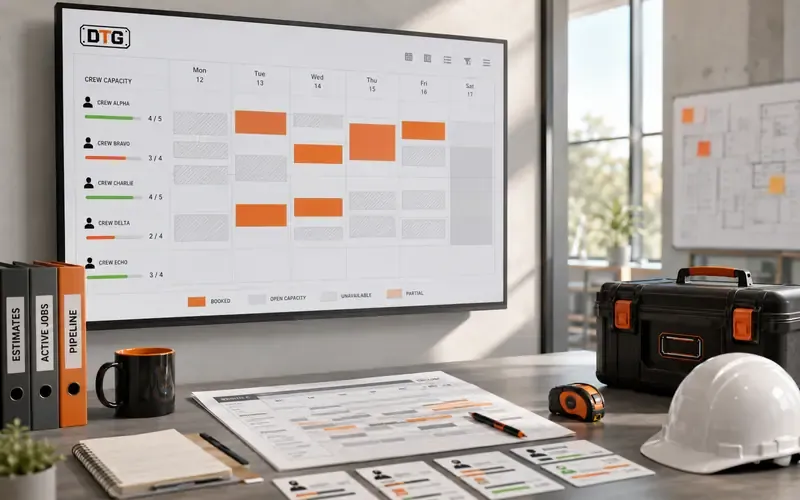
With a properly automated pipeline, the trigger for hiring additional estimators shifts from "we need more capacity to handle all the calls" to "our estimators have more qualified consultations booked than they can attend." That's a better problem to have, and a better signal for growth.
See the full kitchen remodel sales infrastructure on the kitchen remodel trade page, or check whether your metro is available.
Related Articles.
Want this system installed for your trade?
See if your market is still open, then book a 20-30 minute install call. No contracts.