
Kitchen Remodel Marketing: Win Premium Clients, Not Price Wars
Competing on price against big-box stores and low-ball operators is a race you can't win. Here's how kitchen remodelers build authority positioning that attracts premium clients who don't ask "what's your lowest price?"
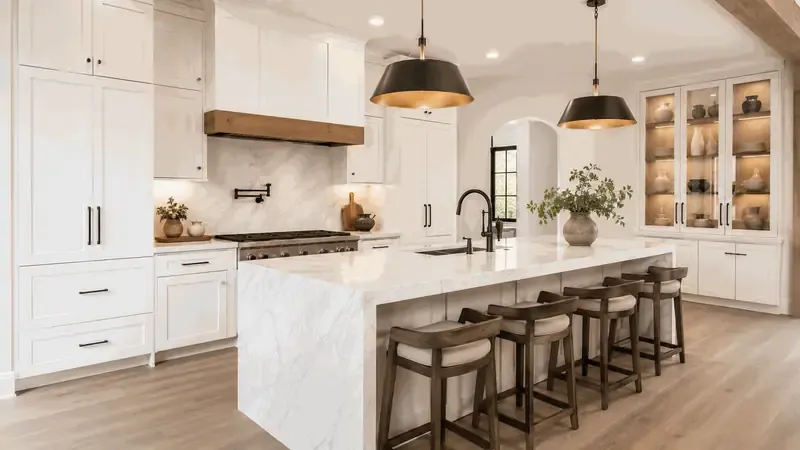
A kitchen remodeler calls us frustrated. They're spending $2,000/month on Google Ads, getting consultation requests, and losing 60% of them to competitors who bid 20% lower. Their work is genuinely better — photos prove it, reviews confirm it — but they can't seem to get homeowners to see that before the quote comparison happens. Their instinct is to lower prices. The real problem is they're competing before they've established authority.
Kitchen remodeling is one of the few home service categories where the commodity trap is entirely avoidable — but only if you understand why homeowners default to price comparison in the first place, and what breaks that pattern.
The Race to the Bottom: Why Kitchen Remodelers Compete on Price When They Don't Have To
Homeowners hiring a kitchen remodeler face a fundamental problem: they cannot evaluate craftsmanship before the job is done. They can look at photos, but photos don't tell them whether the cabinet installation will be plumb in five years, whether the contractor shows up on schedule, or whether the finished product will match the rendered design. Because quality is invisible before purchase, price becomes the proxy metric.
This is the price-comparison trap. When a homeowner receives three quotes and can't evaluate quality independently, the path of least resistance is to choose the middle price or ask the higher-priced contractor to match the lower bid. The premium contractor ends up defending a price premium they haven't yet earned in the homeowner's mind.
Authority positioning is the solution. When a homeowner arrives at a consultation having already seen your documented project work — real budgets, real timelines, real design decisions explained — they're not comparing you to other contractors. They're evaluating whether they can afford you. That's a fundamentally different sales conversation, and it's the one that produces $50,000+ average tickets without constant price negotiation.
The good news: most kitchen remodelers have the work that justifies premium positioning. They just haven't built the digital infrastructure to communicate it before the consultation. Here's what that infrastructure looks like.
The Portfolio-First Marketing Approach
A photo gallery is not a portfolio. A gallery shows outcomes. A portfolio explains decisions — and decisions are what homeowners pay premiums for.
Editorial project case studies are the core asset of kitchen remodel authority positioning. Each case study tells the complete story of one project: the homeowner's starting point (cramped galley kitchen, builder-grade finishes, inadequate lighting), the design goals (open to living area, high-function workflow, durable materials for a family with three kids), the specific decisions made and why (quartz over marble for durability, induction cooktop for the layout, custom cabinet depth to maximize storage), the investment ($68,000, 9 weeks), and the outcome in the homeowner's own words.
Three elements make case studies convert prospects into consultations:
- Disclosed budget and timeline: Homeowners are anxious about both. A contractor who openly shows "$68,000, 9 weeks — here's exactly what that included" signals confidence and transparency. Competitors who hide their numbers seem evasive by comparison.
- Design story, not just outcome: "We chose custom cabinet depth because the standard 24-inch depth would have blocked the swing path to the pantry" is the kind of reasoning that signals expertise. It shows the homeowner you think about things they wouldn't think to ask.
- Before/after photography with the same angle: Matching before/after shots — same lens position, same time of day — create a visceral transformation effect. The homeowner mentally overlays their own kitchen onto the before photo and imagines the after.
A library of 8–12 editorial case studies, each with 400–600 words and 6–10 photos, is enough to anchor authority positioning for most markets. Publish these as dedicated pages on your website, not hidden in a gallery. Each one is independently findable through search and shareable in follow-up communications.
Kitchen remodelers with deliberate authority positioning — documented case studies, disclosed project budgets, transparent process — command average tickets 35–55% higher than comparable contractors competing on price alone in the same market.
The work isn't better. The communication about the work is better. That difference alone can move a company from $1.2M to $1.8M annually without adding a single crew member.
Meta Ads for Kitchen Remodels: The Inspiration-to-Lead Funnel
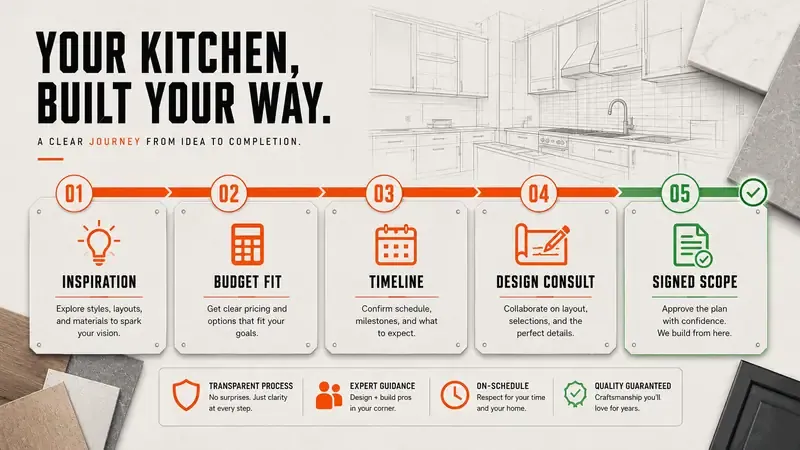
Kitchen remodeling is an aspirational purchase. Most homeowners who eventually remodel their kitchen spend 6–18 months in a passive research and inspiration phase before they take any active step toward getting a quote. Meta — Facebook and Instagram — is where that inspiration phase happens.
The kitchen remodel Meta funnel has three stages:
Stage 1: Inspiration content. Project photos and short video walkthroughs of completed kitchens. The creative doesn't need to sell — it needs to stop the scroll. "Before and after: a 1970s galley kitchen transformed" or "How we opened up a closed kitchen in an 1,800 sq ft ranch home" performs well. This content builds brand familiarity with homeowners who are in the passive research phase. Run it to homeowners in your service area, skewed toward household income and age of home.
Stage 2: Value content. Retarget people who engaged with Stage 1 content with educational posts: "What a kitchen remodel actually costs in [city]," "5 things to ask every kitchen contractor before you sign," "How to tell if a kitchen design is built for your workflow." This content demonstrates expertise and keeps your brand present during the long consideration period.
Stage 3: Lead capture. When a homeowner has seen your work and read your process content, a lead gen ad with a budget qualifier converts at dramatically higher rates than cold traffic. The ad should be specific: "Planning a kitchen remodel with a budget of $40,000 or more? We have 2 consultation openings this month." The qualifier filters out price shoppers before they enter your pipeline. Connect the lead gen form to your CRM and follow up within 2 hours during business hours.
This funnel works because it pre-sells authority before the consultation request. By the time a homeowner submits the lead form, they've already seen your case studies and decided you're the kind of contractor they want to work with. The consultation is confirmation, not discovery.
Managing the Long Sales Cycle Without Losing Momentum
Kitchen remodeling decisions take 30–90 days from initial consultation to signed contract. During that window, the homeowner is comparing contractors, discussing the investment with a spouse, researching financing options, and occasionally getting cold feet about the scope. Most kitchen remodelers follow up once or twice and then stop — assuming the homeowner has moved on. In most cases, they haven't. They're still deciding.
A structured nurture sequence keeps your company top of mind throughout the decision window without feeling pushy. The sequence runs automatically from the moment a consultation is completed:
- Day 1: Email with a link to a case study most relevant to the homeowner's discussed project scope. Personal note from the designer reviewing what was discussed in the consultation.
- Day 3: SMS with a direct link to your financing page, if not already discussed. "Many of our clients use our financing partners — here's how the math looks on a project like yours."
- Day 7: Email featuring a recent project completion with before/after photos. Reinforce timeline expectations: "We just finished this kitchen in 8 weeks — ahead of schedule."
- Day 14: Email with two or three recent 5-star reviews, specifically from clients who mention the design process or on-site professionalism.
- Day 21: SMS check-in: "Hi [Name], just following up on the kitchen project — do you have any questions as you're thinking it through? Happy to set up a quick call."
- Day 30: Final re-engagement: "We're booking [month] projects now — wanted to let you know before we fill the slot. Happy to revisit anything from our conversation."
Each touch has a specific purpose: reinforce quality, address the financing concern, demonstrate timeliness, build trust through social proof, lower the friction on follow-up questions, and create mild urgency around your booking calendar. Together, they prevent the lead from going cold without applying pressure that feels aggressive.

Consultation Show Rate: The Metric That Separates $2M and $5M Kitchen Companies
Most kitchen remodelers track leads and close rate. Very few track consultation show rate — the percentage of booked consultations where the homeowner actually shows up. In our experience working with kitchen contractors, show rates range from 55% to 90%, and that 35-point difference has a bigger impact on annual revenue than any advertising decision.
A company booking 20 consultations per month at 60% show rate has 12 actual consultations. At a 40% close rate, that's 4.8 signed contracts. The same company with a 85% show rate has 17 consultations. At the same 40% close rate, that's 6.8 signed contracts — a 42% revenue increase from fixing one metric that most operators aren't even measuring.
The consultation show rate is driven almost entirely by what happens between the booking confirmation and the appointment:
- Immediate booking confirmation: Email and SMS within 5 minutes of booking. Include the designer's name, photo, and what to expect. This makes the appointment feel real and personal.
- Day-before reminder: Email with the appointment details, a link to your portfolio, and a prompt to gather any inspiration photos they want to discuss. This is also a chance to confirm ("Reply YES to confirm your appointment tomorrow").
- 2-hour SMS: "We're looking forward to meeting you in two hours. [Designer name] has reviewed your project and is excited to show you some initial ideas." This creates anticipation and makes it harder to bail without notice.
- The pre-frame: Every confirmation sequence should set expectations: "Our initial consultation typically runs 45–60 minutes, and we'll walk through your goals, design options, and investment range. You'll leave with a clear picture of what your project could look like." Homeowners who know what to expect show up. Homeowners who aren't sure what they're walking into don't.
Consultation show rate is the highest-payoff fix in kitchen remodel sales — and most operators discover it too late. Fix this before optimizing your ad creative or landing page, and the revenue impact will be faster and larger.
For the full operational breakdown of scaling a kitchen remodel company, see the kitchen remodel scaling guide or read about CRM systems that work for remodel contractors.
Related Articles.
Want this system installed for your trade?
See if your market is still open, then book a 20-30 minute install call. No contracts.