
Landscaping Business Growth: Breaking the Labor-Hours Ceiling.
Most landscaping companies grow to $400K–$600K and stop — not because the market is limited, but because their model is built on selling labor hours. Here's how to break past $1M by selling outcomes, recurring revenue, and premium scope.

There is a revenue ceiling that most landscaping companies hit somewhere between $400,000 and $600,000 in annual revenue. It's not a market size problem — the demand exists. It's not a quality problem — most of these companies do good work. It's a business model problem. They are selling labor hours, and labor hours scale linearly: more revenue requires more crew hours, which requires more crew members, which requires more trucks, more equipment, more supervision, and more management overhead. At some point, the complexity of running the operation eats the margin that growth was supposed to generate.
The landscaping companies that break past $1M in revenue — and do it without the wheels coming off — have made a different structural choice. They are not selling labor. They are selling outcomes: a maintained yard that always looks right, a seasonal program that handles everything, a property that reflects pride of ownership. They price for the outcome, not the hours. They build recurring retainer relationships rather than one-time install projects. They create density in their service routes that makes each crew-hour more profitable than the one before it. This post is about how each of those shifts actually works in practice.
The Two Business Models in Landscaping (And Why One Scales)
The hourly-labor model looks like this: a homeowner calls, you send a crew, you bill by the hour or by a fixed per-job rate, the job completes, the relationship ends until the next call. Revenue is a function of the number of jobs completed. Growing revenue means completing more jobs. Completing more jobs means more crew hours. More crew hours means more staff, more vehicles, more scheduling complexity. The math is relentless: every new dollar of revenue costs about as much to earn as the last one. Nothing in this model compounds.
The outcome and program model looks different: a homeowner signs up for a seasonal maintenance program. Every month, they pay a fixed retainer. Your crew shows up on a scheduled cadence and performs the agreed scope. The client does not think about it — the property is maintained, the billing is predictable, and the relationship persists. From the business side: the revenue is predictable from month one of each year, route density can be optimized in advance, and the client relationship is sticky in a way that one-time work is not.
A landscaping company with $500K in revenue and no recurring contracts starts every January at $0. They need to re-acquire the entire year's revenue through new sales and repeat bookings from a client base that hasn't committed to anything. A company with $500K in revenue and 30% recurring retainer base starts every January knowing $150K is already committed. That base funds payroll stability, makes crew scheduling predictable, and means growth campaigns can be focused on adding to a foundation rather than rebuilding from zero.
The transition from the first model to the second is not a marketing problem. It's a pricing and packaging problem. The market will support recurring programs — it just has to be offered.
The path from labor-hours to outcomes-and-programs doesn't require abandoning install work or one-time projects. Install work is valuable and feeds the retainer pipeline. The structural shift is in how you present maintenance and ongoing care: not as a service you'll provide if the client calls, but as a program they enroll in and don't have to think about again.
Tiered Service Packages: How to Sell a Program Instead of a Price
The single most effective tool for converting a homeowner from a one-time service relationship to a recurring one is a well-structured tiered package. Tiering does several things simultaneously: it eliminates the "yes or no" binary that makes recurring programs feel like a commitment, it lets the homeowner self-select into the scope that fits their needs and budget, and it frames the decision as "which level is right for me" rather than "do I want this at all."
Here's a practical tier structure that maps well to most residential landscaping markets:
- ✓ Essential tier ($199–$299/mo): Bi-weekly mowing and edging, spring and fall cleanup, basic bed maintenance — the minimum program that keeps a property consistently presentable
- ✓ Standard tier ($349–$449/mo): Everything in Essential plus monthly mulch refresh, detailed edging and trimming, shrub shaping twice per season — the program most clients will find covers everything they care about
- ✓ Premium tier ($549–$699/mo): Everything in Standard plus seasonal color rotations, full fertilization and weed control program, fall overseeding, priority scheduling for storm cleanup — the program for clients who want zero-maintenance ownership
- ✓ Present Standard as your default recommendation — it captures 50–60% of conversions and represents the best value for most homeowners
- ✓ Lead every program presentation with what the client gets, not what you do — "your lawn always looks right, spring through fall" rather than "bi-weekly mowing and edging"
- ✓ Price the tiers so Standard is clearly the sweet spot — Essential feels like the minimum, Premium feels like a luxury upgrade, Standard feels like the smart choice
The psychological principle driving tier conversion is called the compromise effect: when given three options, the majority of buyers choose the middle one. You are not trying to get every client into the Premium tier — you're trying to make Standard the obvious, safe, smart default. The clients who want more will self-select up. The clients who want to start somewhere will have an accessible entry point in Essential. The structure does the selling.
Introduce the tier structure at install completion — when client satisfaction is highest and the relationship is freshest — or at the first inquiry for homeowners who reach out specifically about ongoing maintenance. Don't make them ask for a maintenance quote. Present the program as a natural extension of what you've done or are about to do: "We can also set you up on a maintenance program so this continues to look great through the season. Let me share what we offer."
Premium Positioning: How to Escape the Low-Bid Comparison
The majority of landscaping companies that are stuck under $600K have a positioning problem: they look and sound identical to their competitors. Same truck lettering, same basic website with stock photos of lawns, same "free estimate" call to action. When homeowners get three bids that look and feel interchangeable, they choose on price. If you look like a commodity, you will be priced like a commodity.
The companies that consistently win $8,000+ projects without being the lowest bid differentiate on presentation quality, process professionalism, and guarantees rather than undercutting on cost. Here's what that looks like in practice:
- Estimate presentation quality: A branded, detailed written proposal with project photos of comparable work, a scope breakdown that educates the homeowner on what's included and why, and a clear payment structure communicates professionalism before you've said a word about price; most competitors send a one-line email quote
- Design visualization: For install projects above $5,000, a simple landscape design rendering — even a hand-drawn sketch or basic digital layout — dramatically increases close rates because it makes the abstract concrete; the homeowner can see what they're buying
- Project photography in the estimate: Including before/after photos from two or three comparable installs in the proposal shows the homeowner what their result will look like and implicitly answers the "will this actually turn out well?" question that every client has
- Satisfaction guarantee language: "We'll make it right or return until you're satisfied" is a low-cost commitment that signals confidence in your work and reduces the perceived risk of choosing you over a lower bid
- Video testimonials from clients: A QR code in your estimate packet that links to a short video testimonial from a client with a similar project is more compelling than any amount of written marketing copy
The contractors who win premium projects consistently are almost never the lowest bid. They are the bid that looked and felt most professional, most prepared, and most likely to deliver the result the homeowner is imagining. Price objections are rarely about the actual price — they're about the gap between the perceived value and the asked price. Closing that gap is a presentation problem, not a pricing problem.
Geographic Density: The Route Efficiency Strategy
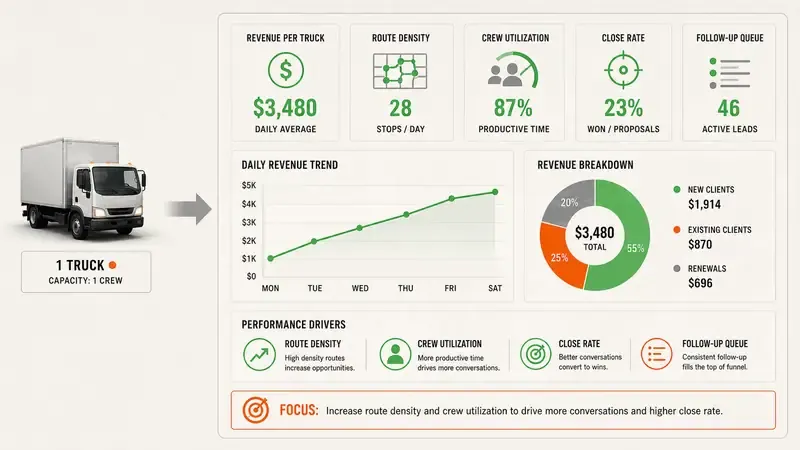
One of the most overlooked margin levers in landscaping is route density: how many paying client-hours your crew is generating per hour of crew time in the field. A landscaping company where crews are driving 30–45 minutes between jobs is losing 30–40% of their field capacity to windshield time — time that is costing them in labor and fuel but generating zero revenue.
The math on route density improvement is dramatic. A four-person crew earning $25/hour fully loaded costs $100/hour in labor. If 35% of their day is transit time on a sparse route, you're paying $35/hour for transit that doesn't generate revenue. Reduce that transit time to 15% through geographic density and you've recovered 20% of your labor cost — without adding a single new client. On a $600K revenue base, that's a $120,000 annual improvement in effective capacity, all from routing efficiency.
The strategy for building route density is neighborhood concentration: rather than taking clients wherever they appear, actively market to fill geographic clusters. Two to three target neighborhoods where you can serve 10–15 clients per crew per day, with minimal transit between stops, is the operational goal.
The marketing tactic that drives neighborhood concentration most effectively: the door-hanger or direct mail campaign that announces your presence in a specific neighborhood: "We're already maintaining properties on [street name] and [adjacent street]. If you'd like to get the same results for your property, here's a special rate for neighbors." This works because the proof is visible from the curb — "you can see our work at the Hendersons' house at the corner" — and the street names make the offer feel personal instead of generic junk mail.
Neighborhood saturation campaigns work best when launched in areas where you already have two or three clients, because you can reference real, visible work that neighbors are already seeing from the street. The visual quality of your installed work in a neighborhood is your best advertisement — if it's excellent, homeowners notice. You're simply giving them a structured path to act on what they've already observed.
Client Lifetime Value: Converting Project Clients to Recurring Revenue
The LTV math in landscaping is simple and stark. A one-time install client who spends $6,000 on a project generates $6,000 in lifetime revenue. If they return for another project in year three, they add another $6,000 — a three-year LTV of $12,000, but only if you're lucky enough to re-engage them when they're ready. A maintenance retainer client at $400/month generates $4,800 in year one — and at an average retention of three years for well-served retainer clients, that's $14,400 in LTV from the same client relationship, with predictable monthly cash flow rather than lumpy, hope-dependent project revenue.
A landscaping client on a monthly maintenance retainer generates 3× more revenue over three years than a one-time install client at the same initial project value. The retainer client also refers at higher rates, is less price-sensitive at renewal, and generates better reviews because you're in regular contact — reinforcing the relationship at every visit.
The conversion from one-time project client to retainer client requires a specific moment and a specific offer. The moment: install completion, when satisfaction is at its peak and the client's confidence in your work is highest. The offer: a clear, specific program with a defined monthly price and a tangible description of what's included. Not "we offer maintenance services" — that's a category description, not an offer. "We have a Standard Maintenance Program that covers everything you'd need to keep this looking the way it does today — it's $389 a month and includes bi-weekly maintenance through the season plus spring and fall cleanups. Want me to leave you the details?"
The clients who don't convert at install completion should be in a follow-up sequence — a 60-day email and SMS nurture that checks in with a project photo, introduces the maintenance program when it's relevant (late summer for fall maintenance enrollment, late winter for spring program enrollment), and makes it easy to say yes without requiring a sales conversation. Many homeowners who didn't convert at install completion will convert within 90 days if they continue to receive relevant, professional follow-up.
Commercial Add-On Revenue: The Overlooked Growth Channel
Most residential landscaping companies that have reached $700K–$800K in revenue have a visible but unexplored growth channel: commercial maintenance accounts. HOA common areas, small commercial properties, medical and dental offices, retail strip centers — these clients have predictable, year-round maintenance needs, make decisions through a procurement process rather than an emotional residential purchase, and represent contract revenue that can stabilize the off-season when residential volume drops.
Commercial landscaping does not require a different fleet or a different crew. It requires different pricing (by the square foot of maintained area rather than hourly), different contract terms (annual agreements rather than monthly cancel-anytime), and a different sales approach (proposals to property managers and HOA boards rather than individual homeowners). Most residential landscaping companies already have the equipment and crew to service commercial accounts — the barrier is operational knowledge and the initial sales effort, not capability.
The commercial accounts that are most accessible for residential-to-commercial expansion:
- HOA common areas and entrance features: Most HOAs in suburban markets with established landscaping spend $12,000–$40,000 per year on maintenance; they make annual contract decisions, which means predictable long-term revenue once you win the account
- Small professional offices: Medical, dental, and professional service offices want their property to look consistently maintained without having to manage it; they are not price-shopping the way residential clients sometimes do
- Small retail and strip centers: Property managers for small commercial sites often manage multiple properties and can award multi-site contracts; winning one relationship can mean five or six accounts
The best entry point into commercial is a warm introduction through an existing residential client. A homeowner who is on your Standard Maintenance Program and runs a small business is a natural bridge: "If you ever need maintenance at your office location, we do commercial maintenance as well — here's what that looks like." Commercial accounts won through client referrals have significantly higher close rates than cold outreach to property managers.
The Operations Bottleneck: Why Marketing Isn't Your Problem
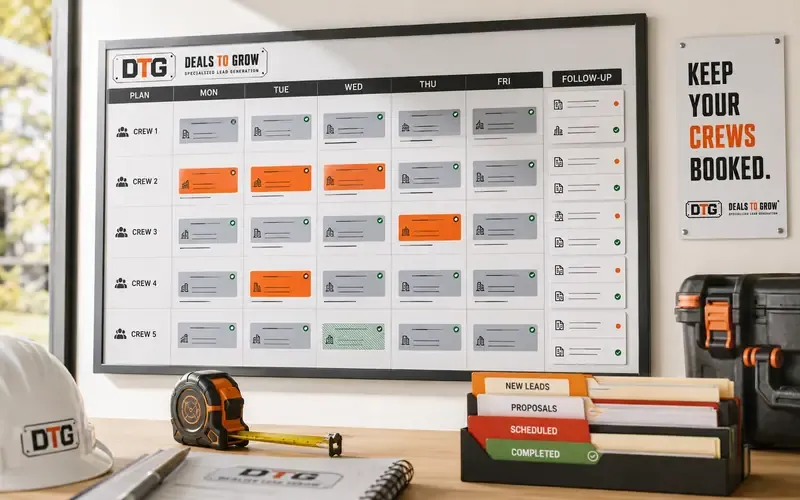
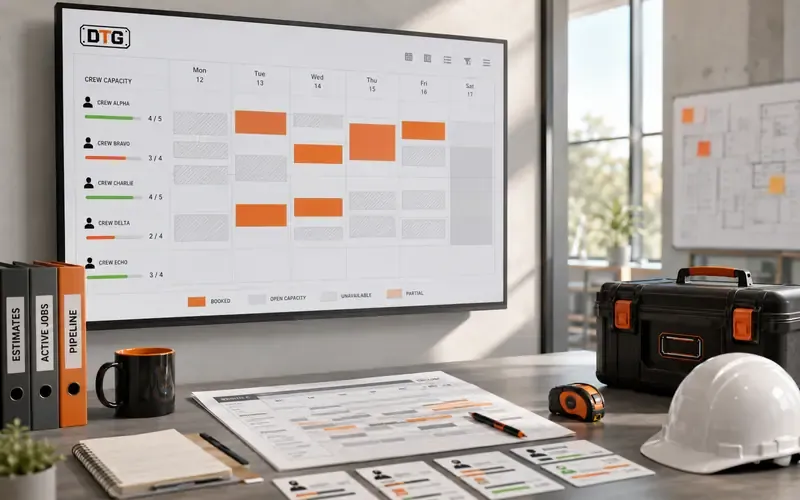
Here is the uncomfortable reality for many landscaping companies that are trying to grow past $700K: their constraint is not leads. They have enough demand. Their constraint is capacity — specifically, the operational systems that allow them to serve more clients without proportionally increasing headcount, management overhead, and operational chaos.
Every time a growing landscaping company adds a crew, they add complexity: another vehicle to maintain, another foreman to manage, another route to schedule, another layer of quality control to implement. If the operations systems underneath the growth are not strong, each new crew adds complexity faster than it adds revenue. The answer to a capacity constraint is not more trucks — it's better systems.
The operational systems that let you grow without hiring in lockstep:
- Route optimization software: Tools like Service Autopilot, Jobber, or LMN can reduce crew transit time by 20–30% on existing routes; that's additional service capacity from crews you already have, no new trucks required
- Crew communication apps: Real-time crew tracking, job status updates, and photo documentation from the field eliminate the "where is the crew now" phone tag that consumes office management time; each crew operates more independently, which frees owner and management attention for growth activities
- Automated scheduling and client communication: Confirmation texts to clients before their scheduled visit, automated follow-up after service completion, and online booking for add-on services reduce the scheduling burden on your office staff and improve the client experience simultaneously
- Standardized scope checklists: Written, photo-documented scope checklists for each service tier ensure consistent quality without requiring supervisory presence on every job; this is the operational foundation that makes tiered packages scalable
- AI receptionist for inbound leads: As your marketing generates more inbound calls, a human receptionist becomes a bottleneck; an AI receptionist handles qualification and scheduling for new inquiries 24/7, ensuring no lead goes to voicemail during high-demand periods
The companies that break past $1M in landscaping revenue are not the ones with the most trucks or the most clients. They are the ones who figured out how to generate more revenue per crew-hour, more client value per relationship, and more capacity per dollar of overhead. That's a systems and business model achievement — not a marketing spend achievement. Marketing brings the clients. The business model determines how much of that client relationship actually converts to the bottom line.
Related Articles.
Want this system installed for your trade?
See if your market is still open, then book a 20-30 minute install call. No contracts.