
Fill the Slow Months Before They Arrive
Your slow months in October are decided by what you did in July. Here's the seasonal marketing playbook that keeps contractor calendars full year-round — not just in peak season.

It's late October. A roofer looks at the calendar and the next three weeks are empty. The phone isn't ringing. The crew is asking questions. He starts wondering whether to cut prices just to keep the trucks moving.
Here's the uncomfortable truth: those empty weeks were locked in back in August, when he shut the marketing off because July was the busiest month of the year and the pipeline looked full. The slow season isn't bad luck. It's the bill for reactive marketing — and it always comes due 90 days later.
Why Slow Months Are a Planning Failure, Not a Market Failure
Your slow months in October are decided by what you did in July. The 90-day lead time rule applies across all trade verticals — replacement decisions have a 60–120 day consideration cycle from first awareness to signed contract.
Consider the two types of demand in trade contracting:
- ✓ Emergency demand — HVAC failure, active roof leak, burst pipe. Inherently unpredictable. Whoever answers the phone wins. You can't create it; you can only capture it with fast response.
- ✓ Replacement demand — planned roof replacement, kitchen remodel, pool build, system upgrade. This has a long consideration cycle and is highly influenced by sustained marketing exposure. Contractors who stop marketing in July lose September's replacement pipeline.
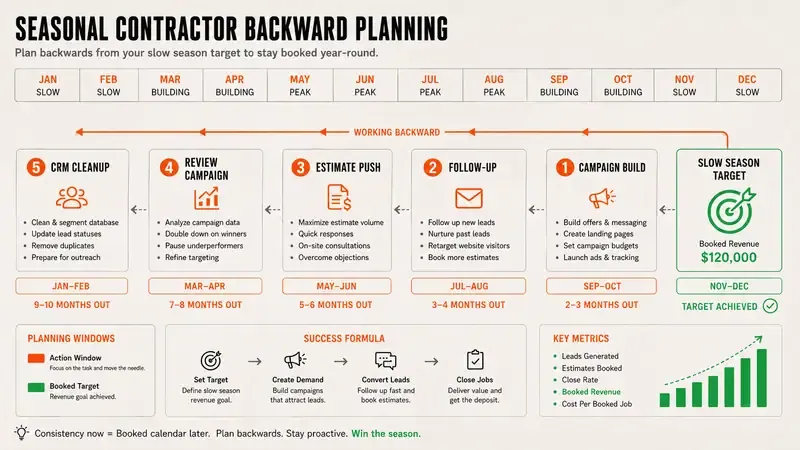
The 90-Day Lead Time Rule
In most trade verticals, the consideration cycle for planned replacement work runs 60–120 days from first awareness to signed contract. This means:
- ✓ December–February slow season jobs were decided by leads from September–November. If you weren't marketing in September, you don't have December pipeline.
- ✓ You cannot recover from a marketing gap quickly. Turning ads back on in November won't fill December. The pipeline lag is real.
- ✓ Your busiest month is your worst time to stop marketing. July and August peak season is exactly when you need to be building the leads that fill October and November.
The contractors who have full calendars year-round treat marketing spend as fixed overhead — not variable spend that goes up when slow and down when busy. The budget doesn't change. The targeting and messaging does.
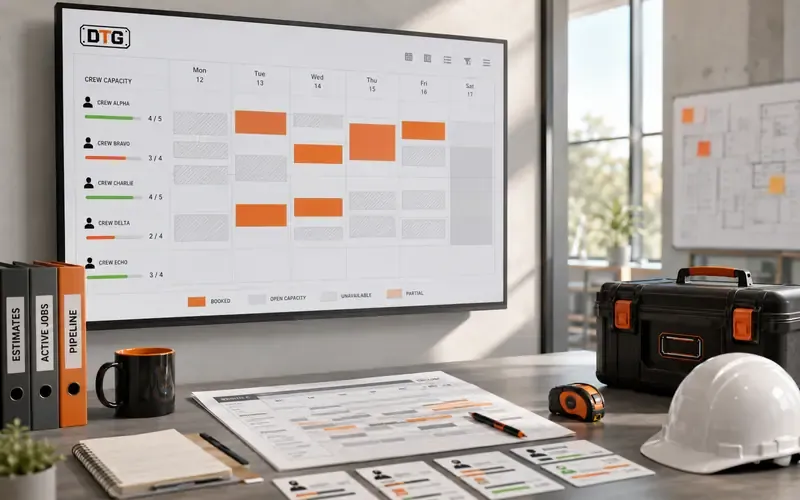
Building a Replacement Pipeline in the Off-Season
The off-season is actually the best time to run awareness and consideration campaigns that warm up homeowners who will be ready to buy in 60–90 days. The playbook by trade:
Meta Retargeting for Shoulder Season
Your peak season builds a big pool of homeowners who clicked your ads, visited your website, or watched your videos — but didn't buy. That's a warm audience, and most contractors let it rot.
Meta Ads retargeting campaigns for shoulder season use different messaging than cold acquisition ads:
- ✓ "Still thinking about that roof? We have 3 spots left before weather season — book before [date]."
- ✓ "47 Dallas homeowners got new roofs from us this summer. Scheduling for fall is open now."
- ✓ "Your neighbors at [neighborhood] just upgraded their HVAC. Pre-season pricing ends [date]."
These retargeting campaigns typically have 3–5× the conversion rate of cold acquisition campaigns at a fraction of the CPL — because the audience already knows who you are.
Reactivating Past Customers
Your CRM contains a list of customers who've already hired you, trusted you, and were presumably satisfied. This list is one of the most valuable and underutilized assets in your business.
A single reactivation campaign to a 200-customer database typically generates 15–30 responses at near-zero acquisition cost. These customers already trust your work and are far easier to close than cold leads.
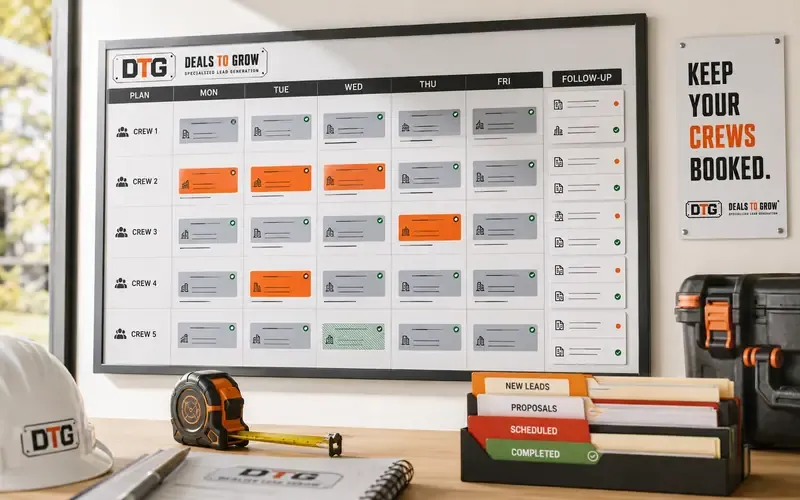
The Contractor Calendar That Books Itself
The seasonal problem has a fix: marketing infrastructure that runs no matter how busy you are, captures both warm and cold demand, and books it straight into the calendar without needing your personal attention.
- ✓ Always-on ad campaigns (Meta + Google) that don't pause during peak season
- ✓ AI receptionist that captures every inbound call regardless of time of day or how busy the crew is
- ✓ Automated CRM workflows that follow up with every lead on a sequence regardless of how many jobs are active
- ✓ Retargeting campaigns that run off your existing warm audience continuously
The contractors who broke the feast-or-famine cycle didn't do it with more discipline or harder work. They built a system that keeps filling the pipeline whether they're thinking about marketing or not. See how the full system works or book a scoping call.
Related Articles.
Want this system installed for your trade?
See if your market is still open, then book a 20-30 minute install call. No contracts.