
Pool Contractor Marketing: Fill Your Calendar 18 Months Out
The best pool builders often have the emptiest calendars. Here's how to build a marketing system that fills your build schedule 12–18 months out and converts high-ticket projects without discounting.
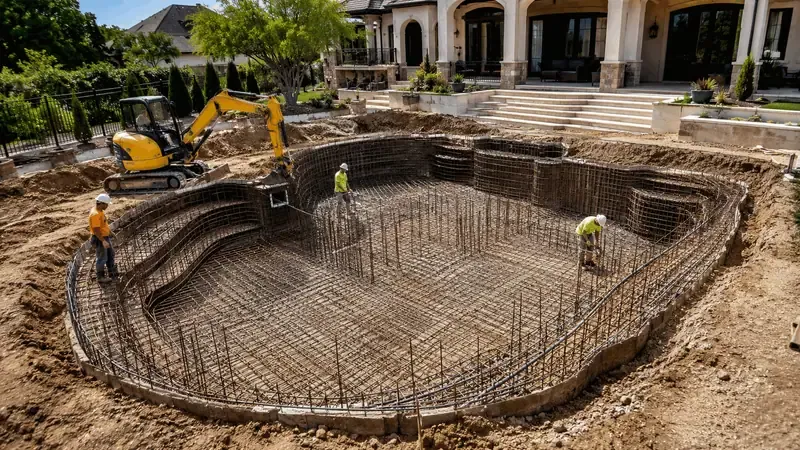
Here's a pattern that repeats among high-end pool builders. The portfolio is immaculate — resort-style builds, outdoor kitchens, precision tile work — and the calendar shows 4 months of booked work. The owner is worried anyway. Not because 4 months is bad, but because 18 months ago the book ran 14 months deep. That forward visibility is what let them hire crews, order materials at scale, and run the business without cash flow stress. Now it's gone, and they're not sure how they built it in the first place.
This is the most common problem among great pool builders: the work is exceptional, the marketing is passive. The calendar got built on referrals — one great project leading to the next — and the pipeline felt like it ran itself. Until it didn't. Marketing a $50,000–150,000 project is a different job than marketing a $500 service call. Here's how to do it right.
The Portfolio Problem: Why Great Work Doesn't Win Projects Automatically
The best pool builders assume the portfolio will sell itself. For a while, it does — the first clients refer the next ones, and so on. But that model has two built-in limits: growth caps at the speed of word-of-mouth, and the business stays invisible to every homeowner who doesn't happen to know a past client.
Most pool buyers start their search online. They search Google, they browse Instagram, they look at Houzz project galleries. If your company doesn't have a strong presence in those channels — good photography indexed on Google, an Instagram account showing recent projects, a Google Business Profile with recent reviews — then the homeowner planning a $75,000 pool and outdoor living build can't find you. They find your competitor who has 142 Google reviews and an Instagram account with 4,000 followers, and they call them first.
Houzz dependency is a particular trap for premium pool builders. Houzz drives leads, but it drives them to a marketplace where you're competing side-by-side with everyone else. You're competing on the quality of your Houzz profile rather than on a direct presentation of your work and your brand. Homeowners who find you through Houzz are comparing you against 6 other contractors before they've had a single conversation with you.
A strong online presence — good Google footprint, a current project gallery, clear calls to action — doesn't replace referrals. It multiplies them. The moment a past client mentions your name, that homeowner Googles you. If they find sharp photography, strong reviews, and a professional operation, the referral converts. If they find a thin website from 2019 and 14 Google reviews, even a glowing referral gets cold feet and calls someone else "just to compare."
The Consultation Funnel for High-Ticket Pool Builds
Nobody buys a pool on impulse. A homeowner doesn't see a Facebook ad Tuesday and sign Thursday. The decision runs 90 to 180 days from first inquiry to signed contract, and the funnel has to respect that. Your marketing's job is not to close anyone on first contact. Its job is to get a qualified project into a design consultation — and let your team and your portfolio close the deal.
The consultation funnel for pool builds has three stages: awareness, qualification, and consultation booking.
Awareness: Meta Visual Ads
Meta is the right top-of-funnel channel for pool builds because pool purchases are visually driven and aspirational. A homeowner who scrolls past a stunning video walkthrough of a finished pool and outdoor kitchen — drone footage of the water, the fire pit, the integrated spa — starts imagining their own backyard. That emotional connection is the first step in a 90-day journey that ends with a signed contract.
Video content dramatically outperforms static photos for pool ads on Meta. A 30–45 second walkthrough of a completed project, showing the pool, the landscaping, the outdoor living features, the finished product in use, generates 2–3× the lead volume of a static before-and-after photo at the same budget. The investment in professional video documentation of your best builds pays back rapidly in ad performance.
Qualification: Intake Form with Budget Filter
Pool leads have a tire-kicker problem. The ad creative is aspirational — it attracts homeowners who dream about a pool but may be years away from being financially ready or serious about starting a project. Without a qualification step, you end up with a calendar full of consultations with homeowners who were inspired by the video but haven't thought through budget, timeline, or the permitting realities of a pool build.
Your intake form or intake call should qualify on two dimensions: budget and timeline. A simple budget qualifier — "Our projects typically start at $40,000. Are you comfortable with that investment range?" — filters out homeowners who are early in their research and aren't ready for a serious conversation. For timeline, asking "When are you hoping to break ground?" identifies homeowners who are actively planning versus those who are gathering inspiration for a someday project. Both questions can be included on a form after the ad click, before the consultation is booked.
This doesn't mean being dismissive of homeowners who are earlier in their process. Those leads go into a long-term nurture sequence (discussed below) rather than directly onto your consultation calendar. The goal is to fill your consultation calendar with qualified buyers who are ready to talk about starting a project, while keeping early-stage leads in your pipeline for the moment they're ready to move.
How Build Timelines Create Urgency (Without Being Sleazy)
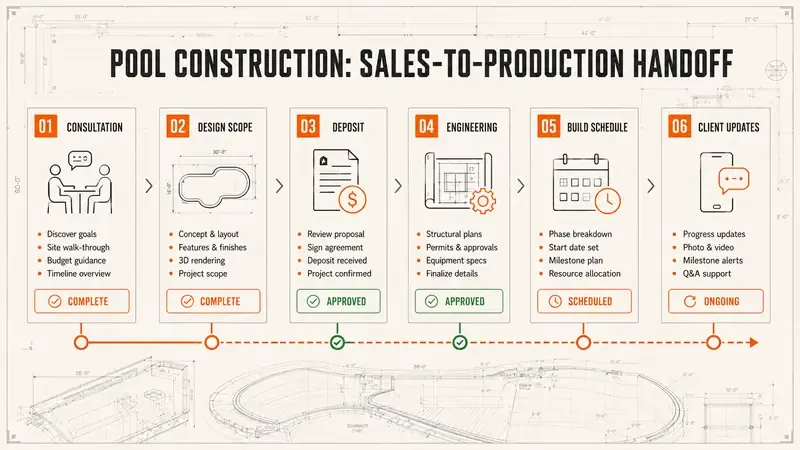
Pool contractors are sitting on one of the most honest and compelling urgency mechanisms in any home improvement vertical: their build calendar. A quality pool company doing 25–35 builds per year has a finite capacity, and that capacity books up months in advance. Communicating that reality to prospective clients isn't a sales tactic — it's accurate information that helps homeowners plan.
"We're currently booking Q3 installs" is not manufactured scarcity. It is a true statement about your schedule. When a homeowner who wants their pool ready for summer hears that you're booking six months out, it creates genuine urgency: if they want the pool they saw in your Instagram video installed in time for next summer's parties, they need to start the process now. That urgency doesn't require any pressure or manipulation — it's just the math of a booked calendar.
The permit and inspection timeline adds additional legitimate urgency. Pool permits in most jurisdictions take 4–12 weeks after submission. Structural inspections add additional time before the deck and coping can be poured. A homeowner who wants to swim in July needs to have signed a contract by February at the latest in many markets. Educating prospective clients on this timeline — through your ad copy, your landing page, and your consultation process — accelerates decision-making without any artificial pressure.
Your ad creative and landing page copy should reflect your actual booking timeline. If you're booking Q3 installs, say so. "Now booking July–September installs — request a design consultation to hold your spot." This framing does two things: it positions your company as in-demand (social proof through scarcity), and it creates a specific, time-bound reason for the homeowner to act today rather than in three months.
Nurturing 6-Month Leads: The Pool Buyer's Long Decision Cycle
Pool buyers take longer to decide than almost anyone else in home improvement. The check is big — $45,000 to $150,000 depending on scope — and the yard gets torn up for months. Most homeowners who first inquire are still 90 to 180 days from signing. If your system has no plan for those long-cycle leads, you hand them to whichever competitor stays in front of them while they decide.
Over those 3–6 months, the nurture sequence has three jobs: keep your name top of mind, build confidence in your work, and walk the homeowner through the process so commitment feels prepared-for instead of scary.
A 12-touch nurture sequence for pool leads might include:
- Week 1–2: Initial response sequence — SMS, email, follow-up call. Confirm their interest, answer initial questions, and set the expectation that you'll be in touch with helpful information about the pool planning process.
- Month 1: Design inspiration email — "Here are 6 pool designs we've completed in [city] this year, including the one you might have seen on our Instagram." Include photography links and a brief description of each project's features and approximate scope.
- Month 2: The process explainer — a video or detailed email walking through what the pool build process looks like from design consultation through final inspection. Most homeowners are intimidated by the complexity of a pool build. Demystifying it builds trust and reduces the psychological barrier to moving forward.
- Month 2–3: Financing education — a breakdown of the financing options available, including home equity lines, pool-specific financing products, and the monthly payment ranges for different project sizes. This addresses the most common reason leads stall: they want a pool but haven't mentally solved the funding question.
- Month 3–4: Social proof package — a collection of Google reviews and client testimonials specifically addressing the build process, project management, and the team. Reassurance that other homeowners trusted you with a major project and were happy with the result is a powerful conversion trigger at this stage.
- Month 4–6: Urgency reactivation — "We're beginning to book [season] installs and our calendar is filling. If you're thinking about starting your project this year, now is the time to schedule a design consultation." This reengages leads who've been warming up for months and may finally be ready to move.
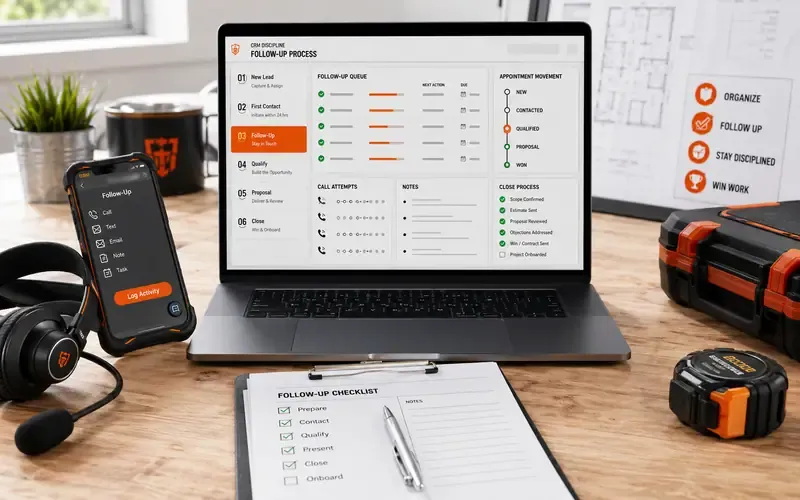
The plumbing behind this sequence — a CRM that knows where each lead sits, automated email and text sends, task reminders when a human call is warranted — is non-negotiable at any real lead volume. Without automation, leads slip through the cracks, and 6-month nurture sequences simply don't happen.
AOV Expansion: Hardscape, Outdoor Kitchen, Spa Add-Ons
A pool-only project is the smallest version of what most of your customers actually want. A homeowner spending $50,000 on a pool is staring at a yard that could use hardscape, seating, a pergola, an outdoor kitchen, a spa. Adding those while the excavator is already in the yard and the crew is already mobilized costs far less than doing them as separate projects years later. Homeowners sense this — which is why the add-on conversation is almost always welcome when it's handled well.
Pool contractors who present outdoor living packages at the design consultation stage see average project values increase from $45,000–60,000 (pool only) to $75,000–120,000 (pool plus hardscape, outdoor kitchen, and/or spa). That's a 60–100% increase in revenue per project with no increase in customer acquisition cost.
The right time to present the full outdoor living vision is at the design consultation — before the homeowner has anchored their mental budget to pool-only pricing. After the pool design is approved and the contract is signed, upsell conversion rates drop significantly.
The add-on pitch timing is everything. The design consultation — the first meeting where you're walking through the homeowner's yard, taking measurements, and discussing their vision — is the moment to expand the scope. At this stage, the homeowner is in a creative, aspirational mindset. They're imagining their finished outdoor space. That's the moment to show them what the full vision looks like: the pool, the surrounding deck, the covered pergola, the built-in grill, the fire pit, the spa. Show them the integrated design before they've committed to just the pool.
Pool companies that have added outdoor living to their service offering — either in-house or through subcontractor partnerships — consistently outperform those that build pools only. The economics are compelling: one homeowner, one mobilization, one project management overhead, dramatically higher revenue. The marketing angle also improves: before-and-after photos of a complete backyard transformation — not just a pool installation — are more striking, more shareable, and more likely to generate referrals than a pool-only project photo.
If you're not currently offering hardscape or outdoor kitchen work, the path of least resistance is subcontractor partnerships. Find a landscaping or hardscape company that does excellent work, establish a referral or white-label relationship, and begin presenting the full outdoor living package as a turnkey offering under your brand. Your homeowner doesn't need to know you're coordinating with a partner — they just need to know they can have one conversation and get the entire backyard they've been dreaming about.
The funnel integration looks like this: your Meta ads lead with the full outdoor living vision — pool, hardscape, outdoor kitchen — rather than just the pool. Your intake form asks about outdoor living goals alongside pool preferences. Your design consultation includes an outdoor living scope conversation before any prices are discussed. And your proposal options include a tiered structure: pool only, pool plus deck and landscaping, pool plus full outdoor living package. Homeowners who see all three options and understand the incremental investment at each level consistently select the middle or upper tier at higher rates than homeowners who were only ever shown a pool-only proposal.
Related Articles.
Want this system installed for your trade?
See if your market is still open, then book a 20-30 minute install call. No contracts.